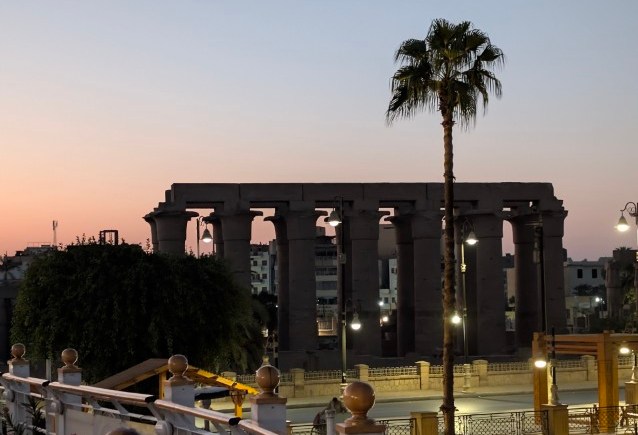
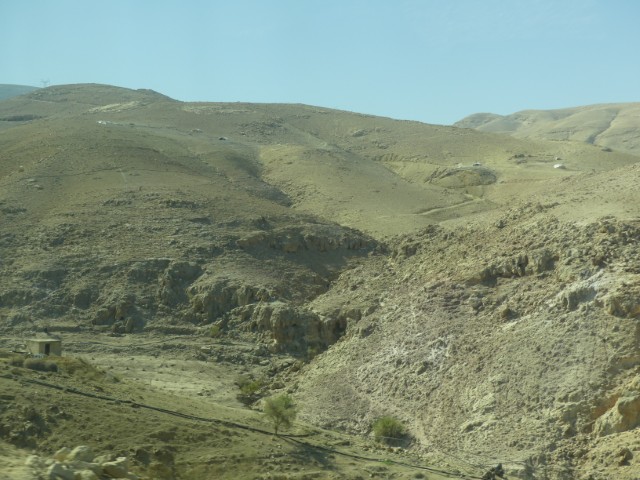
Jordan and Egypt Tour

One of the decisions we need to make before booking travel is whether we want to “go it alone” or take a group tour. There are pros and cons for both, but when we decided to go to Egypt, it was group tour for the win. We had visited Egypt twice previously, both times as port stops on a cruise. It’s one of those places where one can easily be scammed; it’s known for it. On our first visit there, a shopkeeper offered to buy me from Clayton! The sad part was, he only offered chickens. Clayton may have been willing to deal for a camel or two but couldn’t figure out how to get them onto the cruise ship. So, he’s stuck with me! Anyhow, it’s not a particularly friendly country for women to visit, so we booked another Gate 1 tour.

The itinerary started in Dead Sea, Jordan, and ended in Cairo. It also included a 4-day Nile River cruise. On our first visit to Egypt, the tour company offered us “lunch on the Nile”, which we were greatly looking forward to. Apparently, we misunderstood the meaning of this statement; we assumed we would be sailing down the Nile while enjoying a meal. Not exactly what happened – we got on a boat, were fed some food, and then crossed the Nile in 5 minutes to get to the other side. So, this trip will give us an actual boat trip (or so we hope).

We decided to arrive a day early, due to flight arrival times from Thailand. Our flight arrived at 5 pm and there was a dinner scheduled at 6:30 to meet the rest of the group. We knew we could not get to the hotel in time (it’s an hour’s drive from the airport to the resort, and we needed to clear immigration) so opted to book an extra night at the Mövenpick Dead Sea Resort. We also booked a transfer with Gate 1, which we normally do not do as their prices are much higher than other options. But, if Gate 1 picked us up, they would also provide our visas at no additional cost. So, it turned out to be cheaper to go with them.

Our flights were uneventful, which is always a nice way to start a vacation. We flew Qatar Airways to Doha and then Royal Jordanian Airways to Amman. Qatar’s service and food were flawless, Royal Jordanian, not so much. On Royal Jordanian, I ordered the Arabic mezze for an appetizer, filet mignon with mashed potatoes for the main course, and cheesecake for dessert. The mezze was fine but was not served with pita or anything else to eat it with. The filet mignon with mashed potatoes resembled a Swanson’s frozen dinner, if you substituted the salisbury steak with an overcooked filet mignon, right down to the fake potatoes. It’s hard to ruin cheesecake, but this one was a jello no-bake special. On the positive side, we did not arrive in Jordan hungry.

The Gate 1 representative met us and walked us through immigration. Next up was picking up our suitcases. We got excited when Clayton’s was first off of the conveyer belt. We were less excited when mine didn’t quickly follow, or follow at all. My luggage tracker had its location as still in Doha, but that turned out to be untrue as well. Mohanned, our Gate 1 guy, found it in the special security area; it had been pulled due to containing a security risk. What was this dangerous object, you ask? Why, a small pair of binoculars! We didn’t get the memo that you are not allowed to bring binoculars into Jordan, due to geopolitical spying.

Eventually, my luggage was released from security jail, and we could be on our way. Mohanned walked us out to meet our driver, Mohammed, who turned out to be quite a talker. He filled us in on how wonderful Jordan was, and that tourism had been irretrievably damaged by Covid, incidents involving Hamas in 2023, and most recently, Israel sending missiles over Jordan to attack Iran. For a few weeks in June, it was doubtful that we would be able to visit the region. I received notifications from the US State Department several times per day regarding the situation. Mohammed said that tourism overall was down 75% which was having an extremely negative impact on the country since tourism is its 2nd largest industry.

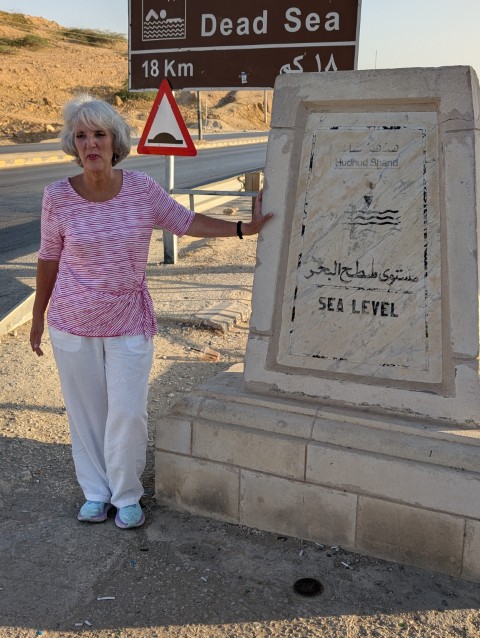
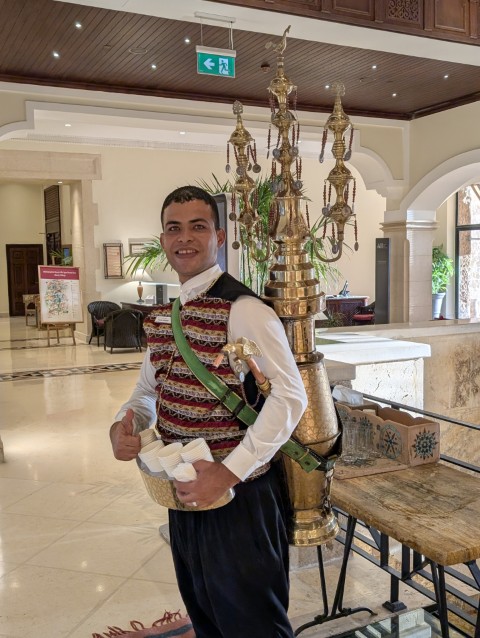
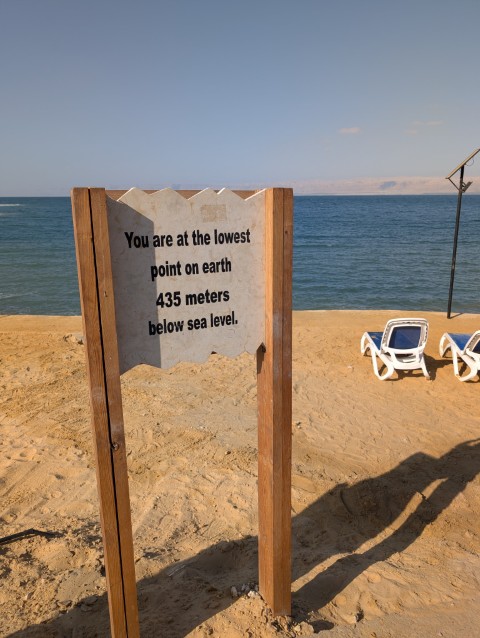
We stopped for a quick photo at sea level before continuing downhill towards the lowest point in the entire world, the Dead Sea. We were greeted by a man wearing the most ornate drink dispenser I have ever seen! He poured a cool, refreshing lemon drink for us by leaning over. The spigot is tucked under his arm in the photo.

After unpacking, we collapsed into bed since with the time zone difference, it had been a very long day.

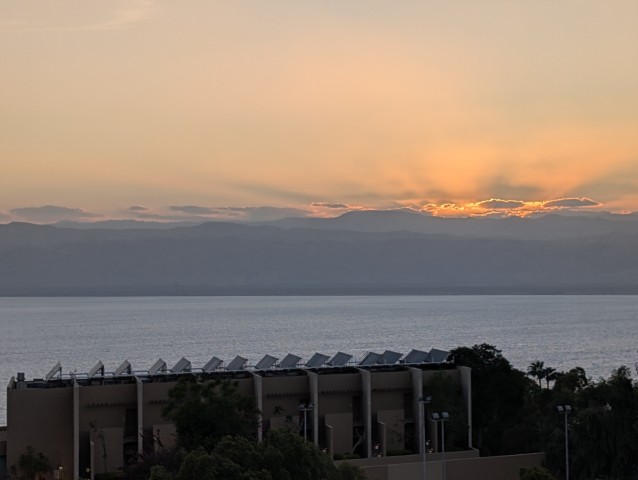
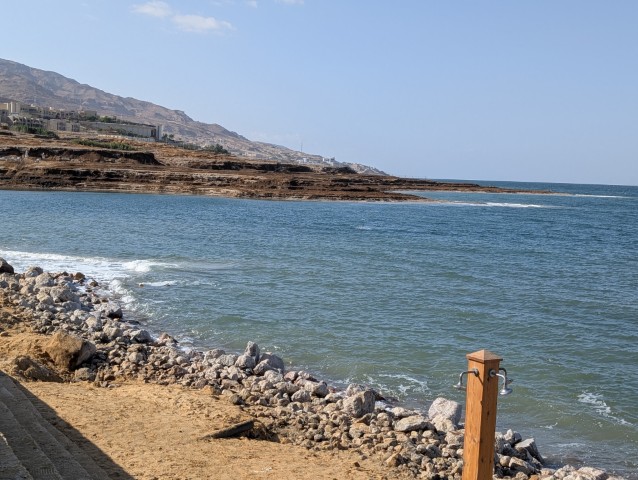
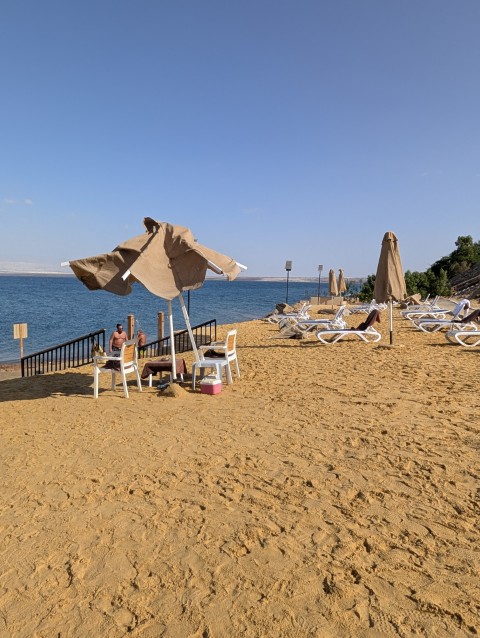
The Mövenpick Dead Sea Resort is a gorgeous 5-star resort located right on the Dead Sea. The property is quite large; we got lost on the way to breakfast. You can walk to get to the beach, or you can ride in a golf cart. I think it would take 10-15 minutes of walking to get there (at least), so we opted for a ride. The first golf cart dropped us off at the pool which is halfway down the hill. A second golf cart took us the rest of the way.

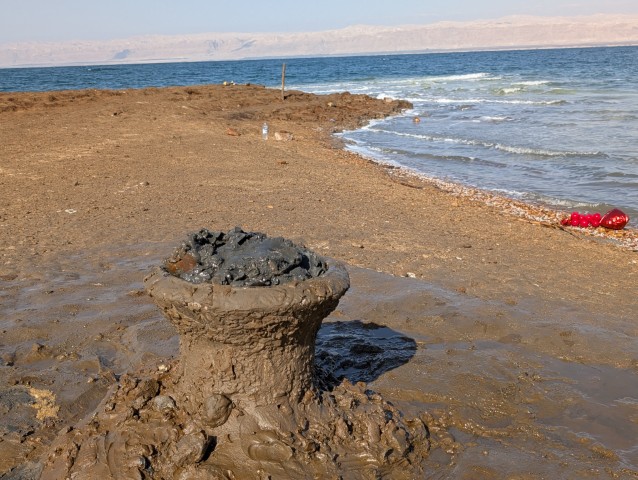
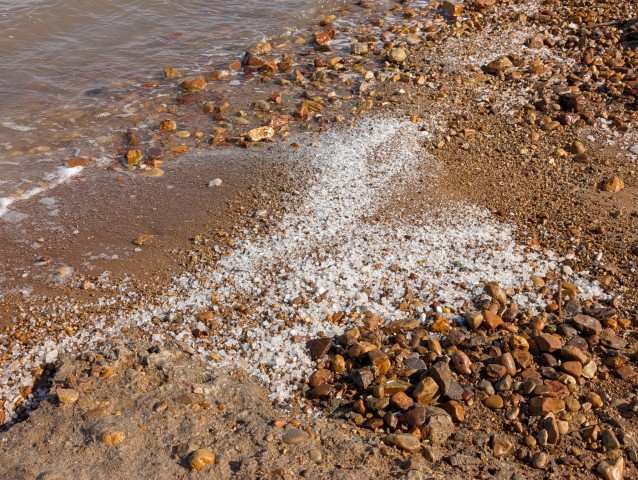
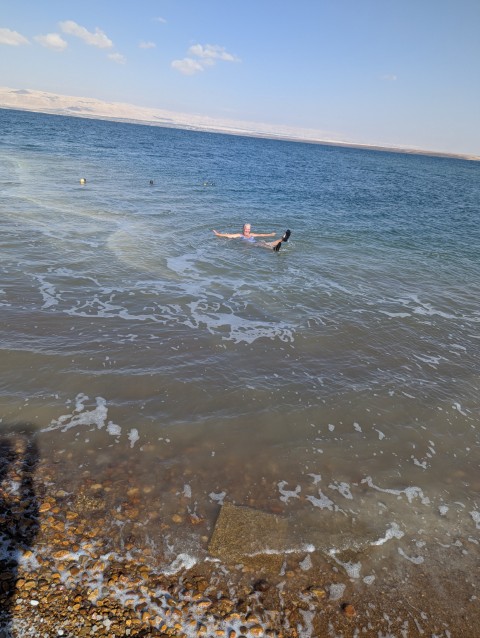
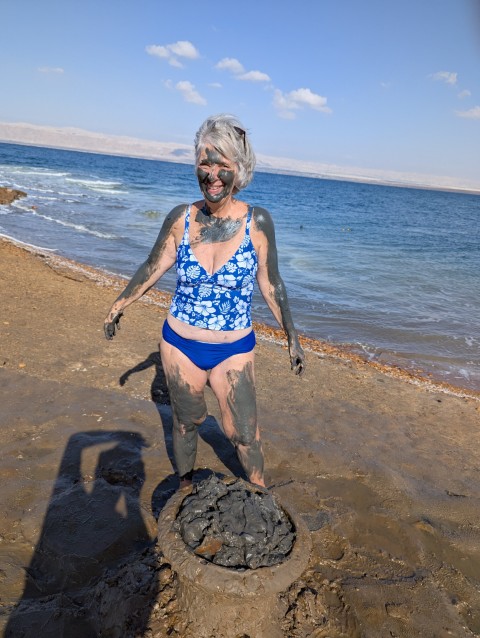
Beach towels are provided and fortunately, there are showers to rinse off as the salinity of the water is 43%. Mud is available; our driver yesterday claimed that the mud treatment takes ten years off your age, LOL. I had to give it a try, so slathered mud all over before testing the conjecture that you float really easily in the water. The water was warm and lovely. Mohammed had warned us that the beach is rocky, so I had worn my Teva sandals which were perfect. And yes, I was exceedingly buoyant in the water! I was so buoyant that when I tried to stand up after back floating, I had trouble standing up (my sandals wanted to float). I foolishly wore my sunglasses when I went in and they slipped off my head. When I tried to retrieve them, I splashed water in my eyes. Suffice it to say that it hurt like heck! I do not recommend getting water in your eyes.

Though there were showers available, the beach attendant personally hosed me off to remove the layers of mud I had slathered on myself. When we were done at the beach, we rode the golf cart back up the hill to the resort.

In case you travel here, I learned from our tour guide, Waleed, that there is a traditional Jordanian way of “taking the waters”, so to speak. You are supposed to float for 15 minutes, then apply mud. Sit for another 15 minutes for the mud to bake on and then go back into the water for another 10-minute float. He claimed that this will take 20 years off your age! If only I’d known before. Oh, well, I will have to settle for looking like I am in my 50’s rather than in my 40’s.

Our time in Jordan (as always, click on the link to read):

Day 1: The baptismal place of Jesus by John the Baptist

Day 2: Drive to Petra; tour Mount Nebo, Madaba, and Shobak Castle

Day 3: Petra

Day 4: Drive to Amman, tour Kerak Castle, city tour of Amman

On the 5th day, we flew to Cairo. I was happy to leave Jordan behind, though we saw some interesting things. It is a perfectly safe country to visit; we had no concerns whatsoever at any point during our stay. We would be getting a new tour guide in Egypt, so said goodbye to Waleed, our Jordanian guide.

We arrived in Cairo at 11 am and spent the rest of the day relaxing. We met our new tour guide, Walid (pronounced the same as Waleed in Jordan) Ghonem. We were immediately impressed with his personality and warmth. He proved to be an excellent guide throughout the trip. We did have a little issue with our room at the hotel (the air conditioning didn’t work properly, and it smelled of smoke) and Walid immediately had us moved to another room. We had an evening meeting to go over some details of the rest of the trip.

Day 6: Pyramids of Giza and the Sphinx

Day 7: Up bright and extremely early for a flight to Luxor. Then, tour the Temple of Karnak

Day 8: Tour Dendera Temple; board cruise

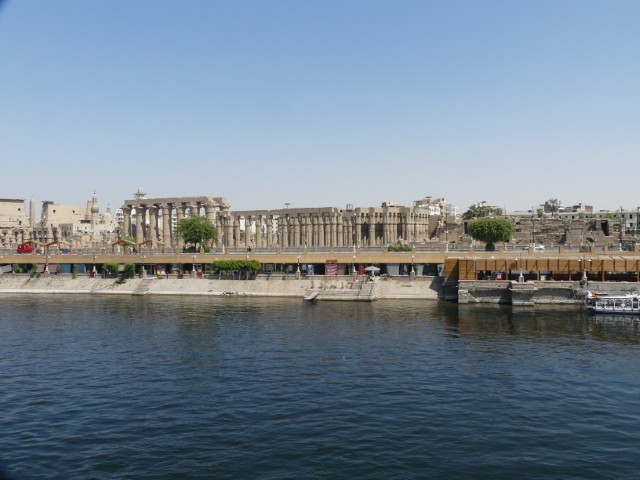
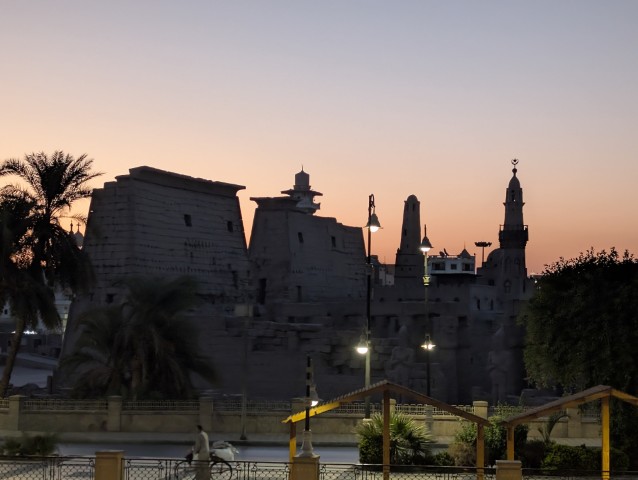
Late afternoon tour of Luxor Temple

Day 9: Optional tour of Valley of the Kings, etc. We opted out since we have done this exact tour twice on other trips

Day 10: Edfu Temple

Day 11: Optional tour of Abu Simbel. We opted out, due to the extreme heat as well as the 3 am wakeup call for those that went!

Day 12: Disembark cruise; tour Philae Temple; fly to Cairo

Day 13: Optional Tour of Grand Egyptian Museum and Grand Bazaar visit

Day 14: fly home!

Technically, this is advertised as a 16-day tour, but day one is flying and day two is arriving and relaxing.

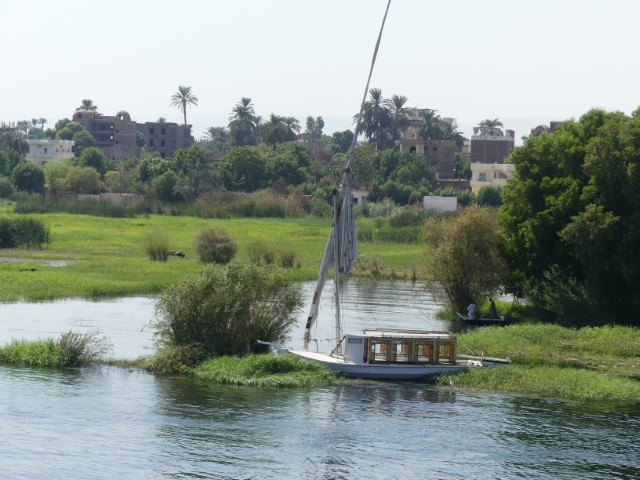
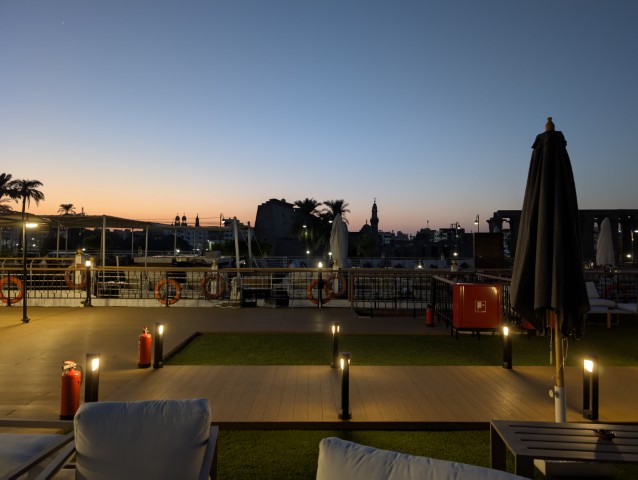
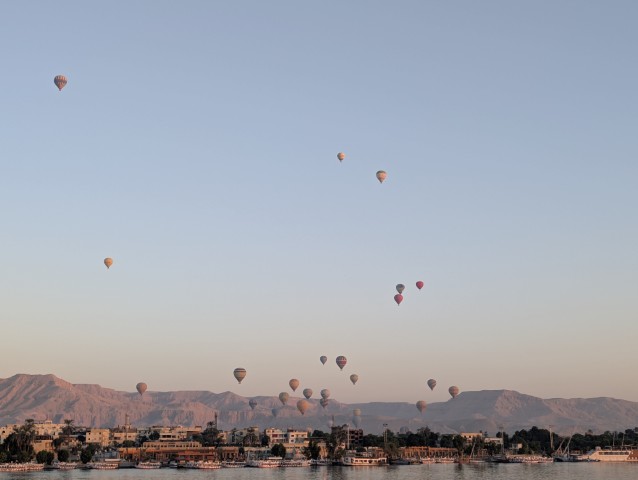
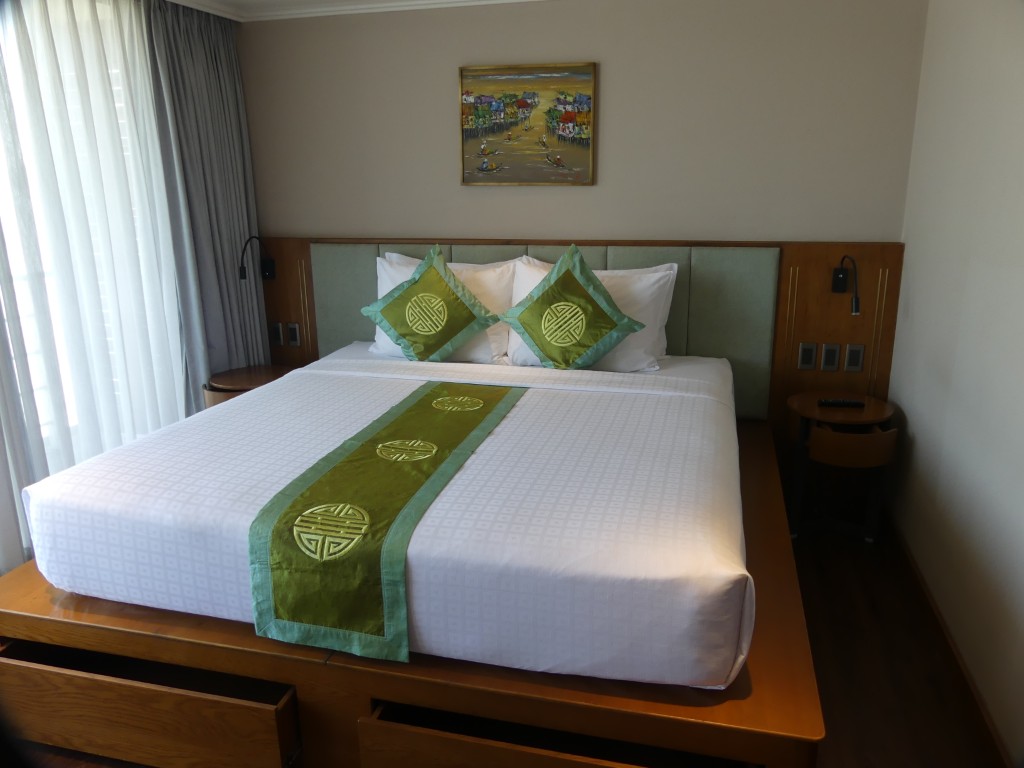
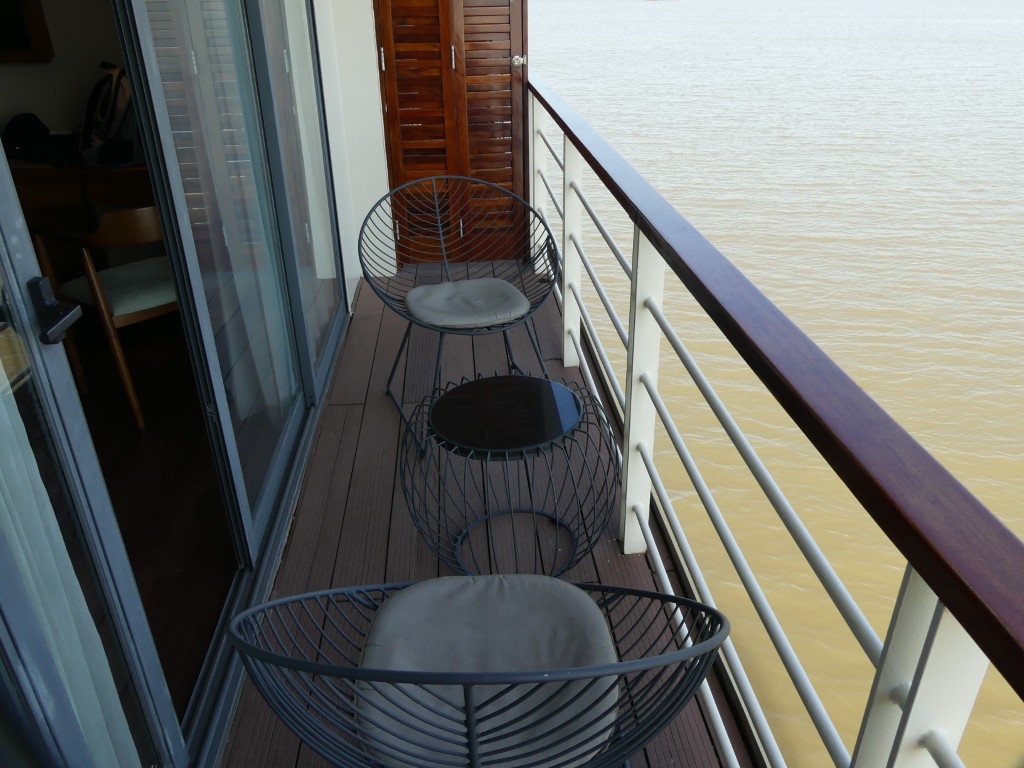
I would like to point out that though the Nile River cruise is advertised as four days in length, most of that time is spent docked rather than cruising. We spent our first night on board but did not yet leave Luxor. The following day was an optional tour of Luxor’s west bank sites. Likewise, the final night of the cruise was spent docked at Aswan. So, essentially, two days cruising, two days docked. There were no balconies on the ship (nor are there on any of the other ships we saw), and as is typical of river cruises, we docked next to several other ships while in port. The ships were stacked five deep at one stop! This meant walking through other ships to get to shore. It also meant that there was no view from the cabins, other than looking directly at another cabin on the ship next door. The windows had some type of glazing so that you could not actually see anything. I couldn’t believe how many other ships there were on the Nile River; this is obviously a very popular activity.

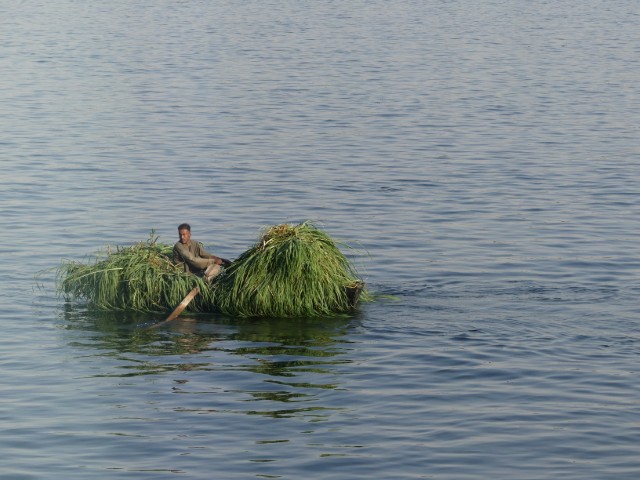
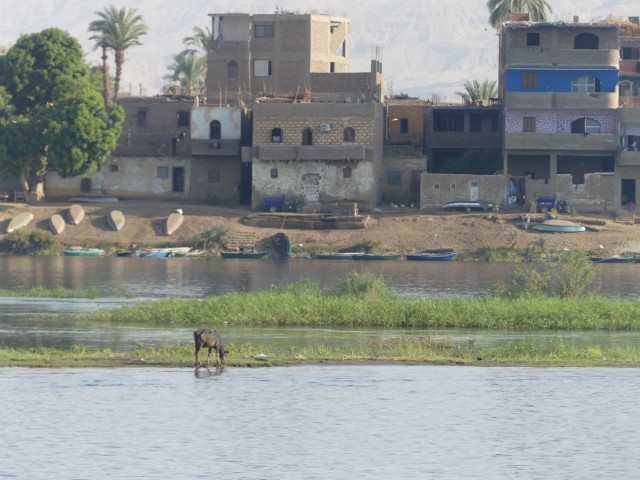
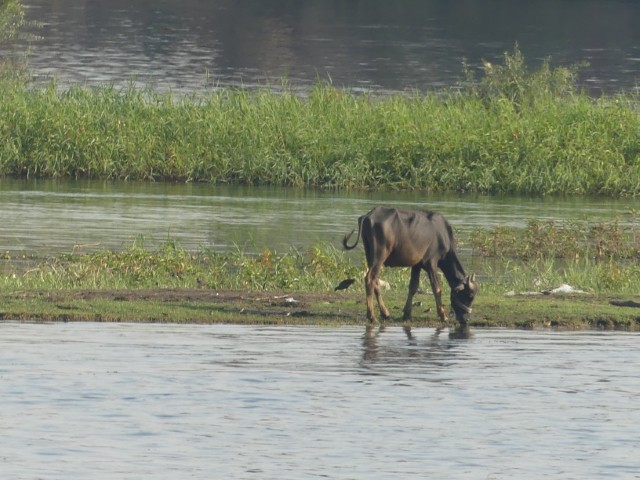
Here are some pictures along the way:

Our tour guide, Walid Ghonem, was excellent. He was a fount of knowledge regarding the temples we visited and took care of any problems immediately. If you have any thoughts regarding booking an Egypt tour with Gate 1, I would find one where he was the tour guide (he leads all the different tours Gate 1 offer of Egypt; not just the one we booked). Just like in Jordan, we had an Egyptian police officer with us everywhere we went. We felt perfectly safe and would not hesitate to recommend visiting this part of the world.

A lazy float down the Mekong River

We had such a good time on our last Gate 1 tour that we decided to book another! This time, we signed up for a tour of Vietnam and Cambodia that included a 7-day Mekong River cruise. We have been to all of the cities on the tour previously, and have even done a shorter Mekong River cruise, but the itinerary sounded interesting, and it’s located in our “neck of the woods” so to speak. Just a quick flight to Vietnam and we would be good to go!

Our first stop was Saigon (aka Ho Chi Minh City); this would be our fourth time visiting there. Click here to read about our city tour: Saigon: City Tour

Though we have been to HCMC multiple times, we had not visited the Cu Chi Tunnels. It was an optional excursion, and I am so glad we opted in! It was a fascinating glimpse into a 150-mile long series of tunnels that up to 10,000 Viet Cong lived in during the Vietnam War (known as the American War in Vietnam). Click here to learn about the tunnels: Cu Chi Tunnels

Next up was embarking on our river cruise, on Christmas day no less! We had a bit of a drive to get to the embarkation point. On our 5-hour ride from Saigon to the boat (ship?), our tour guide, Yang, told us about the transition from the difficult communist years to the present capitalist economy. Yes, Vietnam’s government is still communist but only 5% of the population is communist; the remainder are apolitical. There were some very rough years from 1975 until 1991, especially for the south Vietnamese who had previously been business owners and predominantly white-collar workers. Under the first president of the reunified Vietnam, everything was stripped away from them. Many were sent to reeducation camps, theoretically for two weeks, but lasting anywhere from a year to 17 years. Overnight, everyone became farmers. They only produced half of the needs of the rice (a staple of the diet) of the people. Russia sent wheat flour which was used to produce noodles. Rice and noodles were mixed and became a staple of their diet. Each person received a voucher to get only 0.9 kg of meat per month. Starvation was common. The rice that was given was bug-ridden and rotten. It was not the rice being currently produced, but rice that had been stored for long periods of time. Many from the south fled to other countries that would accept them as refugees (the boat people). Only 60% of those that fled the country survived the journey.

In 1991, the new president of the country decided that the communal farms were not working. He started to allow factories to be owned by people rather than by the government. Productivity and the happiness of the populace increased dramatically. Within a year or two, enough rice was being produced to feed the entire country; no more wheat from Russia. Now, rice is the 2nd largest export of the country. Even though the country is nominally communist at this time, he says that people are happy and confident of their economic future.

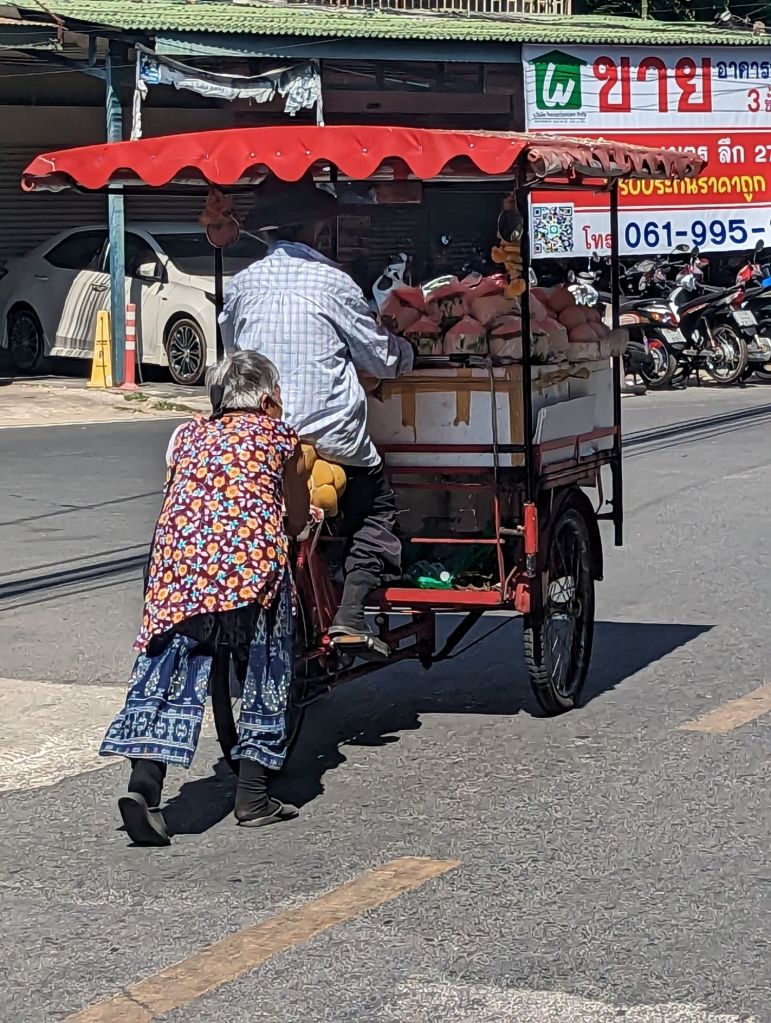
We made a quick stop for lunch – pho and fresh fruit. We arrived a little early for check-in for the cruise so had a little bit of time in the city of Can Tho to walk around. They had interesting ways of pushing their food carts!

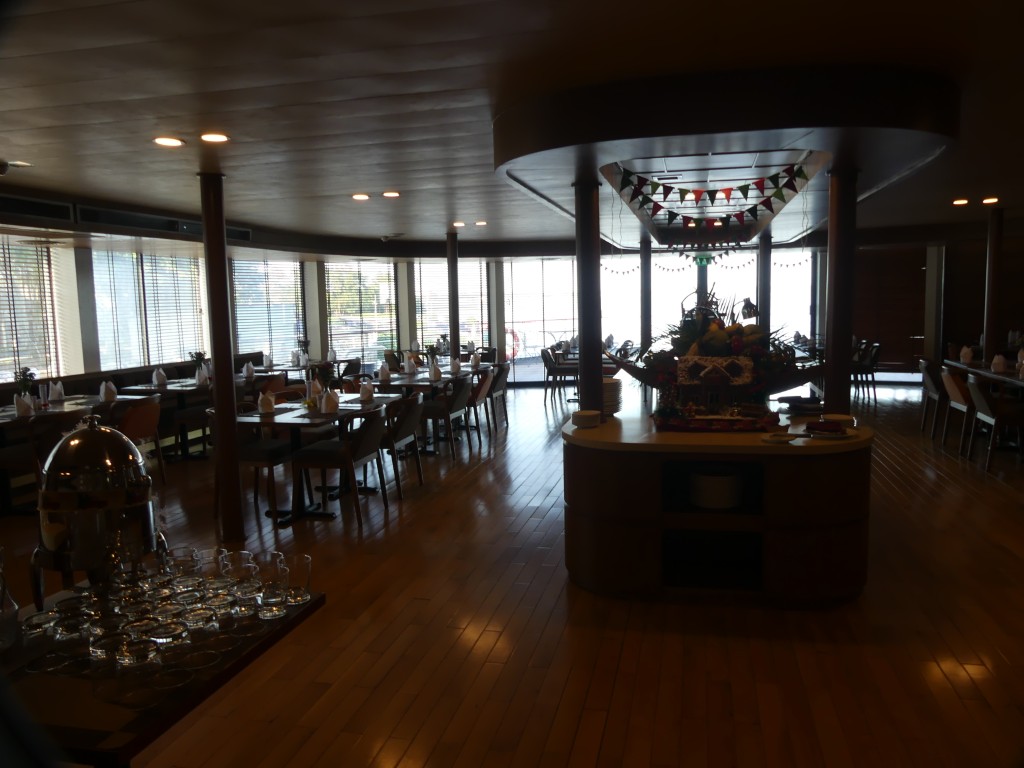
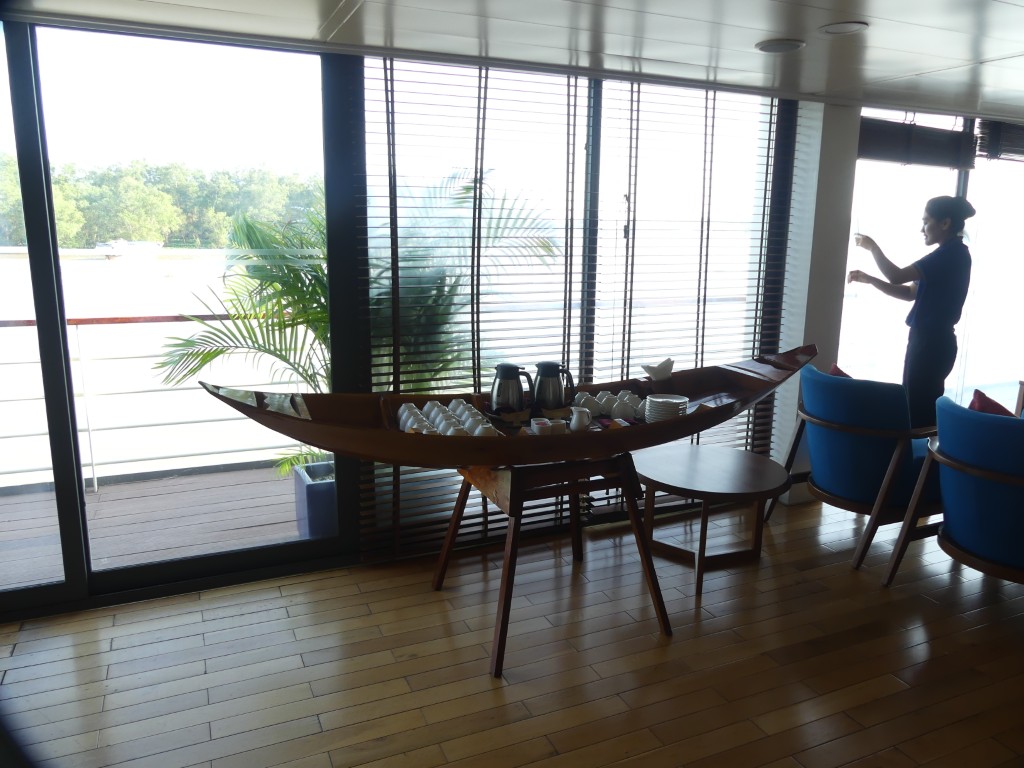
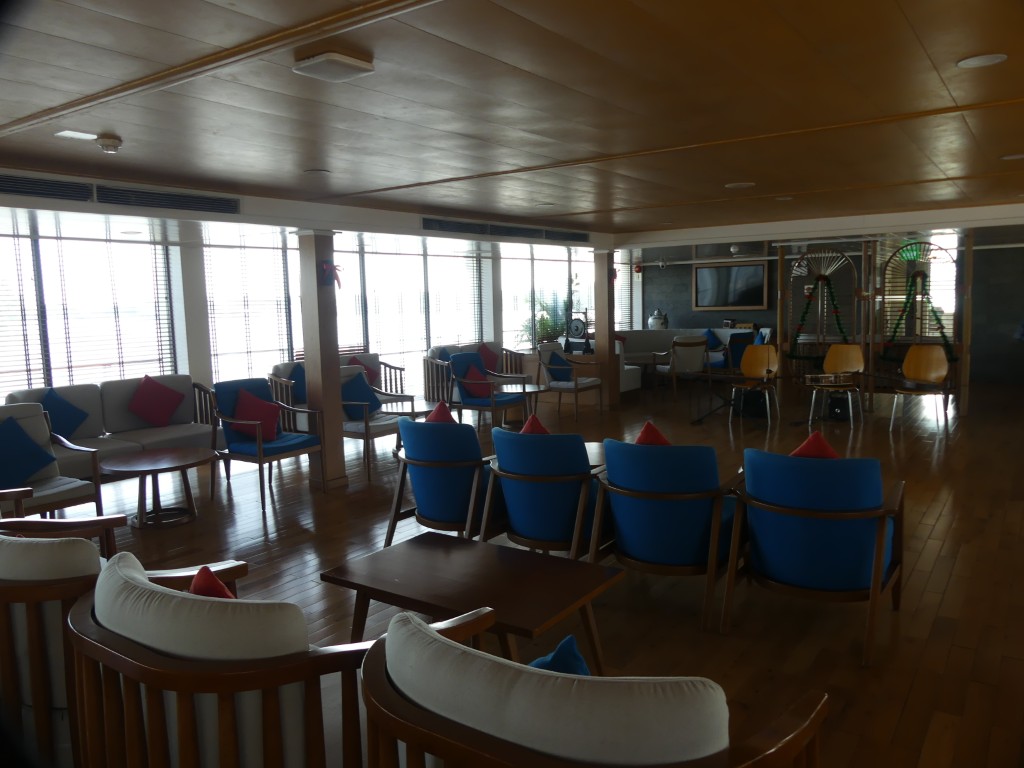
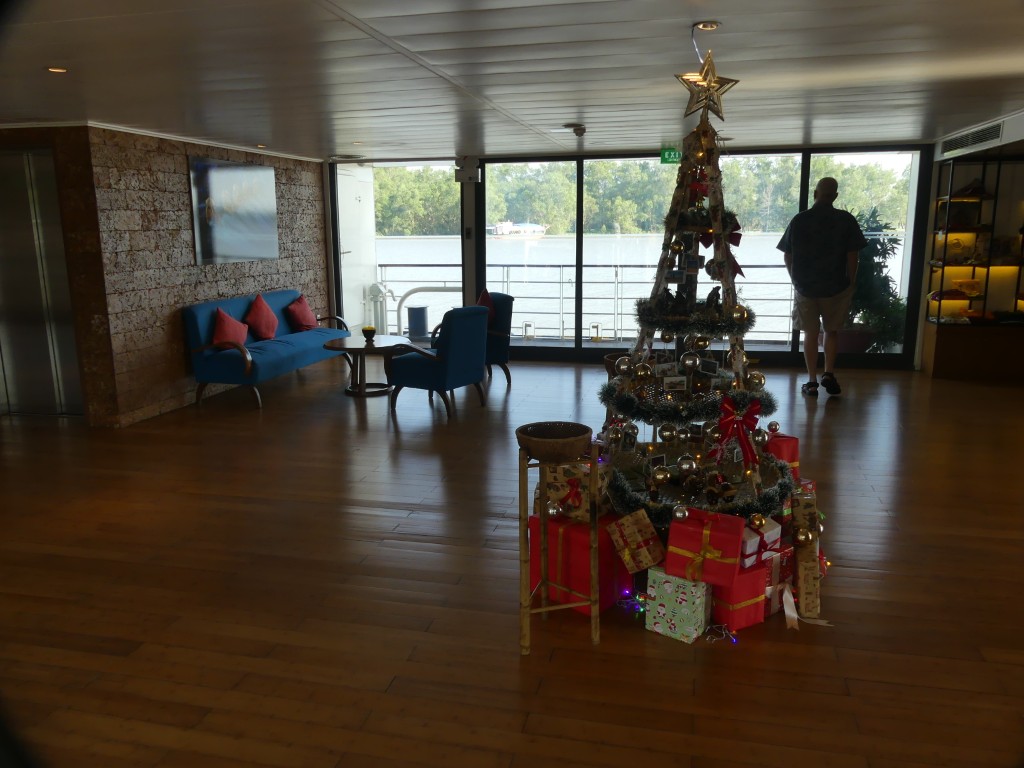
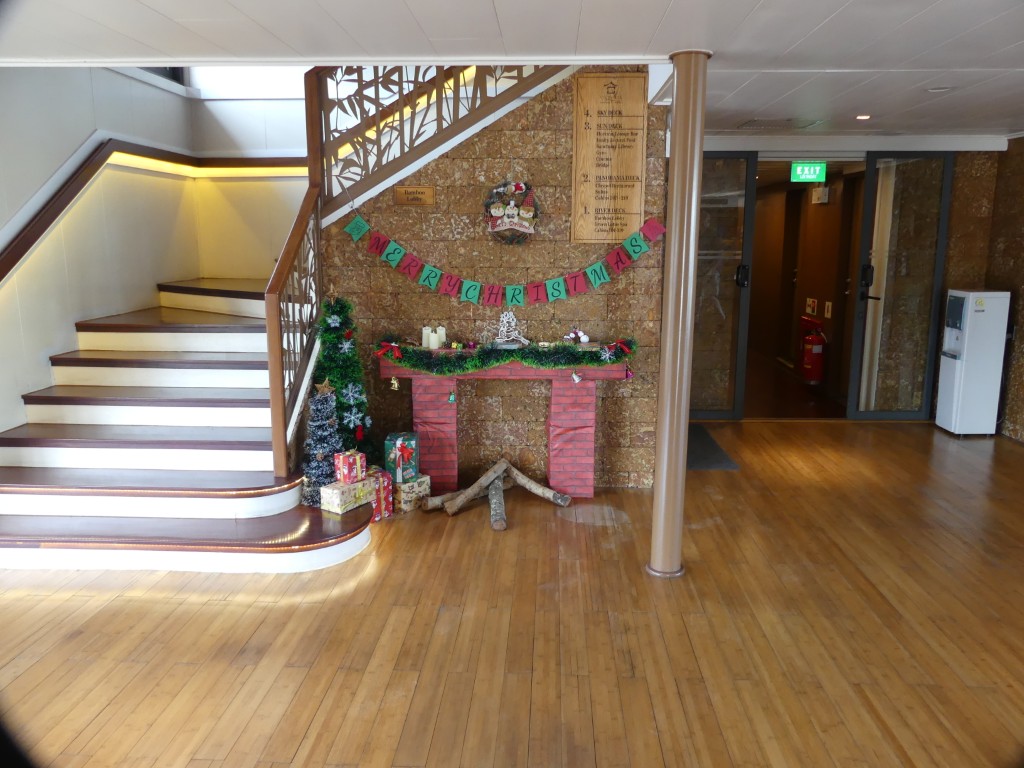
We boarded the boat and had some time to explore before dinner. It was all decked out for Christmas (we boarded on Christmas day). The rest of the day was spent eating, drinking, and relaxing. We also experienced a local musical/dance performance. We were provided with an afternoon cocktail before dinner on a daily basis. Wine, beer, and soft drinks were also provided at lunch and dinner. They were very generous with the complimentary beverages.

Each day, we had a morning and an afternoon excursion. Click on the links below to read about them:

Floating Market

Tiger Island

Clay Cooking Pot Tour

Phnom Penh Tour (full day)

Silver Village and Oudong Meditation Center

Silk Weaving Village

Angkor Ban

Kampong Cham and the road to Siem Reap

There was also a tour of a fish farm offered; we opted to skip that one.

Several evenings, we had entertainment. I am posting a few videos of the singing and dancing:

Traditional Vietnamese song and dance
Lion Dance
Dragon Dance
Cambodian Dance
We used to have to use these in PE during Elementary School. Tinikling sticks, aka ankle breakers.

We disembarked the boat on New Year’s Day and had a long bus ride to Siem Reap. The only negative of the entire tour was our lunch that day – poor food and poor service. Enough said! We arrived in Siem Reap late in the afternoon and had a free evening to explore the town. Our hotel was the lovely Sokha Angkor Resort which was about ¾ mile from Pub Street.

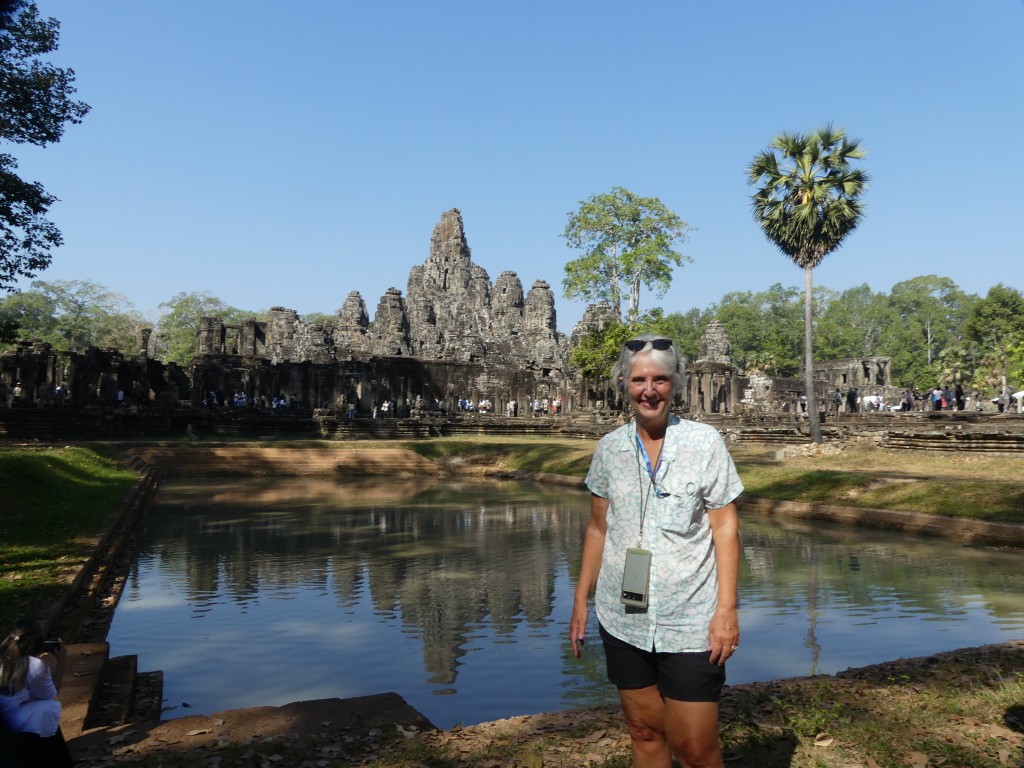
Our final full day was spent exploring a few of the temples in the Angkor Wat area – Angkor Thom and Ta Phrom temples in the morning, and Angkor Wat in the afternoon. I took many, many photos! Click here to take a look and read about the temples: Angkor Wat

Many on the trip were continuing on to Hanoi, but we had decided not to when we booked the tour. It turned out to be an excellent decision as only two days were supposed to be spent there. However, the schedule had the group arriving in Hanoi at 10:30 pm, so they would only have one day in Hanoi before heading back to the US and Canada. Personally, I would have been disappointed with the limited time in that city.

I would recommend this tour to others, especially if you have not toured in the area previously. The boat was lovely and the service onboard exceptional. Though we were not first time visitors, we still enjoyed seeing the sights and learning new things along the way.

From Cape Town to Johannesburg: The Third Time’s The Charm

If you are a reader of my blog, you know that we were stuck in Cape Town’s harbor on a cruise ship at the beginning of the pandemic. After a few days floating in Table Bay, the South African government allowed us to go directly to the airport and fly out. Let’s just say that my memories of the visit are less than stellar. I have lots of pictures of Table Mountain taken from the balcony of our cabin and unpleasant memories of the airport and those that worked there as we departed.

We rebooked a cruise around Africa during the pandemic, followed by a tour from Cape Town to Johannesburg, but that was cancelled by both the cruise line and tour company.

Now that the pandemic is over, we decided to give it another try. We decided to skip the cruise part and go directly to the tour part this time.  We booked a 12-day tour from Cape Town to Johannesburg with a couple of game drives along the way.

Our flight from Chiang Mai to Cape Town was over 30 hours long, including layovers in Bangkok and Dubai. The Dubai airport was something else – if you ever need to shop for high-end goods at 2 am, this is your place! We flew on Emirates and have nothing but good things to say about them.  The lounge in Dubai was fabulous. I’m all about the buffet and theirs was top notch. We arrived in Cape Town around 11:30 in the morning. We passed through immigration quickly and were met by our taxi driver. I had pre-booked a taxi through booking.com which we have had great luck with on previous trips. Our driver was very friendly and outgoing. He dropped us at a hotel and took off. Notice I said “a” hotel? Not a typo. We went to the front desk to check in and no reservation could be found in our name. I told the woman helping us that we were on a Gate 1 tour, but she had no record of that, either. I was wondering whether we had arrived on the wrong date, or just what the problem was. Apparently, the taxi driver had dropped us at the wrong hotel – we were booked at the Southern Sun Waterfront; he took us to the Southern Sun Cape Sun.

The doorman was very helpful and kind after we figured out what the issue was. He suggested taking an Uber as a cab was likely to rip us off. He also said that oftentimes, Uber doesn’t show up when you book them. Fortunately, this time the driver appeared and took us to the correct hotel which did have our reservation. As we were checking in, so was our tour guide, Don! He was a friendly, outgoing guy and it was nice to have a chance to chat with him a bit before meeting up with the rest of the group.

Typically, the first day of a Gate 1 tour is for arrivals, and so there are no activities or meetings planned. We had the remainder of the day to recover from our flights. We hung out at the hotel, had an early dinner, and went to bed to get caught up on our sleep.

The next day, we started our tour. I am posting a separate page for each place we visited:

Cape Town City Tour

Cape Peninsula Tour

Wine Lands Tour

St. Lucia Estuary

Game Drive #1: Hluhluwe Imfolozi Park

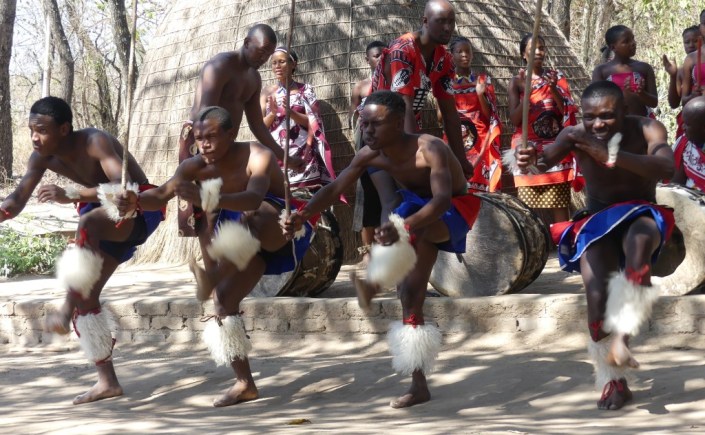
Eswatini (Swaziland) and Matsamo Village Tour

Game Drive #2: Kruger National Park

Johannesburg

This was an amazing trip. I have a few suggestions if you are fortunate enough to travel to this area. First, bring a camera with a good zoom lens. Some in our group that only had camera phones were not able to get the quality of pictures that those carrying DSLRs were able to. I normally have to edit my pictures; the pictures I posted (except for the close-up of the leopard) are not edited at all. I used a Panasonic Lumix DMC-FZ300 that has an excellent zoom.

A good pair of binoculars is also needed. We have a couple of pairs of good binoculars back in Seattle. Unfortunately, I did not think to pack them and so bought a pair in Thailand (since that is where we flew from). Suffice it to say that they were not top-quality glass…

Some of the wildlife was very close to our vehicle – impalas and nyalas were everywhere – no binoculars needed. But lions, zebras, and giraffes were quite a distance away. Without either binoculars or a good zoom lens on your camera, you wouldn’t be able to see them as well as you might wish.

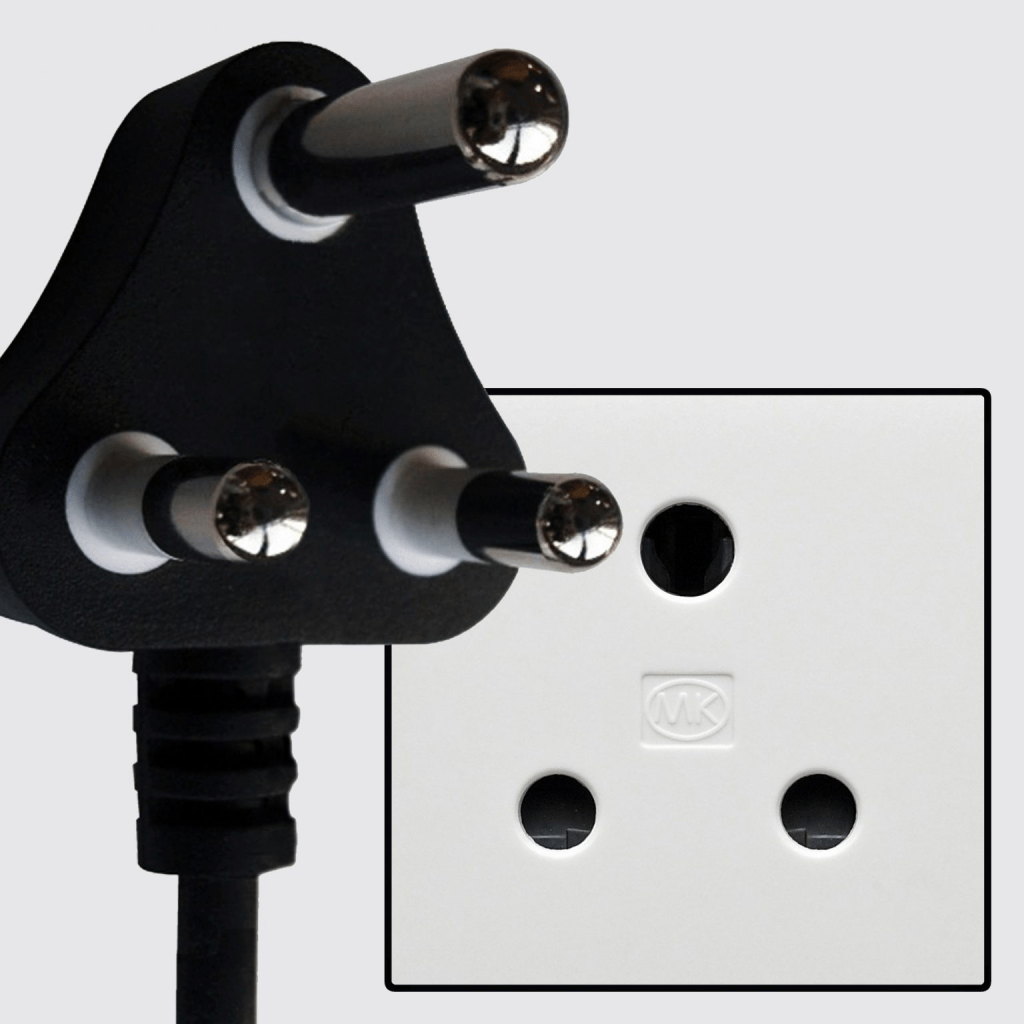
The power plugs in South Africa are different than most places; a typical universal adapter will not work. I bought one from Amazon that did not work except in the last two hotels we were at. Here is a picture of what you need:

One other thing to pack? A washcloth. Only one of our hotels provided them, so if you like to use one, bring your own.

It is very windy on the cape so if you have longer hair, bring something to tie it back with. Or wear a hat that stays on your head in windy conditions. Also bring sunscreen and insect repellent. We chose not to do anti-malaria prophylaxis and relied on a superior quality deet spray for Kruger.

I will leave you with the infamous words of our tour guide, Don, “Never, never, ever, ever let someone help you at an ATM!”.

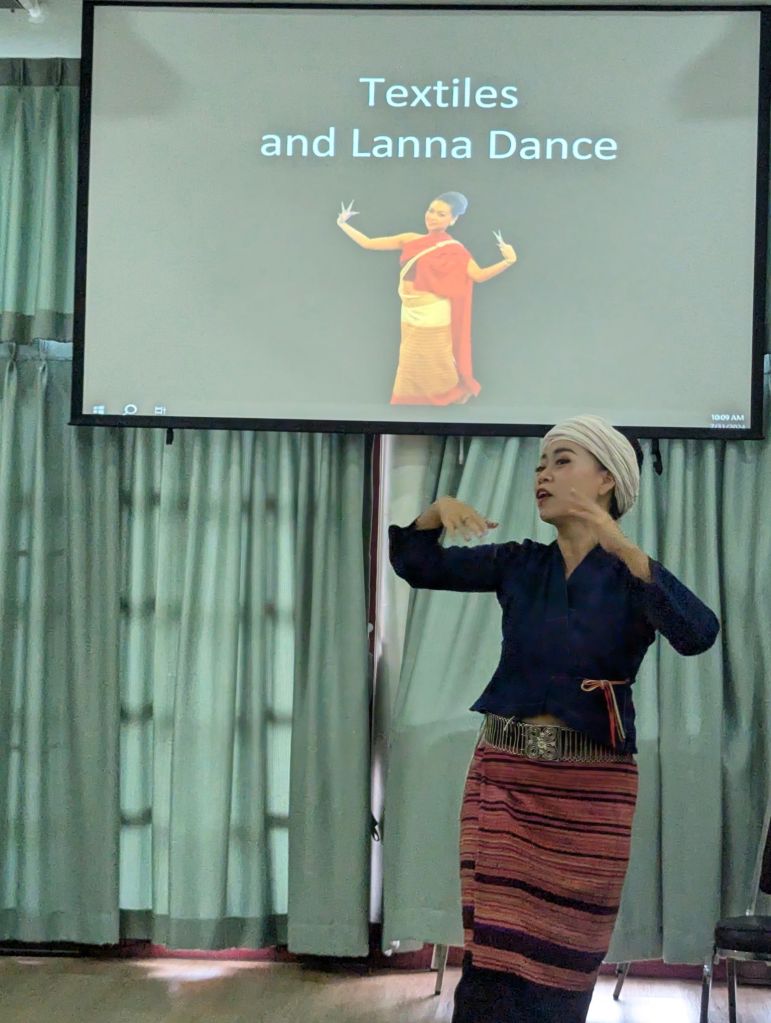
Lanna Dance and Textiles

Beautiful and elegant are but two words that describe Thai dance. One of the best parts of living in a different country is learning about its cultural heritage. I had the opportunity to attend a class on Lanna dance and textiles. The Lanna Kingdom was the “kingdom of a million rice fields” in northern Thailand from the 13th to 18th centuries. There were over 30 tribes in the highlands and lowlands of Lanna; our class focused on five of them.

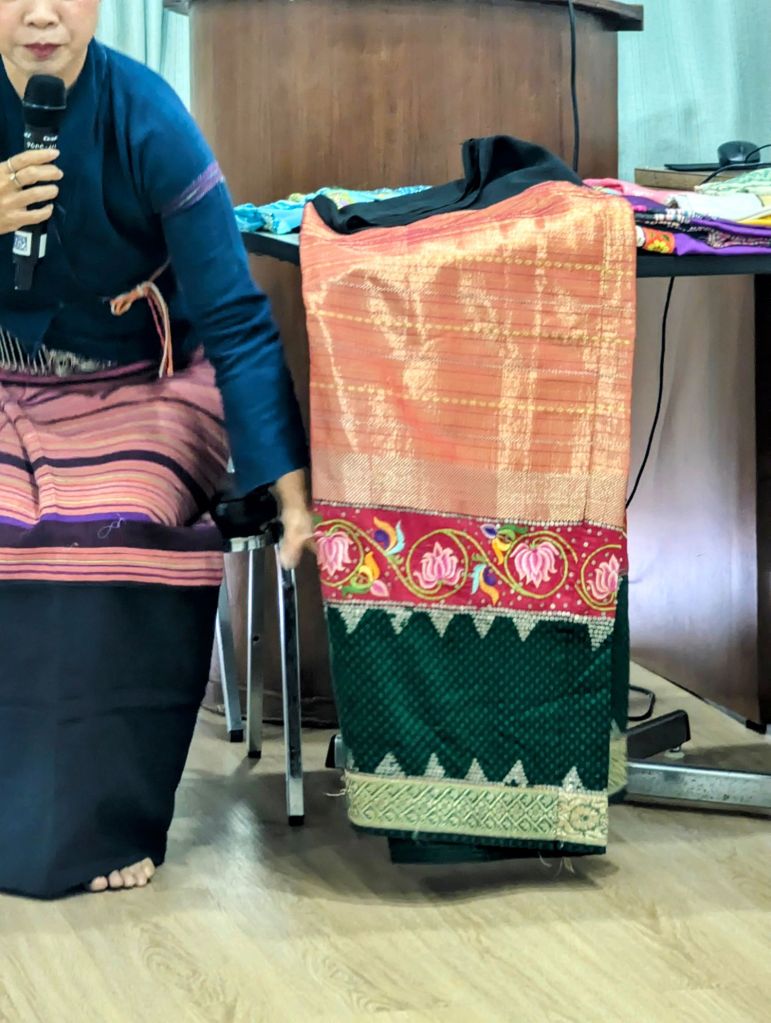
Traditionally, Thai women wear “pha sin”; what you might call a sarong. Unlike the sarongs that are sold to tourists, a pha sin (pronounced paw scene) is a round tube of fabric, divided into three sections: the head, body, and feet. The “head” holds the pha sin in place by being rolled down and is oftentimes covered by a belt. The “body” is the main part and contains many distinctive designs, depending on the tribe. What all have in common is a belief in cosmology; the patterns typically depict the ocean, sand, forests, mountains, flowers, etc. The “feet” is the end of the pha sin and typically has some type of trim in order to distinguish it from the head. Traditionally, the colors in a pha sin were muted as natural dyes were used. In modern times, artificial dyes are used, and so colors are brighter.

When wearing a pha sin, the seam is normally hidden by folding the tube of fabric over the seam. However, one tribe puts the seam in the back, to protect one from black magic. In some tribes, the ankles must be hidden. Going topless? Fine!

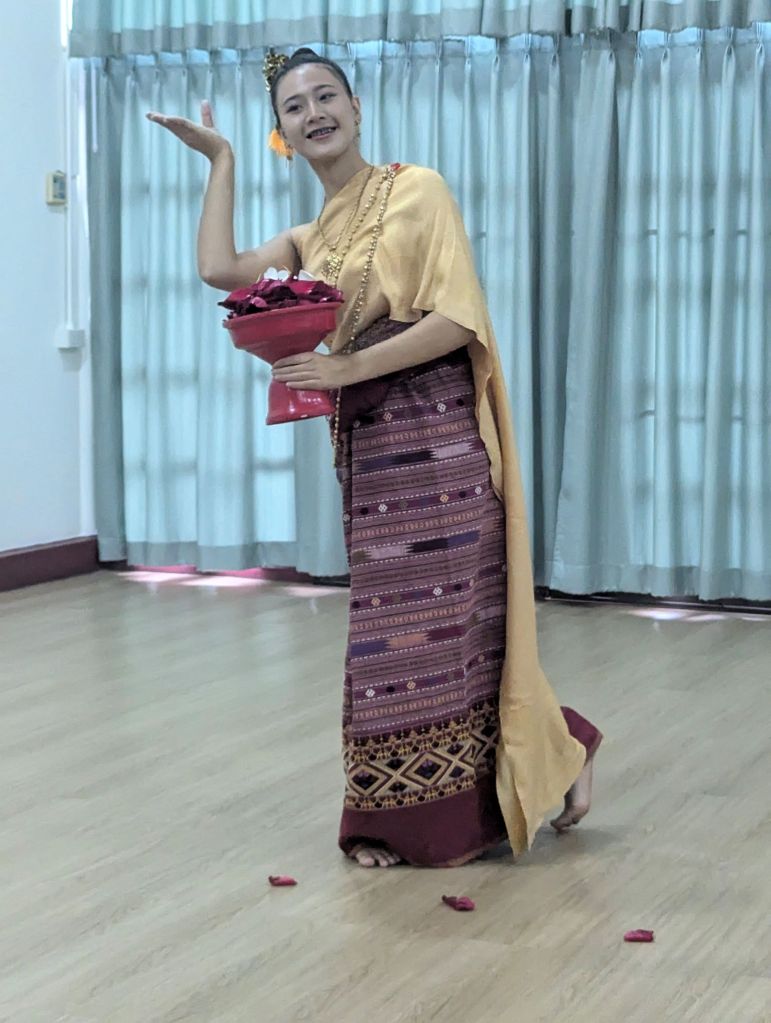
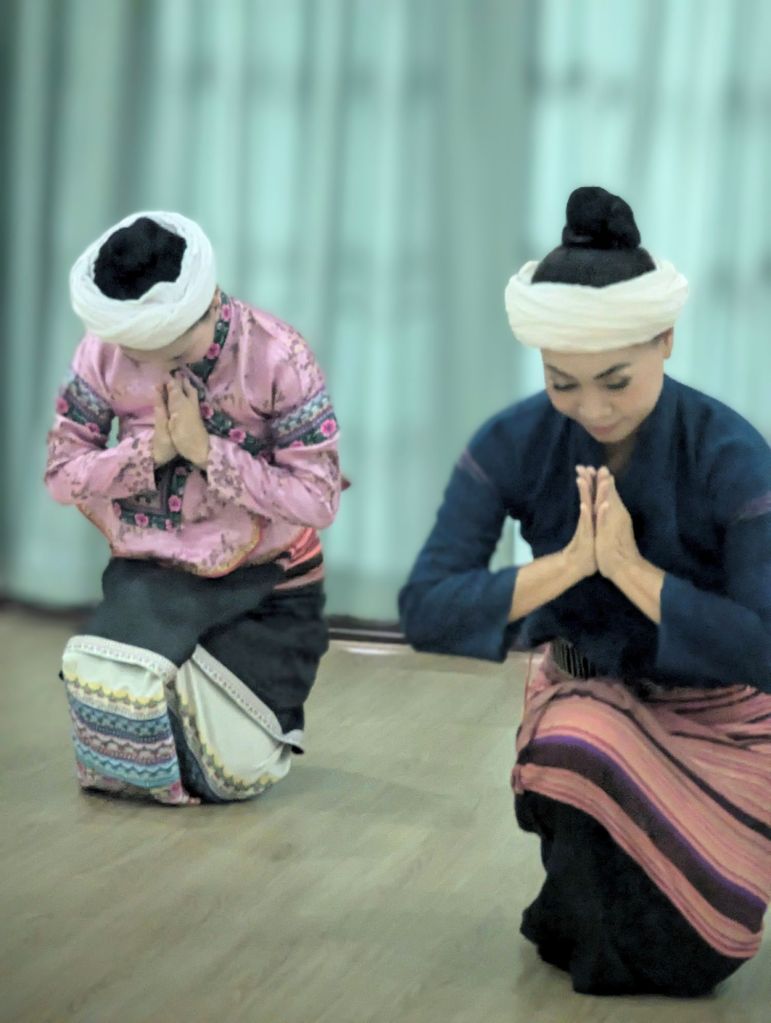
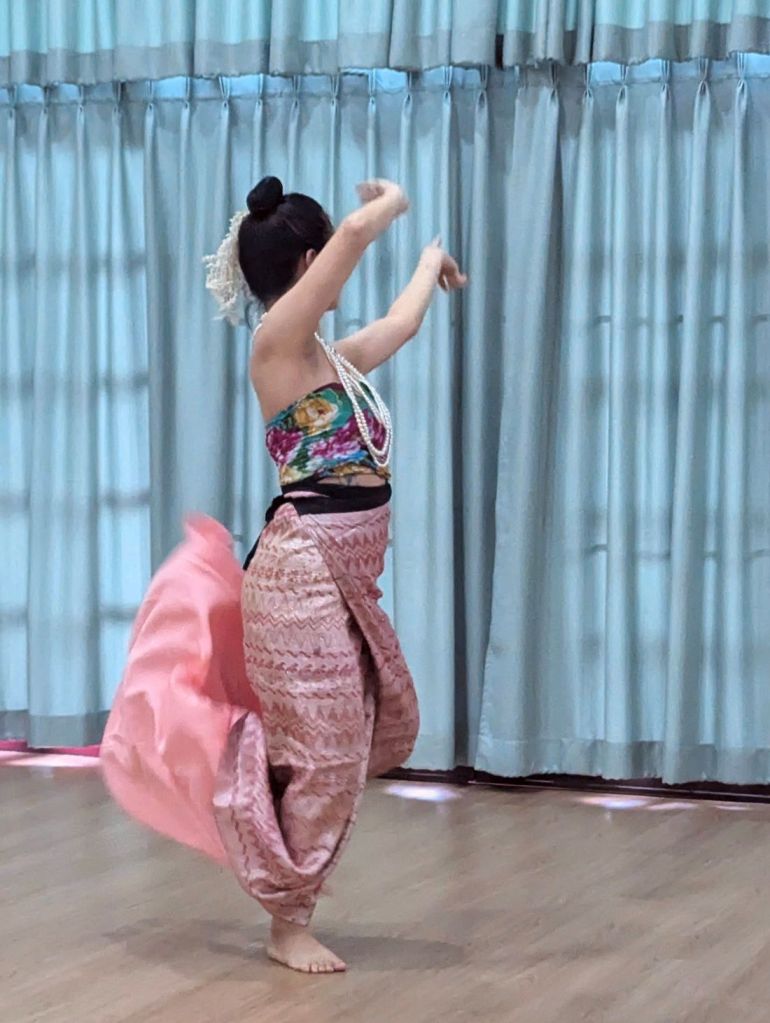
After learning about the textiles used to create the pha sin, we were treated to dances representing the tribes. In Thai culture, dances are for worship as opposed to performances.

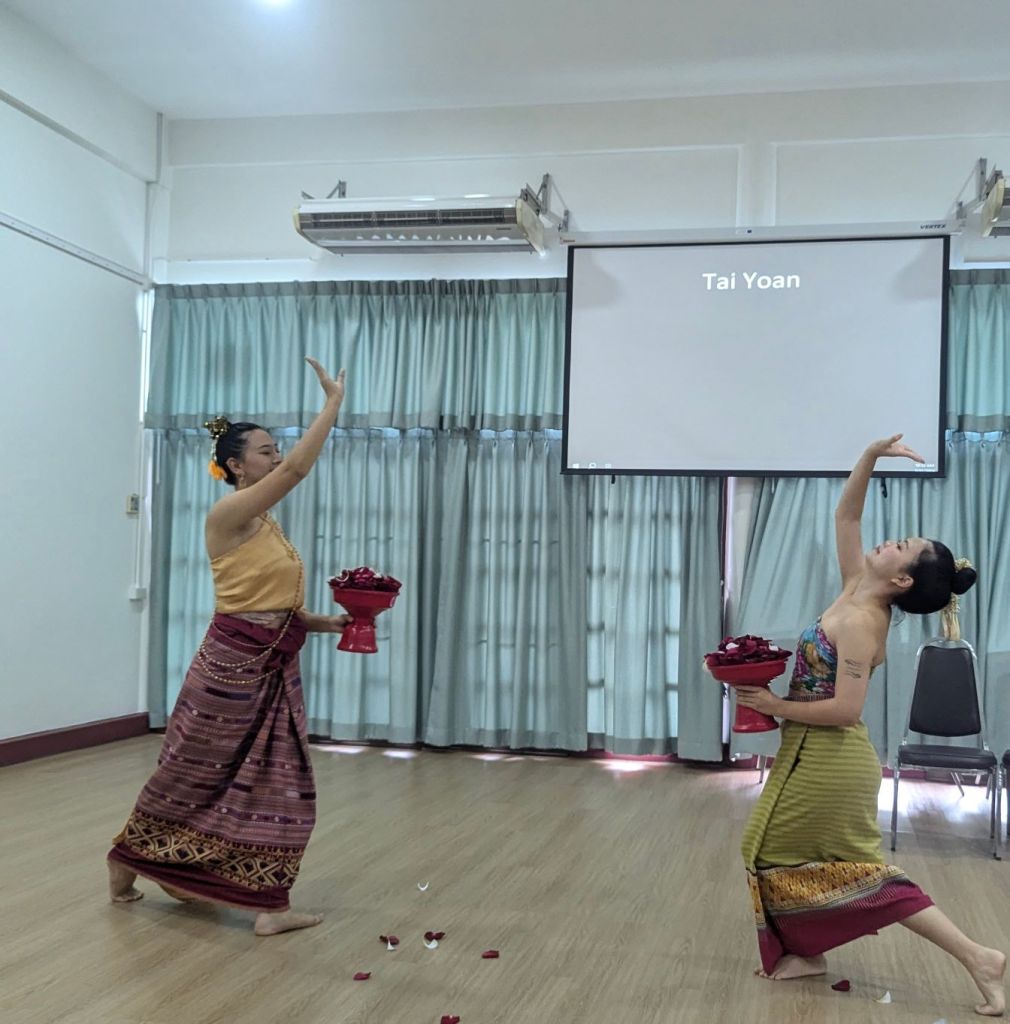
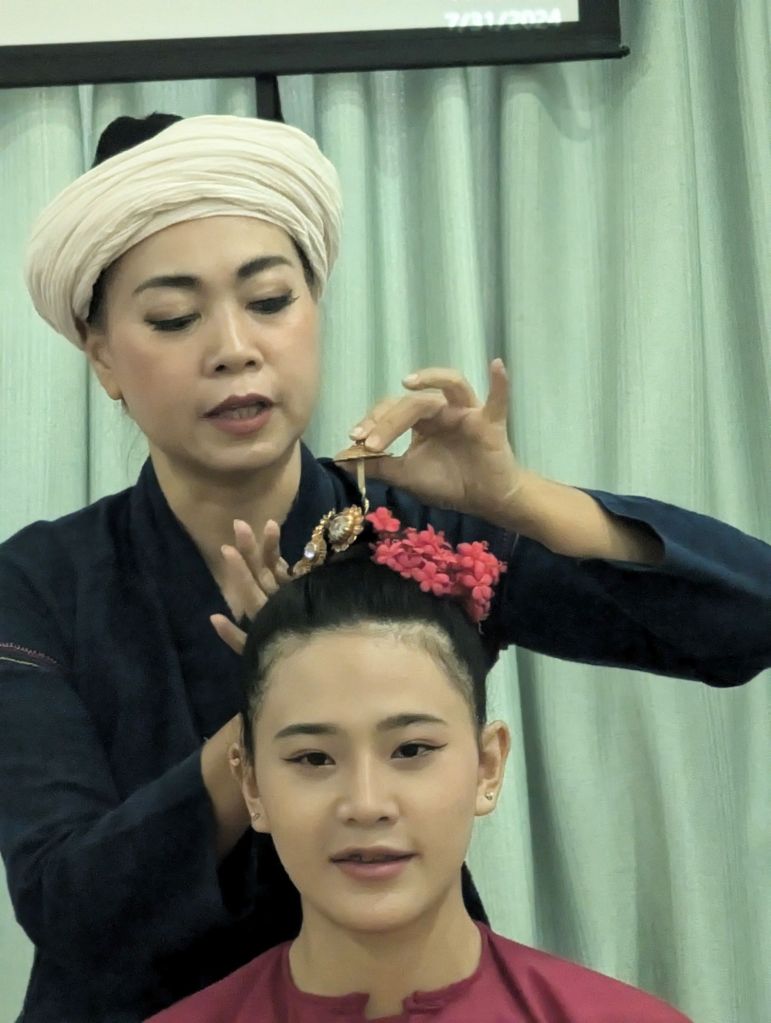
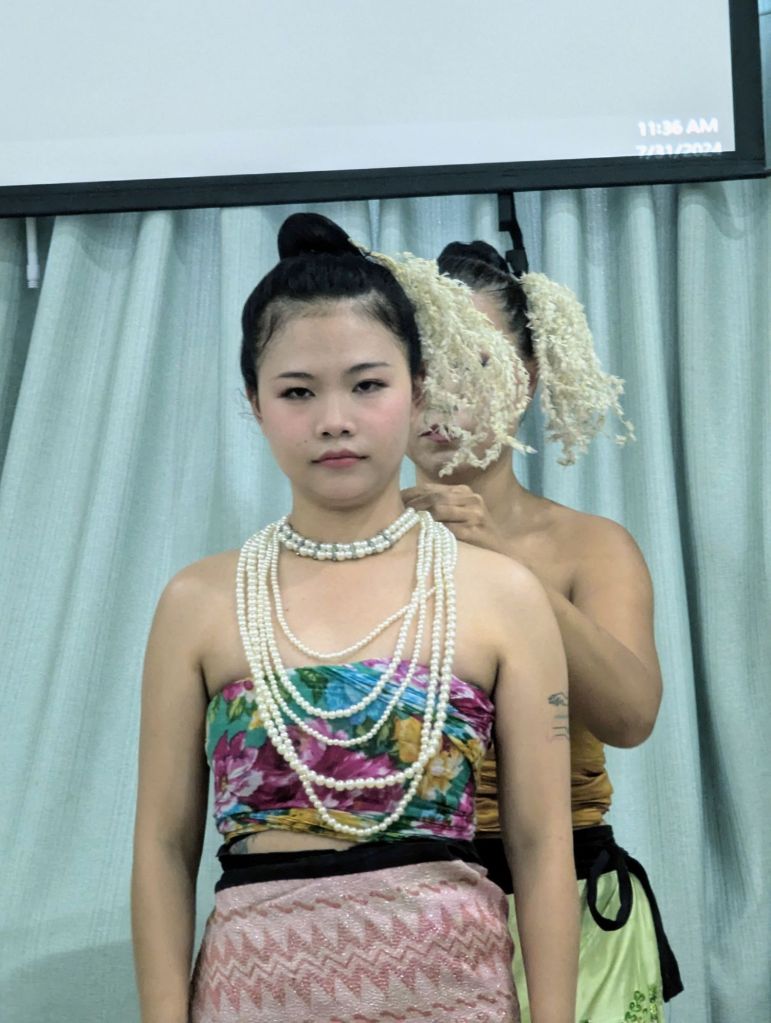
Prior to dancing, women assist each other with ornamentation, adding jewelry and other items to complete their outfits. The first dance we saw was the Flower Blessing Dance from the Thai Yoan culture.

A brief video clip of the Flower Blessing Dance

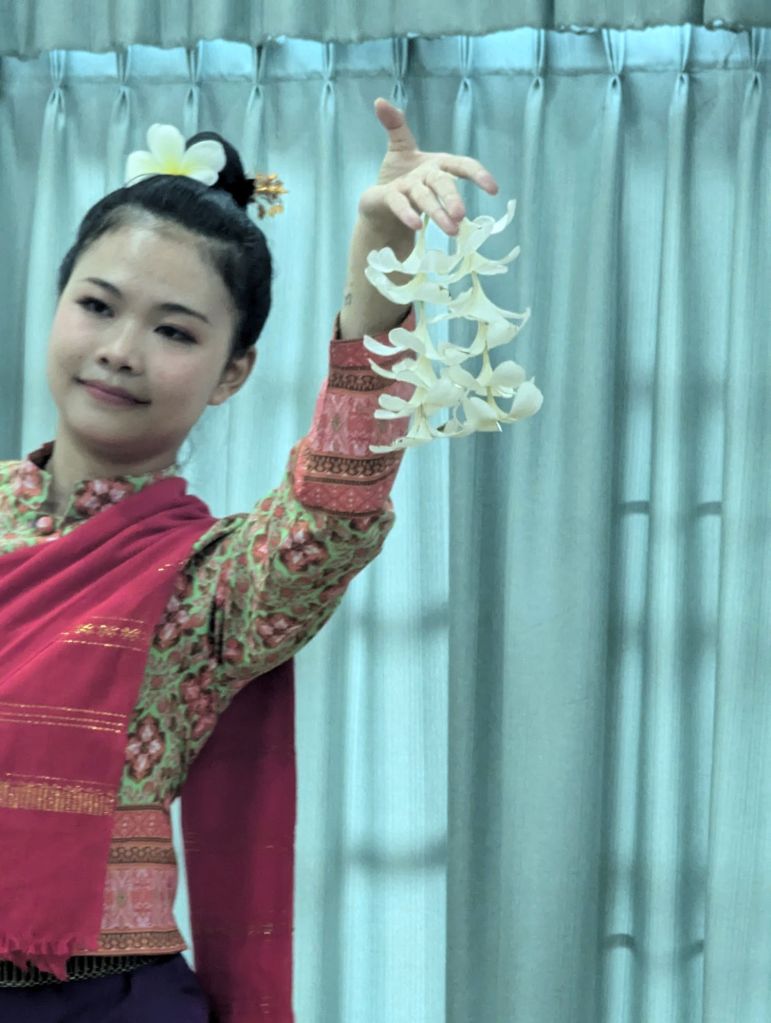
The next performance was representative of the Thai Lao. Typical ornamentation in this culture uses the flower which we call a plumeria or frangipani.

Thai Yao dancing

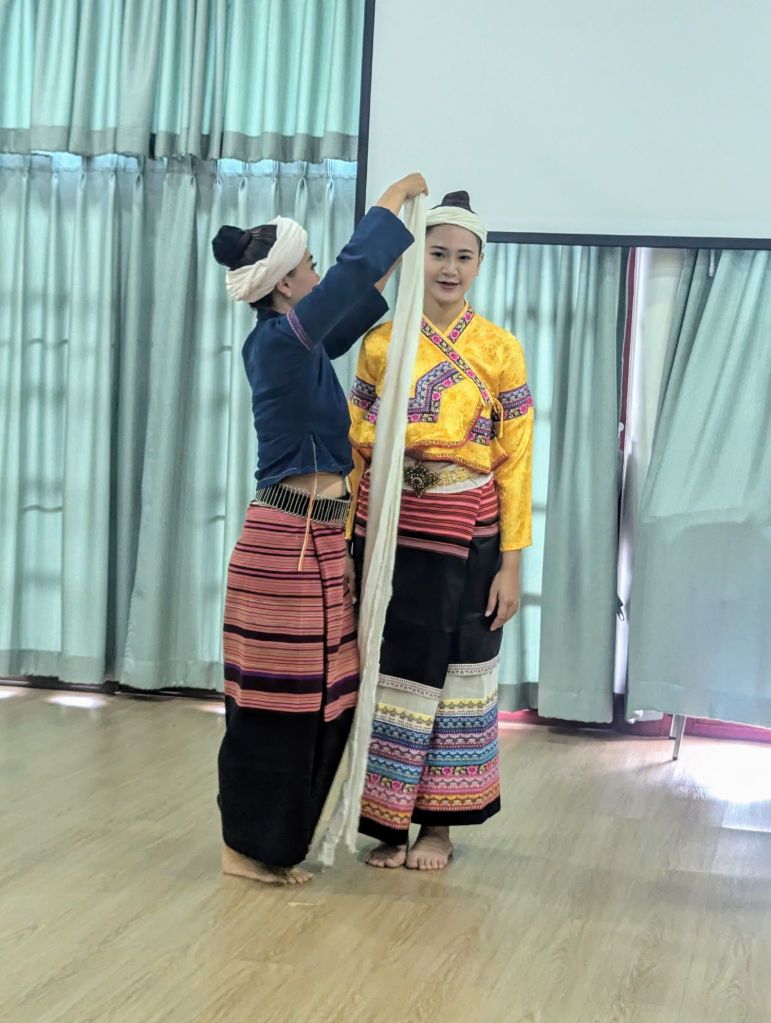
Thai Lue dance originated in Vietnam and Laos. The headdress that all are wearing are created from a long piece of fabric that is wound around the head.

Thai Lue dance.

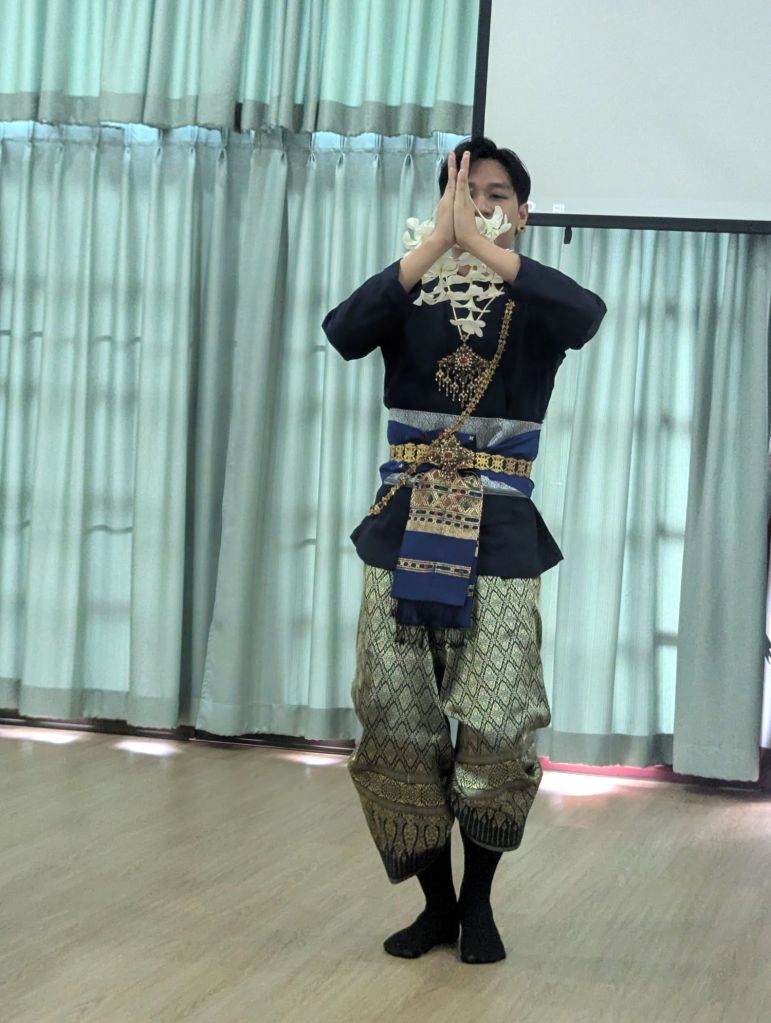
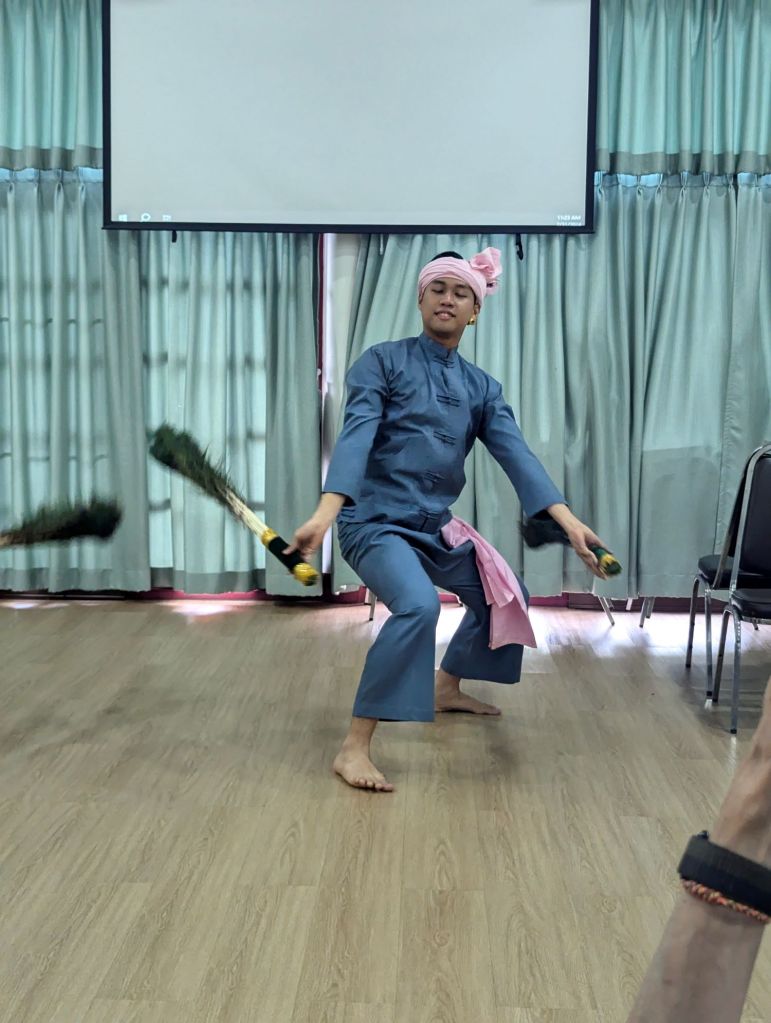
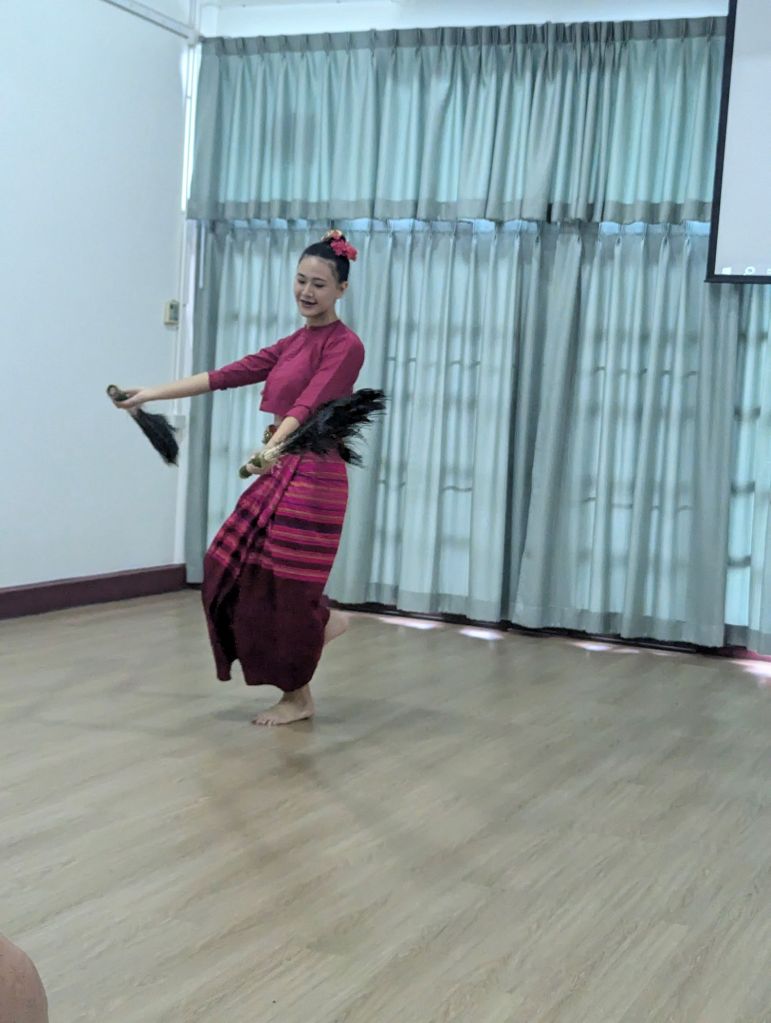
Next up, Thai Kiun. The dance was choreographed by the young man who is not only an expert in Thai dance, but also in martial arts. He incorporated some martial arts moves into the routine. As you can see, this dance necessitated a change of costume for him.
A very brief clip of the Peacock Dance

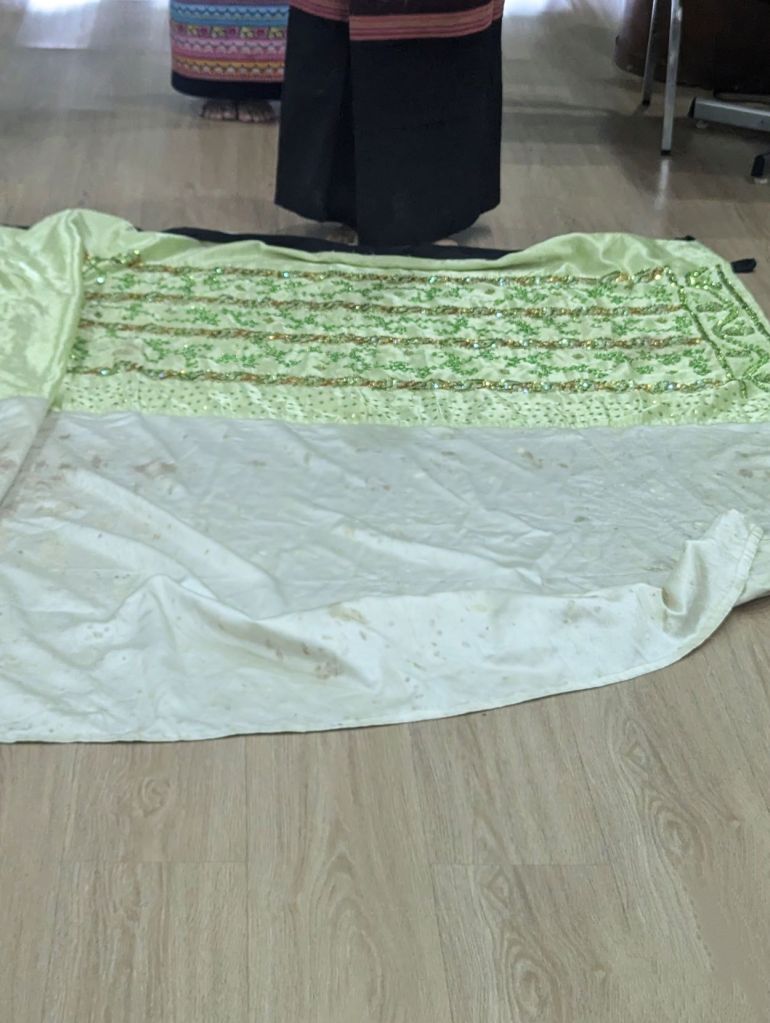
The final dance was from the Thai Yai tribe, the Candle Dance. The maids in our apartment are Thai Yai; many came from Burma (now Myanmar) originally. People here still call the country Burma! The Thai Yai pha sin is the only one that is not a tube; it is a large piece of fabric that is wrapped around the dancer and secured with a rope at the waist. Then the fabric is rolled down to cover the rope. To me, the Thai Yai fabrics were the most beautiful.

The final dance: Thai Yai

The teacher explained that the spirit of the person is contained in the head of the pha sin, so when she dies, her pha sin will be passed along to her niece, but the heads will first be removed.

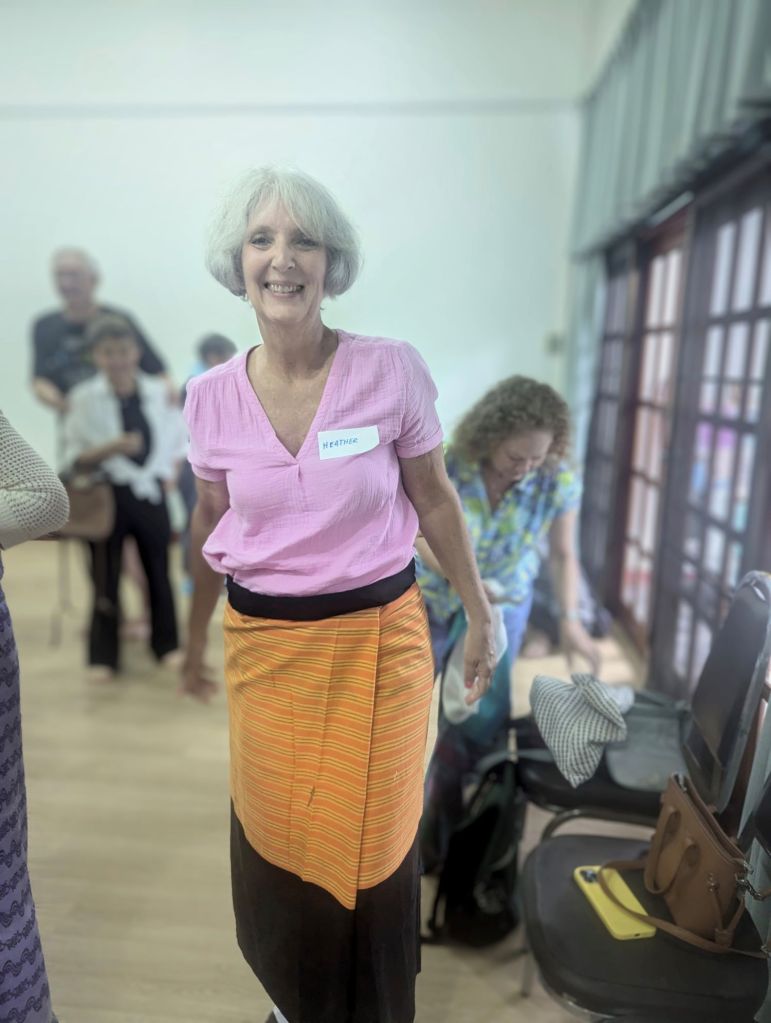
We couldn’t leave until we successfully figured out how to put on a pha sin!

An 11-day Cruise in a Penthouse Suite for $43.68? T

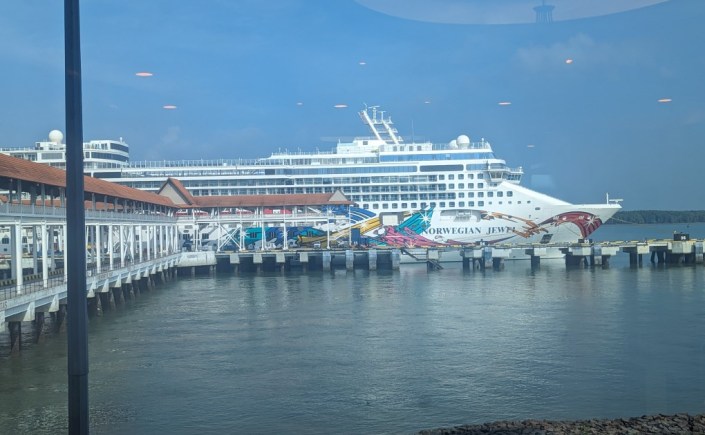
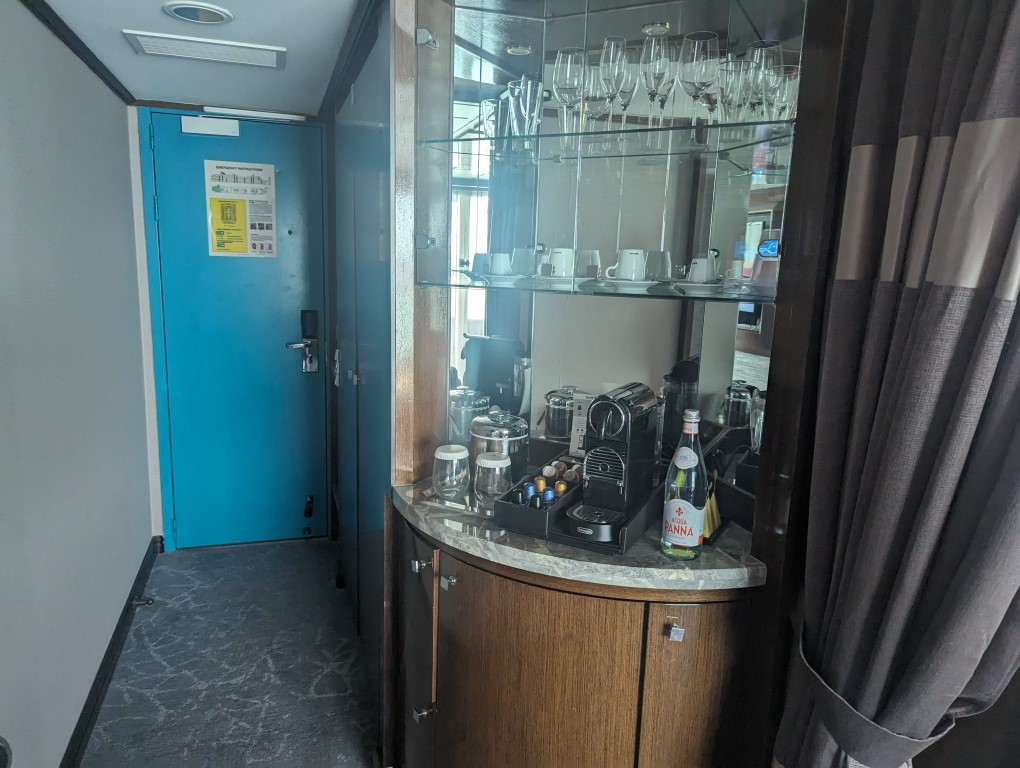
Once upon a time, Clayton and I floated at sea during the outbreak of the pandemic. Not the best of times, but we soldiered through. Since we were unable to dock at the majority of the ports on that cruise, NCL gave us 75% off towards a future cruise. We had already been given 25% off a future cruise due to the first leg of our cruise being delayed for several days and several hundred dollars credit due to a non-functional toilet in our cabin. During the pandemic, we bravely booked a couple of cruises that never happened, giving us an additional percentage off a future cruise. Why bring this up? Because we cashed in all our future cruise credits, took advantage of a price drop on a cruise, and due to Clayton’s military service, received an additional discount. When all was said and done, we booked a penthouse suite (with a butler) for an 11-day cruise for a whopping $43.68 (for two!). And, as NCL stockholders, we were given $100 onboard credit so actually, NCL paid us to take a cruise. Right up until we boarded, I figured NCL would realize that they screwed up in some way and ask us to give them more money, but not so. As I type this, I am sitting on the couch in my aft penthouse suite!

We typically book balcony cabins; we have never ever been at the suite level of service. Like everything else, I diligently researched what to expect with the “suite life”. And let me tell you, it is wonderful.

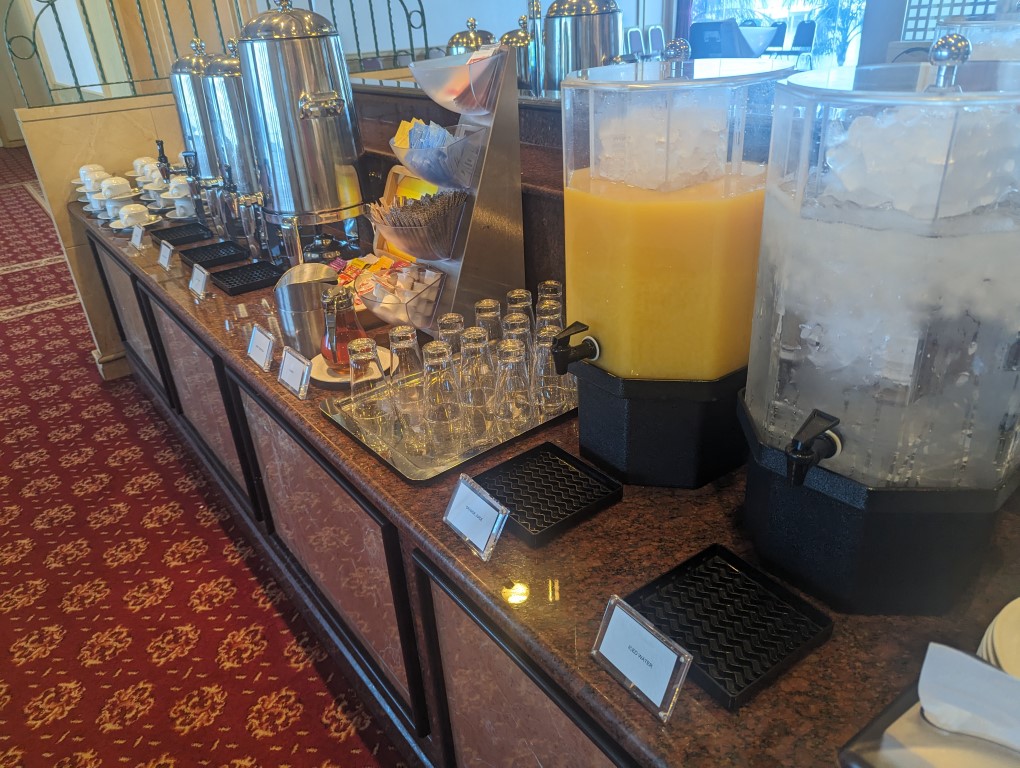
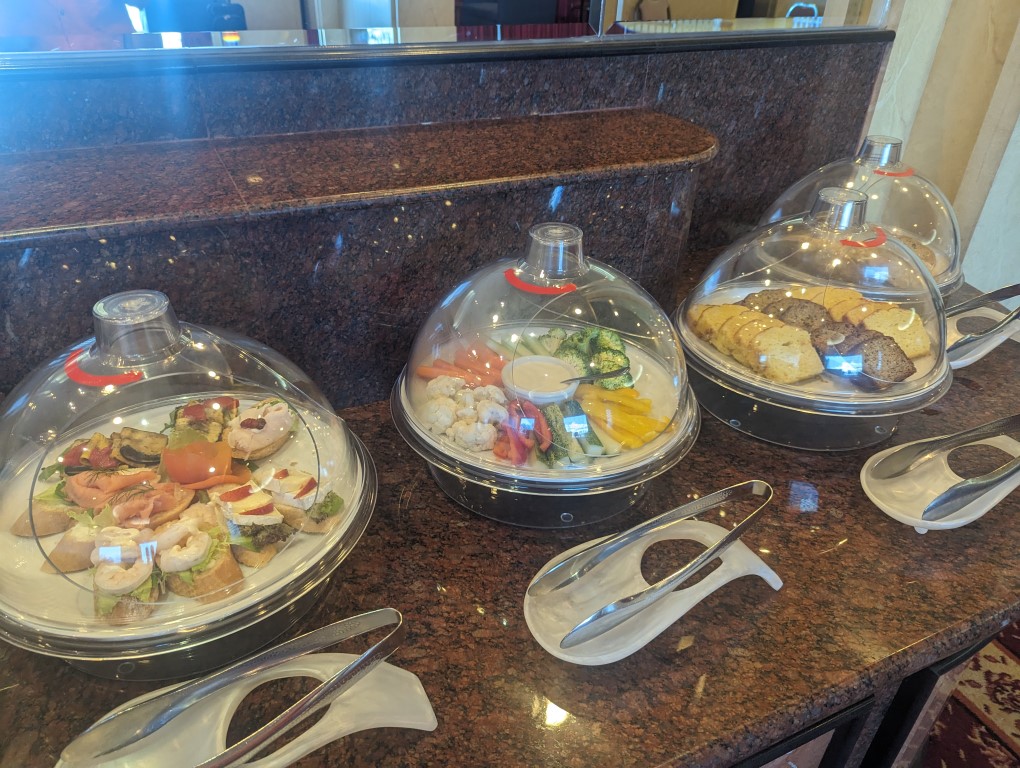
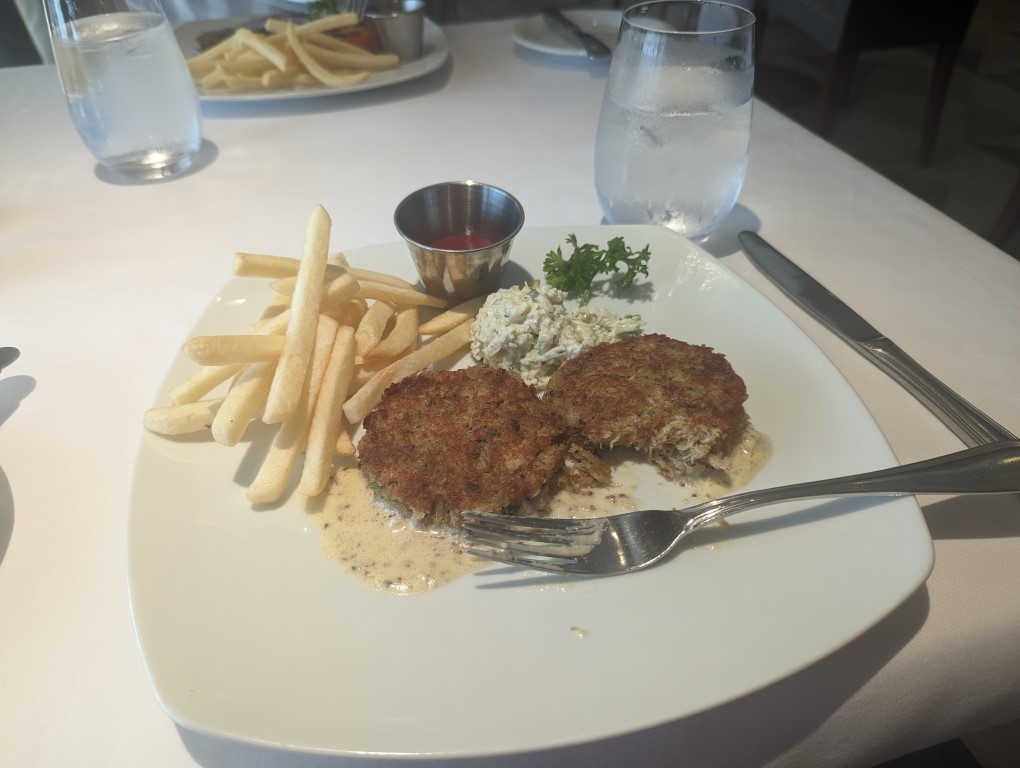
We arrived at the port a couple of hours ahead of our scheduled check-in time, on the off chance that we could get on board that much sooner. There was a dedicated lounge for suite guests, separate from the madhouse that everyone else experiences pre-cruise. There were juices, coffee, and tea as well as lovely crudites and appetizers. I indulged myself with a piece of avocado toast topped with three large prawns. I think Clayton may have had a cookie or two. We were checked in right in the room, taking mere minutes. We met our concierge, who was there to help with anything we needed to make our experience more pleasurable. There was only one other couple in the lounge with us. By eleven o’clock, we were being personally escorted on the ship and to the special restaurant for suite guests. We were seated by the window and provided our menus. The service was impeccable and the food delicious. I opted for the crab cakes; Clayton had steak. We were told that when we finished eating, we would be able to go to our cabin. This is unusual; typically, when boarding, cruisers must wait until mid-afternoon to access their rooms, since the cabin stewards must thoroughly clean them after the prior cruise’s guests have disembarked.

There is a special elevator for suite guests. An NCL employee is in there to push the buttons for you. We wouldn’t want to get our fingers dirty, would we?

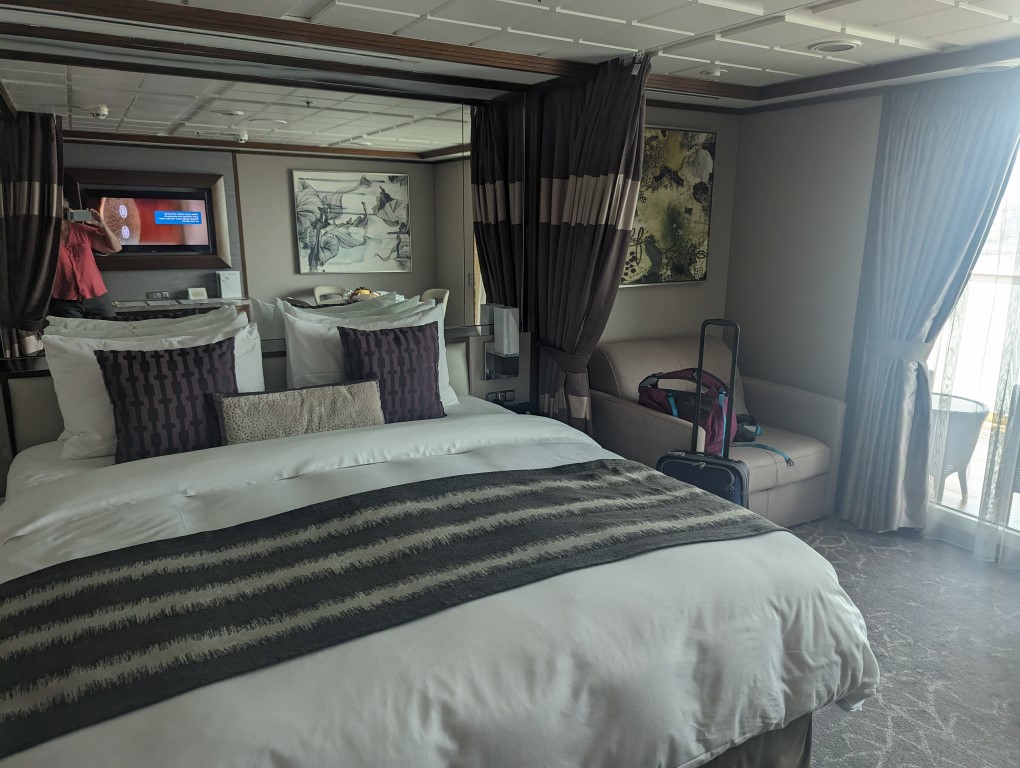
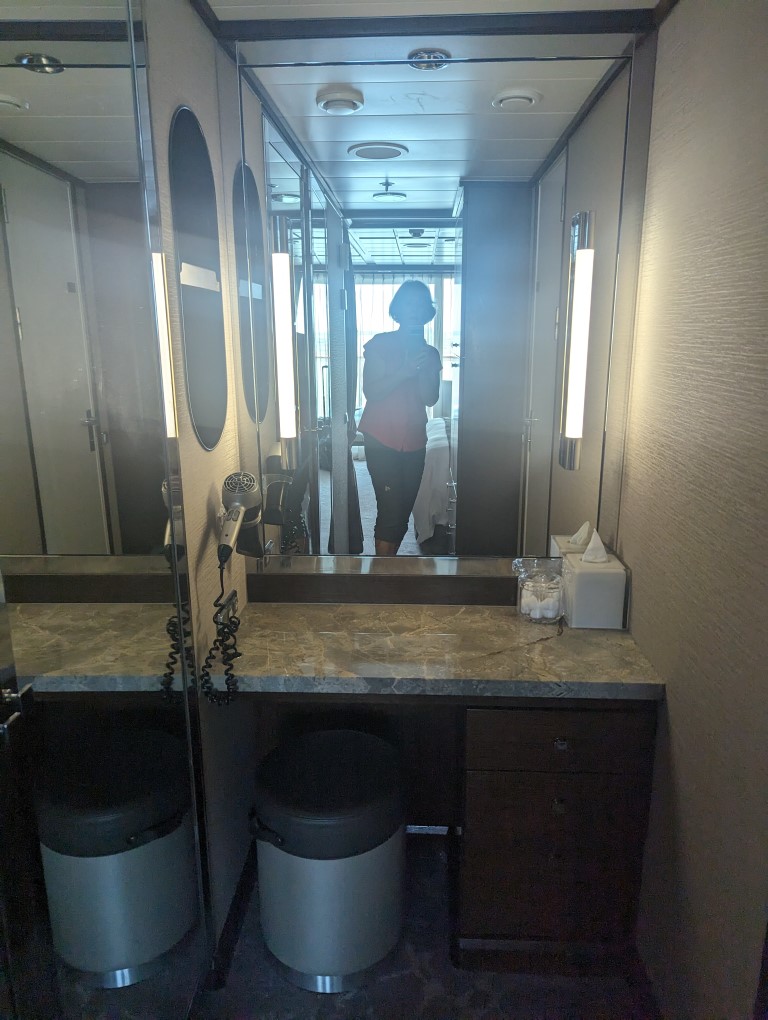
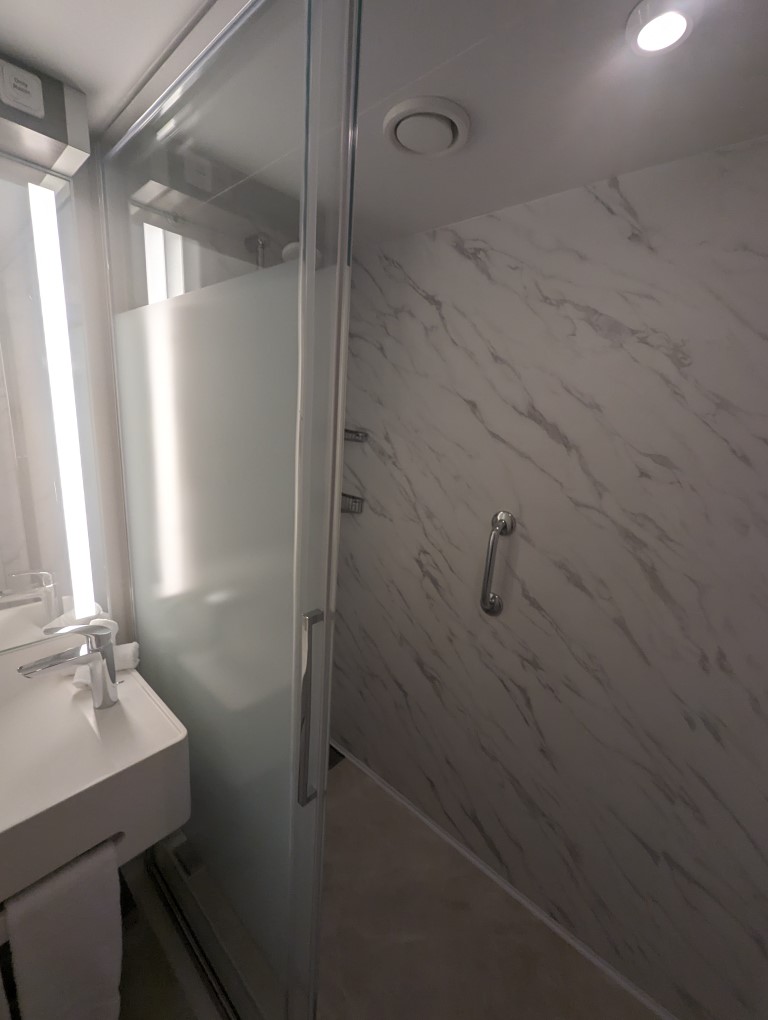
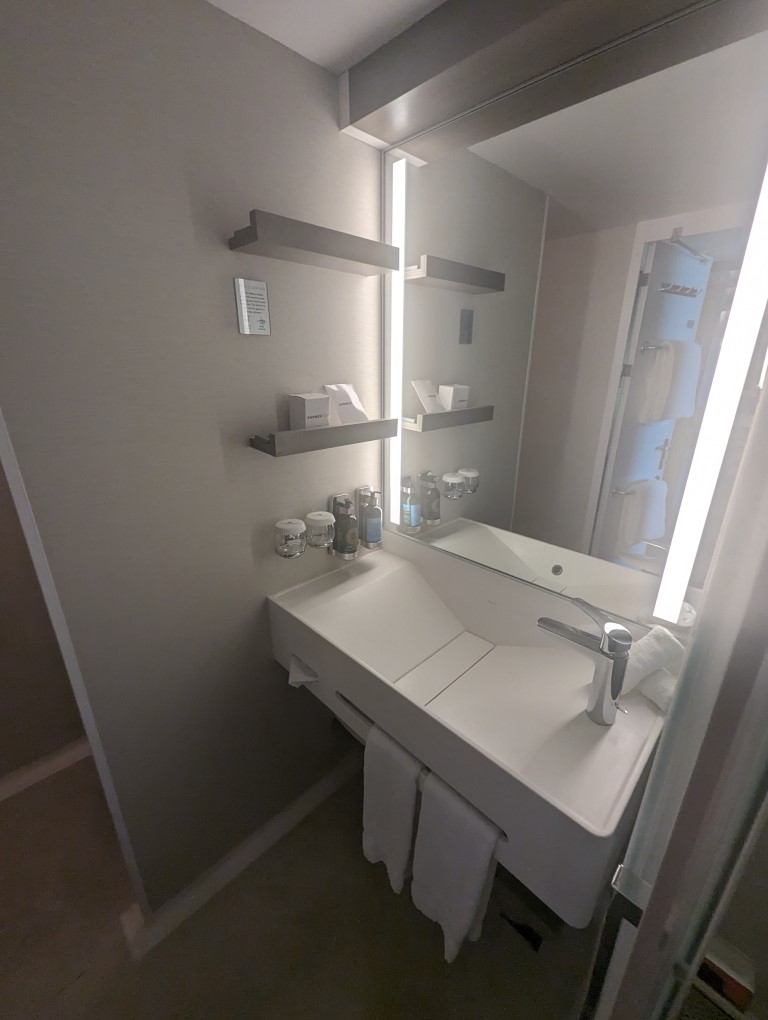
Our cabin is quite lovely. There are larger suites, but I chose this one for its aft location and large balcony. I like nothing more than watching the wake of the ship. There was a bottle of sparkling wine chilled and waiting for us as well as a tray of chocolate covered strawberries. We received invitations to a couple of cocktail parties. A fresh fruit bowl adorned our dining room table. And lest we get hungry before our next meal, the butler delivered a tray of hors d’oeuvres. We could have requested that our butler unpack for us, but I rather like putting things where I can find them, so opted to DIY. Poor me!

Pre-Covid, there was a mandatory muster drill on the day of embarkation. In the post-Covid era, this is done by watching a safety video online as part of filling in pre-cruise documents. On the day of embarkation, you need only drop by your muster station and have a crew member scan your keycard, so they know you’ve checked in. I much prefer the new way of doing things. The previous muster drills were a complete waste of time. There was much standing around and waiting because some passengers thought they did not have to attend, so the crew members would wait until everyone showed up, usually quite a lengthy wait. This typically took place on the promenade deck, so you were squeezed in with your muster buddies outdoors. The crew members would valiantly attempt to give directions, but nobody listened. It was a total waste of time. NCL attempted to go back to the old, bad way of doing things but got lots of negative feedback from passengers, so are now doing it the new, good way again. So much better.

Our first week of the cruise had no sea days. We have visited almost every port previously, so wouldn’t be seeing too much new, not that I am complaining. Due to a terrible experience on our first NCL excursion in Langkawi, Malaysia, we opted to not do any further NCL excursions. The one port we had not visited previously, Nha Trang, ended up getting cancelled due to dangerous conditions (it was a tender port). I did get a few pictures at a few of the ports, so click on the links if you want to see what they were like:

Langkawi, Malaysia

Penang, Malaysia

Phuket, Thailand (including a monkey show)

The rest of the cruise (Singapore, Vietnam)

Following the cruise, we are spent a few days in Pattaya for a completely different slice of Thai life. Click here for information on that city and many photos of the Sanctuary of Truth.

We will return to our home away from home of Chiang Mai until early April. We plan to spend a couple of months in Seattle before jetting back to Chiang Mai. In August, we head to South Africa for a tour and (hopefully) lots of animal sightings. Stay tuned!
Hello Again, Vietnam!

Xin Chao from Vietnam!

We returned to our home in Chiang Mai several weeks ago and will be staying until April. We learned last year that April and May are just simply way too hot for our liking and so will head back to Seattle for those months. Rather than spend all our time in Thailand this time, we have a few side trips planned. We are currently in Vietnam on a Gate 1 Tour. We are not normally group tour people, but decided to give it another try. There are definitely pros and cons to touring with a group. Since we have toured Vietnam on our own twice, we decided to go with a group. I am hoping to learn more about the country by being with a tour guide.

We flew from Chiang Mai to Ho Chi Minh City the day before the tour was to begin. We like to arrive a day early in case there are any hiccups with travel. It gives us a nice safety net as well as giving us a chance to settle in and explore our surroundings before joining the group. I had pre-arranged a taxi to take us from the airport to our hotel through Booking.com. We had a bad experience with taxis in Vietnam previously so thought this would be a safer way to go. I highly recommend the service. A representative was waiting outside of customs with a sign with our name on it. He walked us over and waited with us until our taxi arrived. We had pre-paid for the ride so there was no issue with being overcharged. We had enough Vietnamese dong left from a previous trip so that we could tip the driver. Tipping is optional in Vietnam. Nevertheless, I like to give a tip for good service. Given the traffic when we arrived, the driver earned his money!

We booked a room at the Liberty Central Saigon Centre Hotel, which was the same hotel that Gate 1 booked. The receptionist provided us with a packet from Gate 1 that gave us our schedule and other tour-related information. We arrived in the evening and so just had dinner at the hotel before settling in for the night.

We had a day and a half on our own before any scheduled events, so revisited some places we had previously been, including the War Remnants Museum. The next day, we met our group and took a short tour of the city. Click here to read about Ho Chi Minh City (Saigon): HCMC

The following day, there was an optional tour of the Mekong Delta, which involved a boat ride down the Mekong River. We felt like we had seen all we needed to in Saigon since we had spent a considerable amount of time there in the past, so we signed up for the optional tour. Click here to read about the Mekong Delta tour: Mekong Delta

Next up was a flight to Da Nang, followed by a short bus ride to Hoi An where we spent two days. Click here to read about the charming ancient city of Hoi An: Hoi An

The imperial city of Hueʹ was next. On the way to Hue, we toured some sights along the coast before Bee led us on a tour of the Imperial City. The next day there was an optional tour. We opted to have time on our own instead. Information and pictures here: Hueʹ

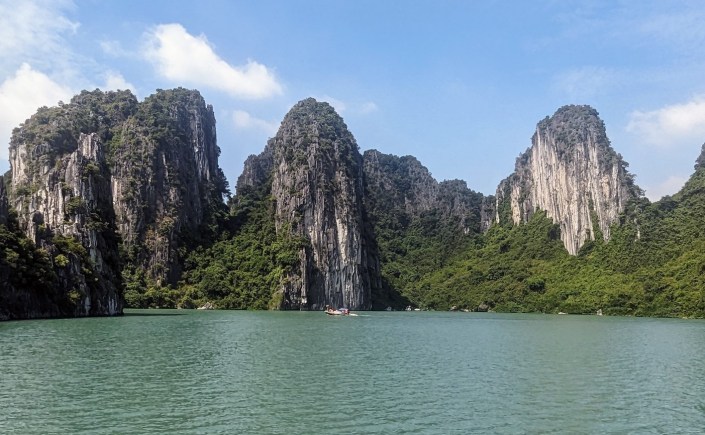
Now it was time to head to the northern part of Vietnam. We flew to Hanoi and rode the bus out to Ha Long Bay. This is the only place on the tour that we had not previously visited! It is spectacular and I am so glad we were able to see it: Ha Long Bay
Finally, we ended up in Hanoi. We were “toured out” by then and so took it easy. We did do a city tour and took a few pictures: Hanoi

So, how did it go touring with a group? As I said in my introductory paragraph, there are plusses and minuses. On the plus side, having someone take care of all the details is wonderful. The hotels were all genuinely nice, and our tour guide Bee was truly knowledgeable and made the trip enjoyable. For us, one of the negatives was not being able to go at our own pace. We like to start our day early and tour places before the crowds arrive. We also like to eat dinner early, and all the group dinners were way past our normal dinner time. I also had a problem with motion sickness on the bus rides, which made things difficult. I also have a tough time when it’s hot and humid out (which is one reason we like to tour early in the day) but on a group tour, you are on a set schedule and are often out in the heat of the day. Given my bus and heat issues, we are rethinking our trip to India in the spring. To end on a positive note, I learned so much about Vietnam from Bee and enjoyed the people we toured with. We are going to return to Hanoi in a few months to spend some additional time in that beautiful city. We will also be in Saigon again as part of our cruise in December.

6 Months in Thailand

After being stuck at home for the past 3 years (except for a 2-month stint in Chiang Mai last year), we decided it was time to tick something off our bucket list: spending an extended period in Chiang Mai, Thailand. We have visited several times previously and fell in love with the city. Ideally, we would have liked to have spent September through March there, but my hip replacement surgery changed our timeline. We arrived in November and stayed until the end of May. Unlike the United States, there are only 3 seasons in Thailand – rainy, hot, and cold. If you add in smoky season, I guess that would be four, but smoky season is just a part of hot season. The cold season is not what most would call cold; the temperatures range from around 60 degrees at night to the mid-80’s during the day. I was a bit hesitant to stay there during smoky and hot seasons but decided to give it a go anyhow.

I have already shared much of what we did during our time in Chiang Mai in previous posts but wanted to share my thoughts after spending so much time there. And I neglected to post anything about Songkran so I will include that in this post as well.

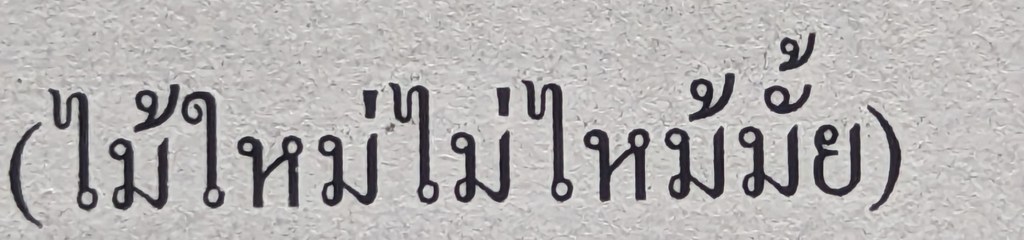
One of the things that a person visiting Thailand will need to adapt to is not being able to read or speak the language. Now, I know that some visitors can, but I am not among them, nor is Clayton. The alphabet is completely different than ours; it contains 32 vowels (short and long), 44 consonants (split into 3 classes) and 4 tone marks (high, low, rising, falling). There is also a neutral tone, but it does not have a special mark. So, to read Thai, one needs to be able to read the letters (and there is no spacing between words; only a space at the end of a sentence), translate the Thai letters into Latin-script letters, and then understand what the word means. To speak Thai, add in the correct tone so that a Thai can understand what you said. I have provided much glee among the Thais that I have attempted to speak to. They giggle uproariously at my Thai! As an example, here is a simple sentence in Thai (the marks above some of the letters are tone marks):

Here it is in Latin-script alphabet:

Each “mai” is pronounced differently! The meaning of the sentence is “New wood doesn’t burn, does it?”. But you knew that, right? LOL!

Google Lens has provided to be an invaluable tool. After opening the app, you just point your camera at something written in Thai, and it translates it for you. It is not perfect, but it is tremendously helpful.

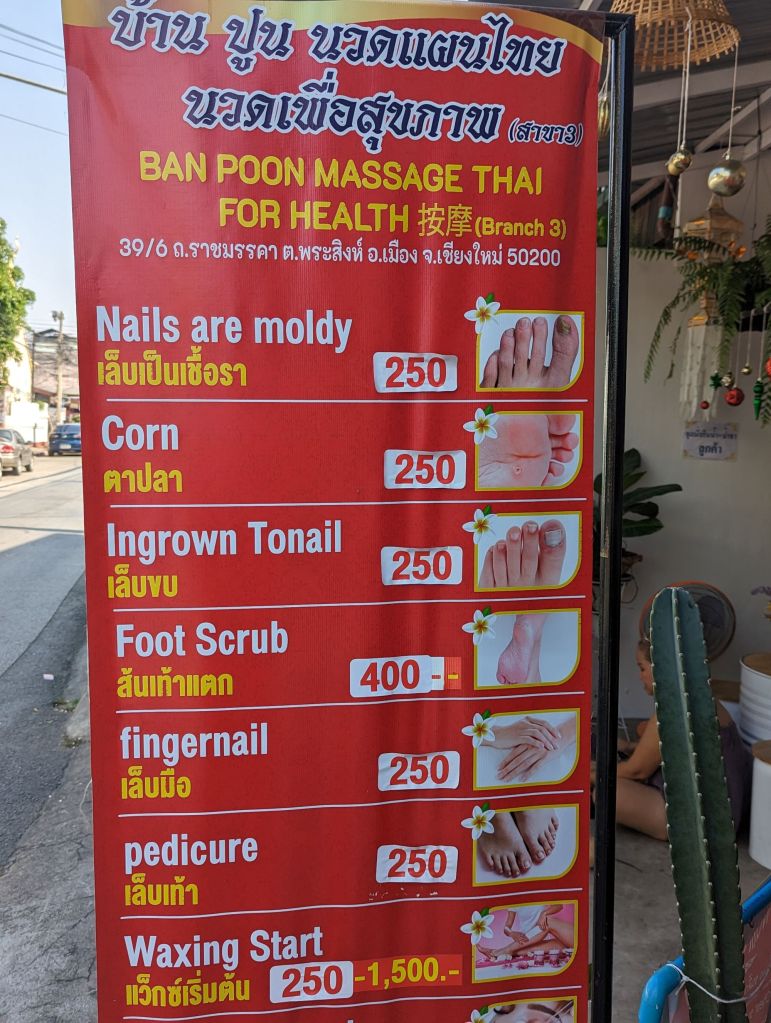
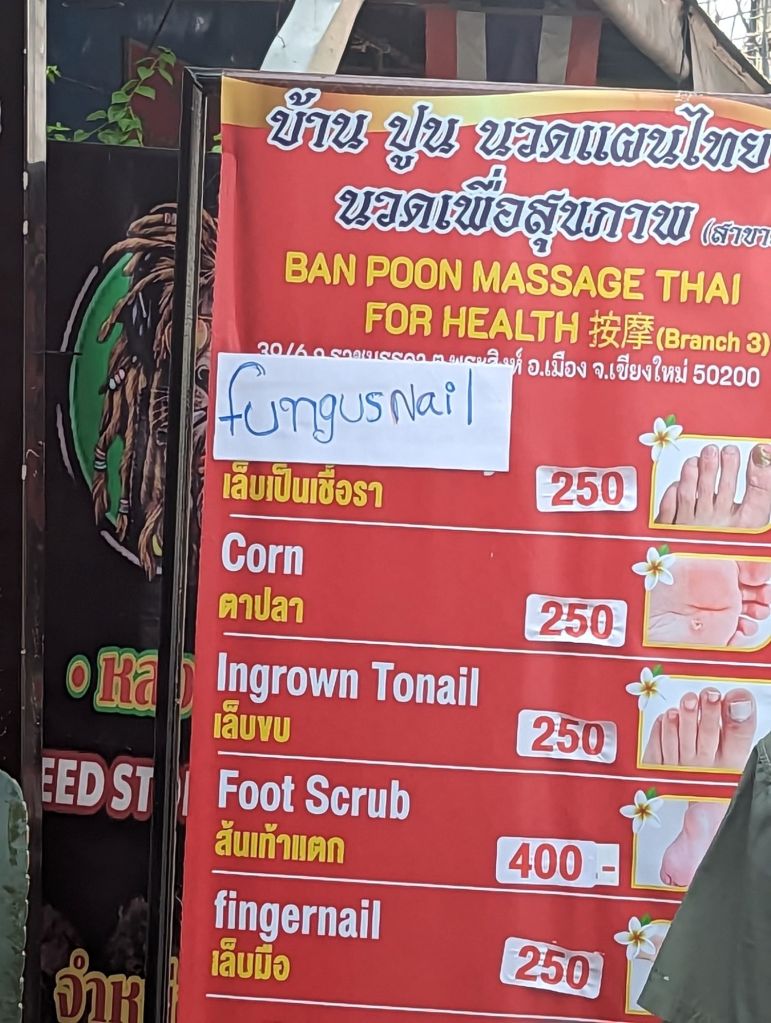
Clayton’s barber shop advertises a butt shave, according to Google Lens. I am assuming this is not an accurate translation, but you never know! I thought the translation for the first item at the nail salon wasn’t quite right but came back a week later and it had been fixed. So much better!

Google Translate works OK, too and allows you to have an actual conversation in a different language. Some of the translations are “interesting”.

Shopping was a bit of a struggle when we first arrived. And then we discovered Lazada – the Amazon of Thailand. My first purchase was a hairdryer. I thought the price was a misprint – $2 for a full-sized hairdryer. I figured I couldn’t go too far wrong by trying it out (shipping added another $1) and so if a toy hairdryer showed up, I wouldn’t be out too much money. Imagine my surprise and delight when a “real”, fully functioning hairdryer appeared a couple of days later. The delivery guy called when he arrived (they actually still do COD in Thailand, though I always paid for my purchases in advance). Since I had success with that first purchase, Clayton and I found all types of things we could make use of; all at bargain basement prices. Some of the items came from China, which added about a week to the delivery time. But still, the convenience couldn’t be beaten. When we stayed for two months last year, there were things we just did without. For a 6-month stay, we decided to purchase some items that would make our lives easier. The front desk guy at our apartment would hold our purchases for us so we didn’t need to be home to accept delivery.

Our day-to-day shopping was done at the fruit and vegetable market by the Chiang Mai gate. Every couple of weeks we made a pilgrimage to a “real” grocery store to pick up items that weren’t available at the fresh market or the small grocery store near us. I don’t want you to think that I did any actual cooking (one of the best parts of living in Thailand), but we did like to have breakfast and dinner in our apartment so that we didn’t eat out for three meals/day. Breakfast was typically eggs and toast or oatmeal, served with lots of tropical fruit. We ate lunch out daily. By the time we left, we had found our favorite places for our favorite Thai foods and rotated between them. Dinner was typically a sandwich and yogurt. We like to eat light in the evenings.

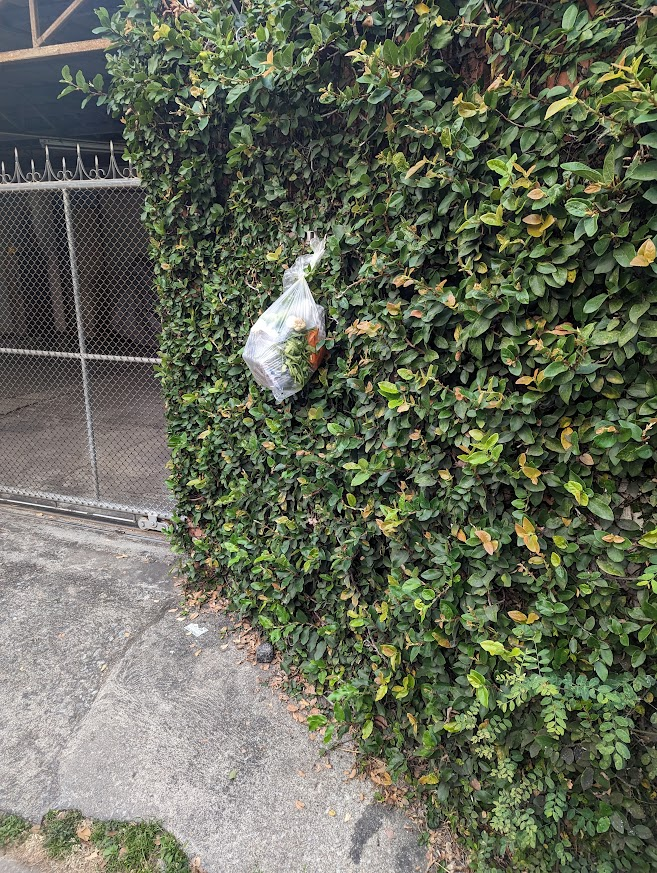
There were some definite differences in our daily life in Chiang Mai compared to the US. Garbage was put in plastic bags and tied to a fence. Our apartment had garbage cans, but that was atypical. The garbage was picked up by the garbage men who then often sat on the bags of garbage.

There were certain days that alcohol was not sold, either in restaurants or stores. Most of these were tried to Buddhist holidays but it was also true on election days. Incidentally, alcohol cannot be served in Chiang Mai between the hours of 2 pm to 5 pm. Apparent too many people were showing up drunk at work…

Fashion-wise, it was very much a mixed bag. Most people wore what they could afford, which meant that you saw the most interesting combinations of colors and patterns. In general, Thais dress very modestly. You don’t see many in shorts and/or revealing tops. Most wear long pants and long-sleeved shirts. Add to that a sweatshirt, even in over 100-degree heat! Occasionally, you see people in pajamas. I have been told that it is a sign of wealth. If you can afford special pajamas, you are upper-middle class. There is a minimum wage in Thailand, but it is just over $300 US per month. Social security exists as well, but only pays 600 Baht/month, which is around $20. The amount increases with age and tops out at 1000 Baht/month if you are over 90 (around $30). Most elderly Thais live with family. Obviously, even with the lower standard of living in Thailand, $20-$30/month isn’t sufficient for anyone to live independently. You often see older people working. Every day, we walked by an elderly woman grilling bananas and selling them for 10 Baht/each. She was a sweet little lady and always offered me bananas with a big smile. I nicknamed her “Nana Banana”. I tried one and let’s just say that it is an acquired taste. There are two types of bananas in Thailand – the kind you are probably familiar with, and the smaller, cooking bananas. She grilled the cooking bananas which are not as sweet. Grilling them gives them a leathery texture. I always felt bad turning down her bananas but didn’t want her to waste them on me since I didn’t really like them.

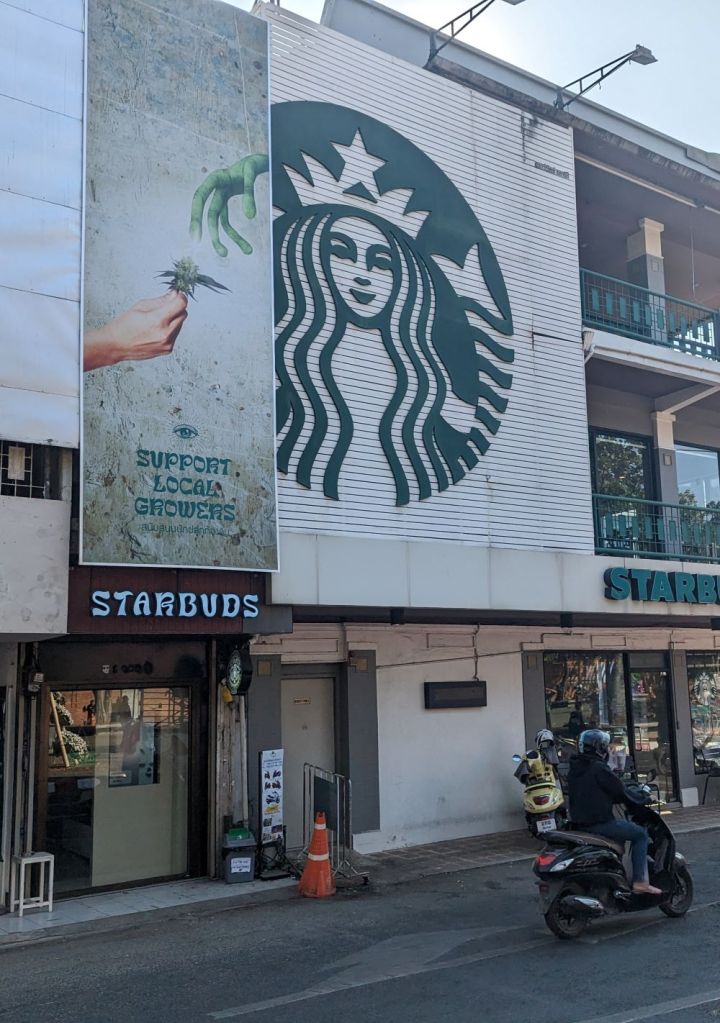
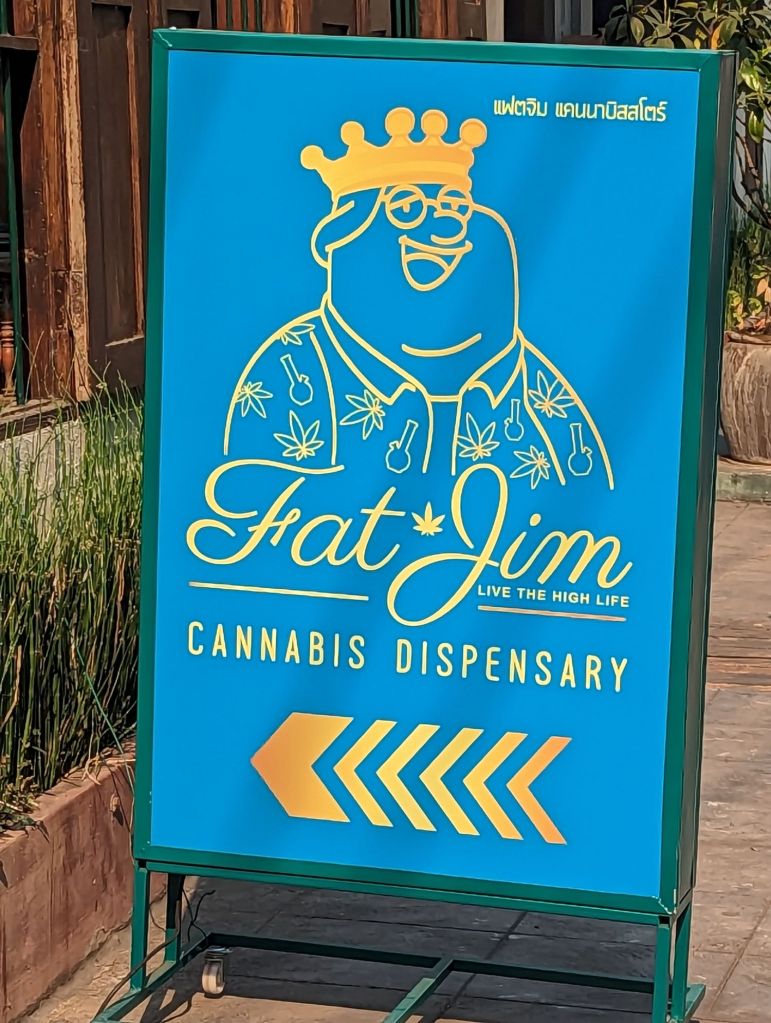
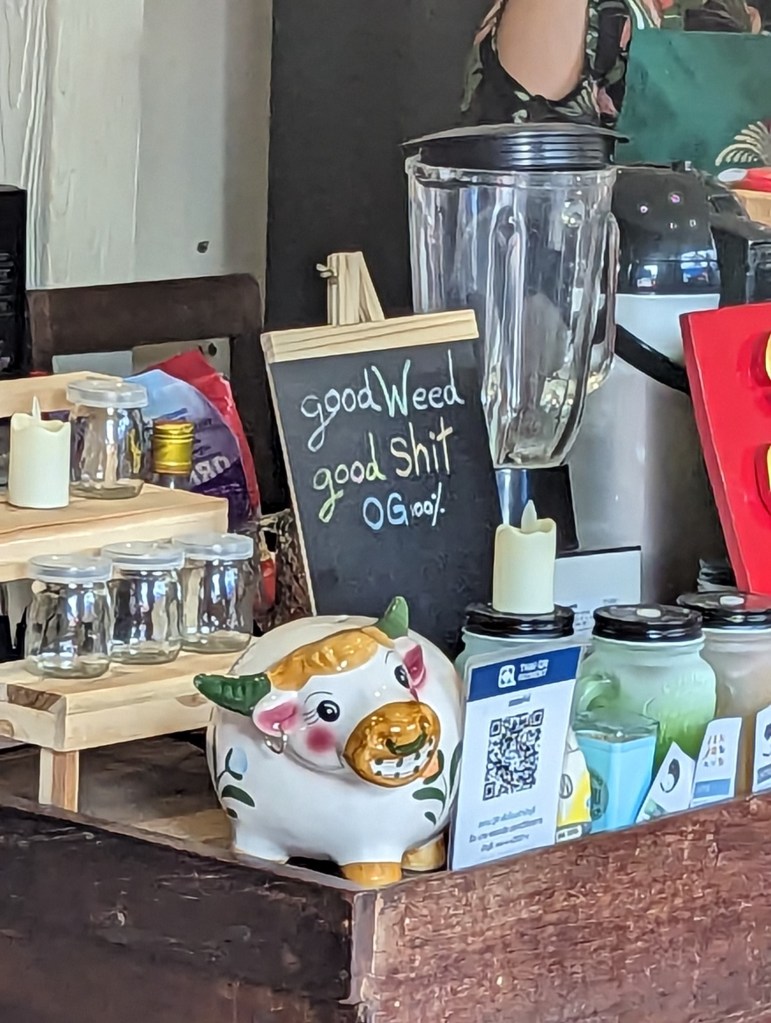
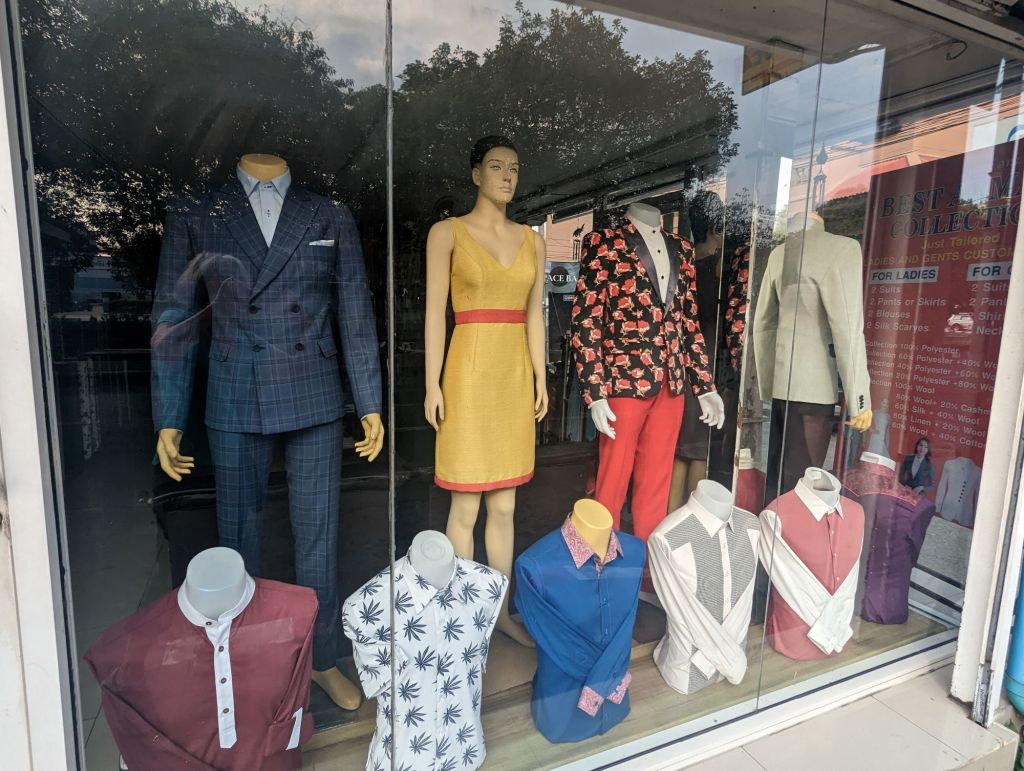
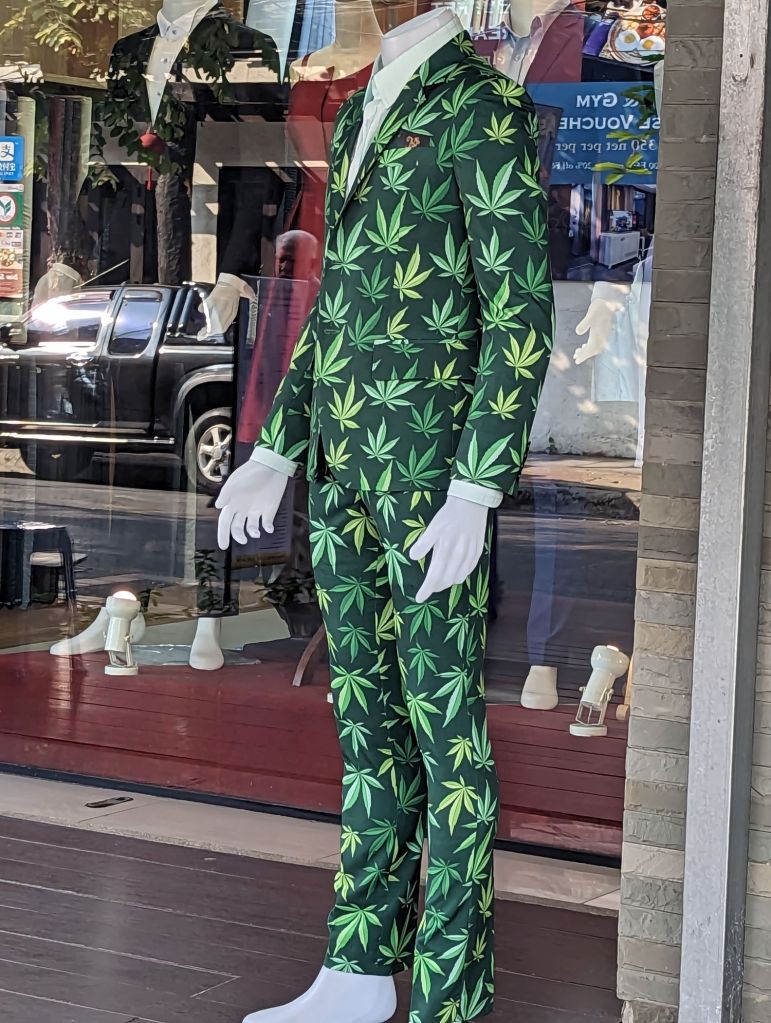
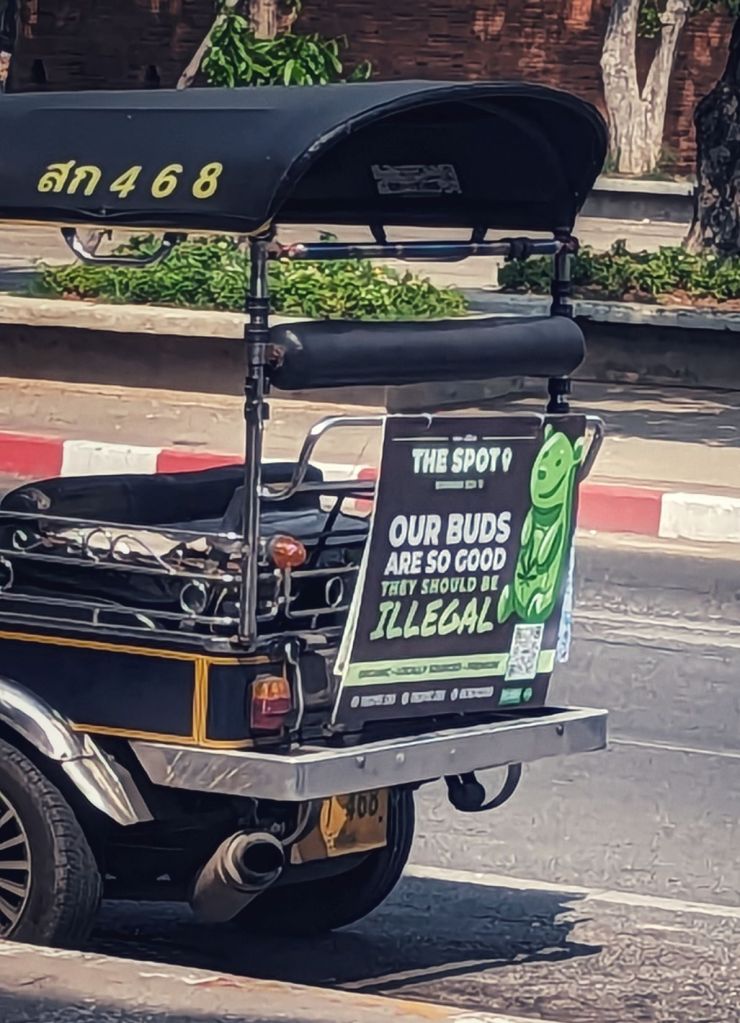
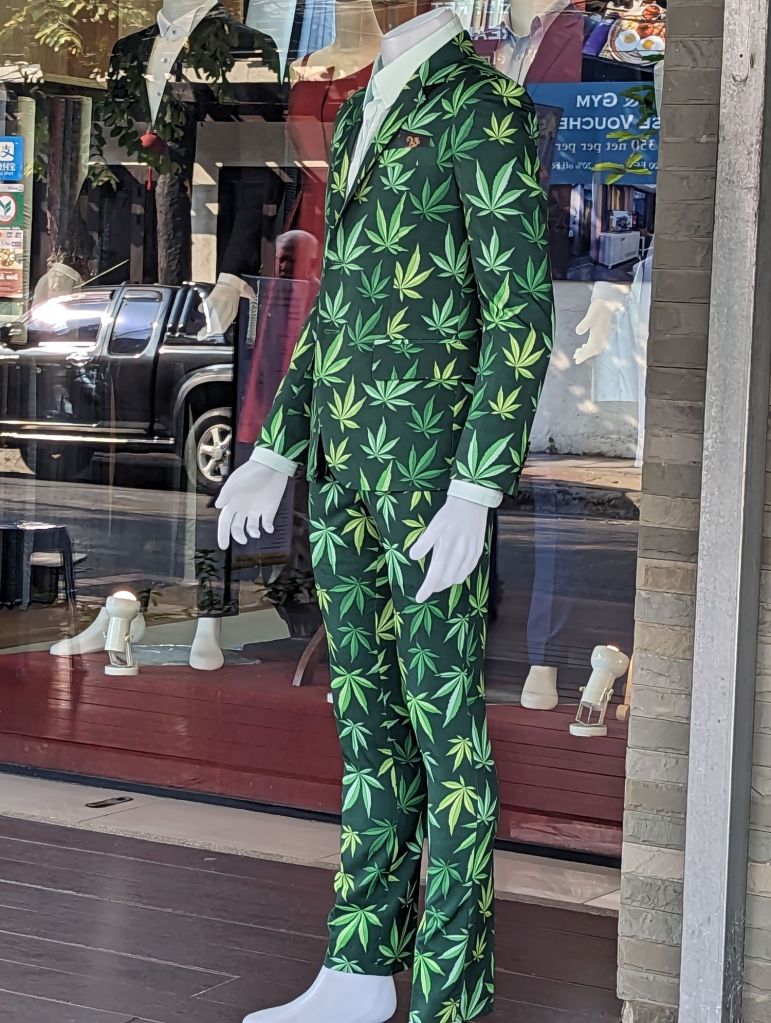
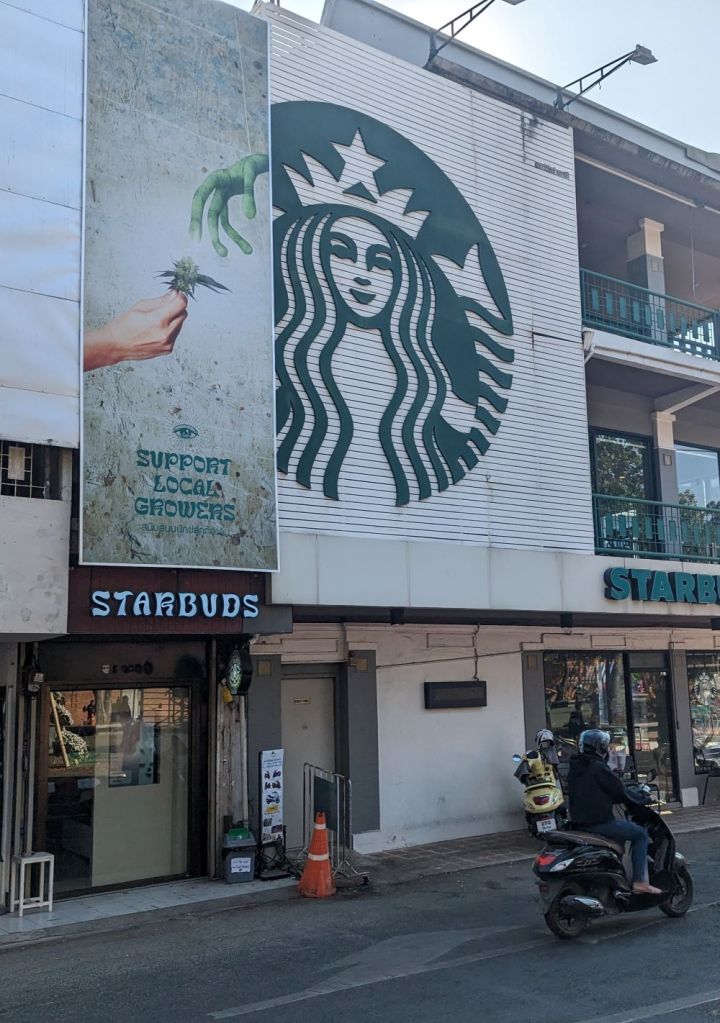
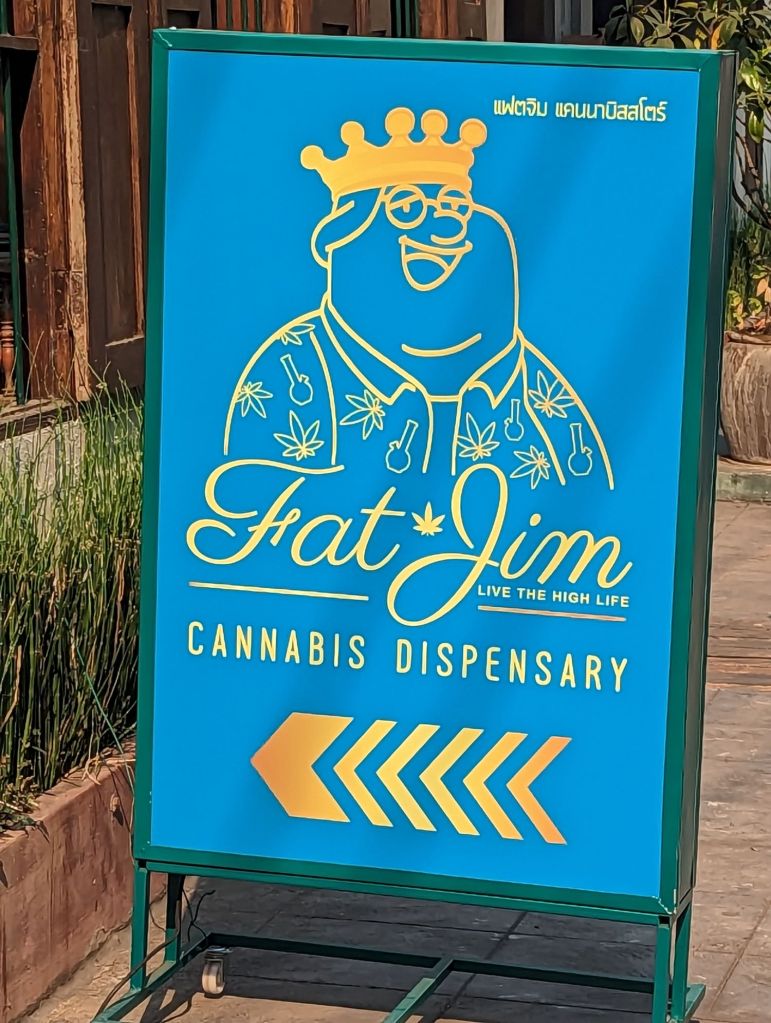
Marijuana was sort-of legalized last year and so the number of pot shops blossomed. Pot is legal in Washington state, where we live, so it was no big deal to us. But, for many of the British and Aussie backpacker set, it was a big draw. There were streets lined with pot shops near the main tourist part of town. One of my coffee shops got in on the action. Sadly, the Star Buds store wasn’t in business for long, though I do appreciate the name and location! Even Armani got into the game, fashion-wise. Not to be outdone, this haberdasher designed this fabulous suit.

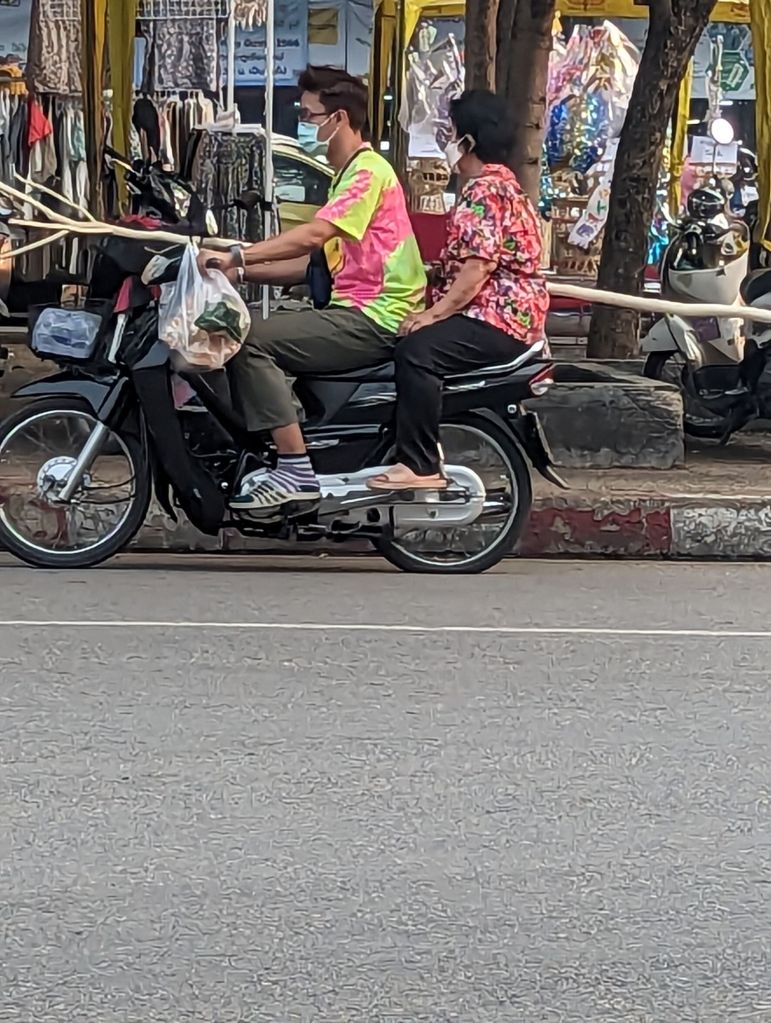
We learned to “drive like Thais”; in other words, to drive as if no traffic laws, signs, or signals exist. We became immune to seeing two-year olds “help” their parents steer their motor scooters. It became common to see four on a scooter, the family minivan of Thailand. People drive what they can afford, and not everyone can afford a car. Scooters drive right through the markets – why walk when you can ride? Whilst riding, we became used to cars pulling out in front of us (without signaling), other scooters passing us on the left and right within our own lane, scooters driving really fast (typically, the food delivery drivers) or really slow (tuk-tuks, scooters with sidecars attached that haul goods, multiple people riding a 110-cc bike, etc.).  As scary as the other scooter drivers are, the car drivers are even scarier. I may be completely off-base, but I think that since most Thais grow up riding scooters that being in a bigger vehicle throws off their depth perception in gauging distances. It’s crazy getting behind a car turning. Most come to an almost complete stop before making a turn and then either turn wide or cut the corner. Or the exact opposite – typically a young guy in a big pickup driving like a bat out of hell! The excitement comes in by trying to anticipate what everyone around you is going to do and to be prepared for all eventualities.

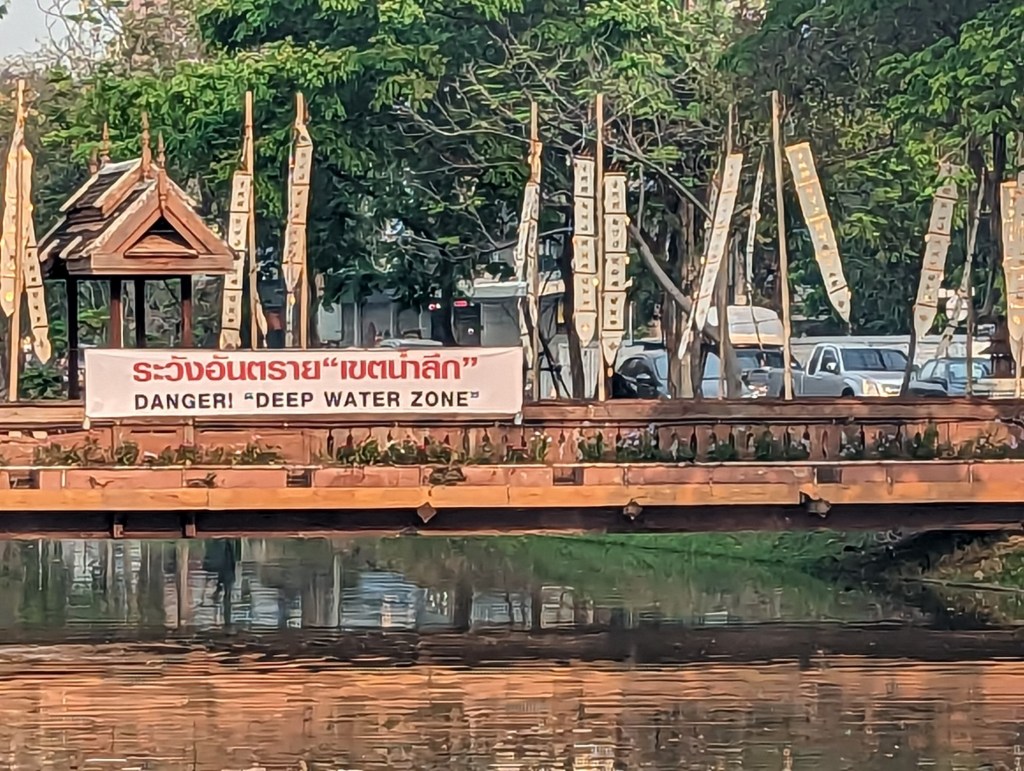
Our first few months were idyllic – the weather was fantastic. In the mornings, the temperature was typically in the 60’s to low 70’s. By late afternoon, it warmed to the mid-80’s and then cooled off after the sun went down (between 6:30 and 7:00 pm). It was perfect weather for walking. We took morning walks, midday walks (to get lunch) and evening walks. And then, in February, smoky season started. Farmers burn their crops at this time of year. Usually, it is worst during the months of March and April. This year, it started early and lasted longer. It is illegal to burn, but that doesn’t stop anyone from doing it. Besides, farmers from surrounding countries burn crops, so even if Thailand managed to quash the habit, there would still be smoke. Locals told us that this was the worst burning season in years. Chiang Mai topped the “world’s most polluted city” list for weeks on end. To make matters worse, hot season kicked in in April. So, besides the nasty smoke, the temperature hovered around 105 degrees daily. We returned to wearing masks outdoors. It helped keep us breathing and helped keep the crud out of our lungs. We ran an air purifier day and night. We also had to run air conditioning 24/7 because of the excessive heat. It did cool down at night, but the temperature only dropped into the upper 70’s to low 80’s. Sadly, our lovely daily walks had to end. From what I read in the news, this was the worst heat wave SE Asia has ever seen.

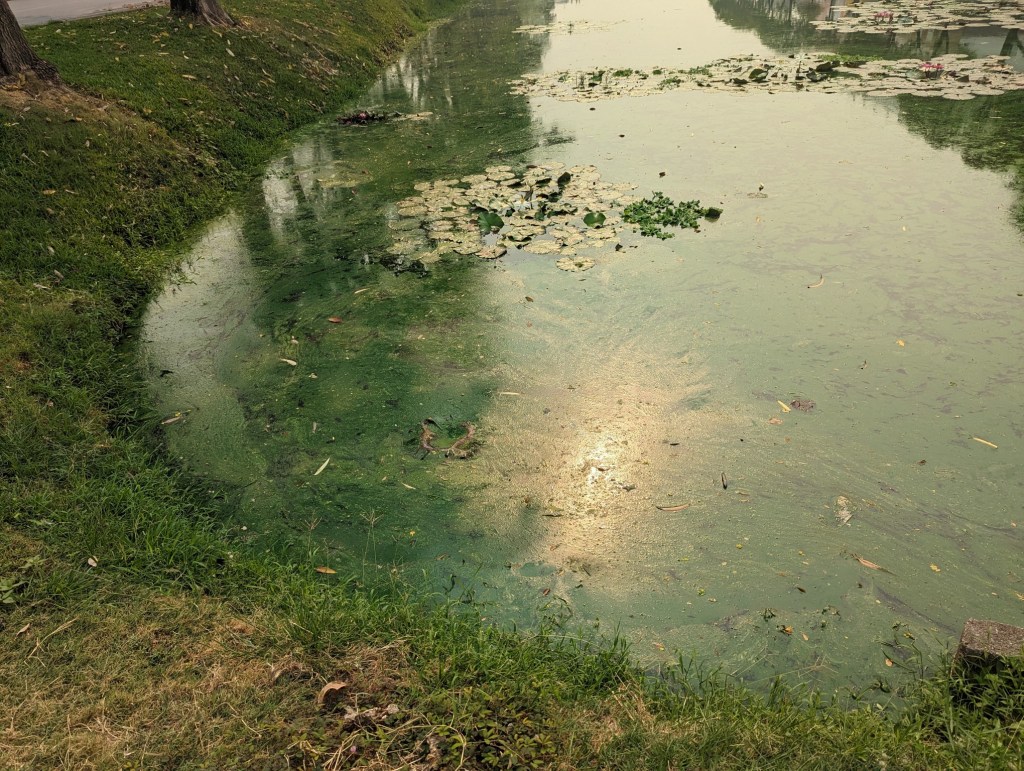
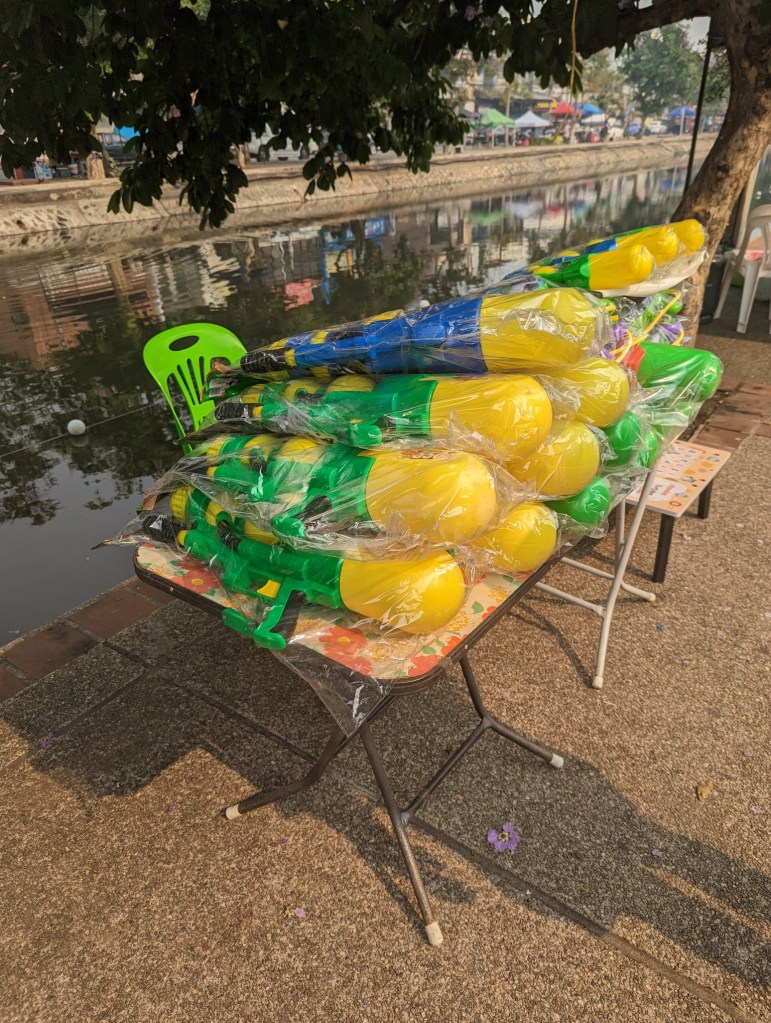
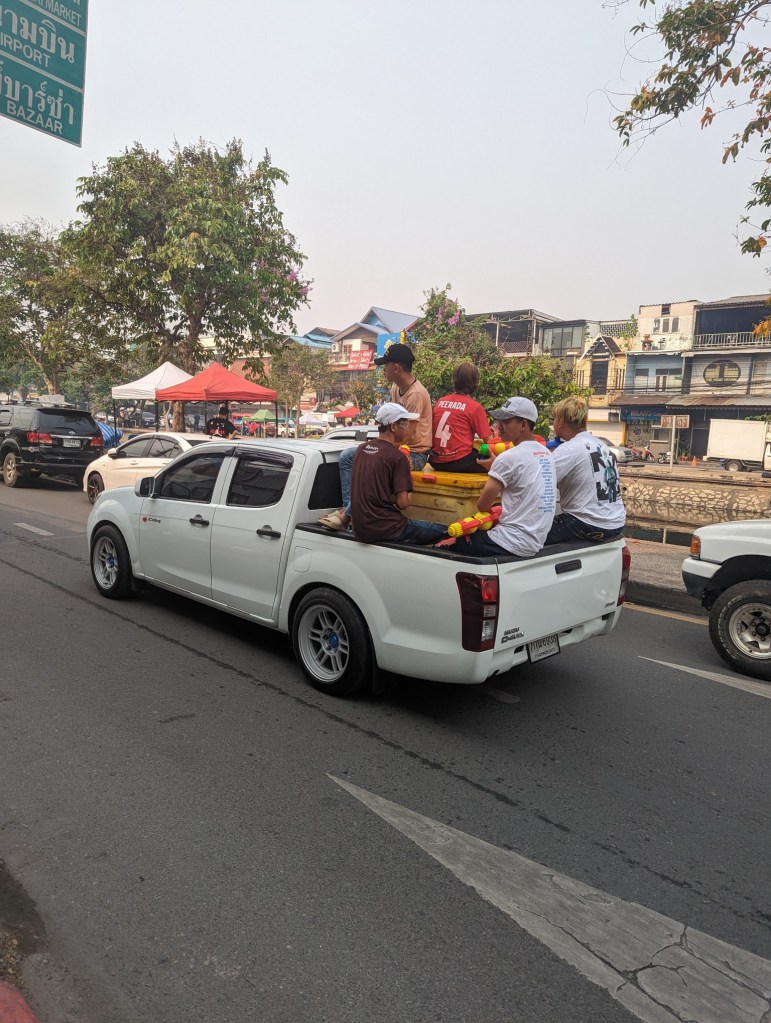
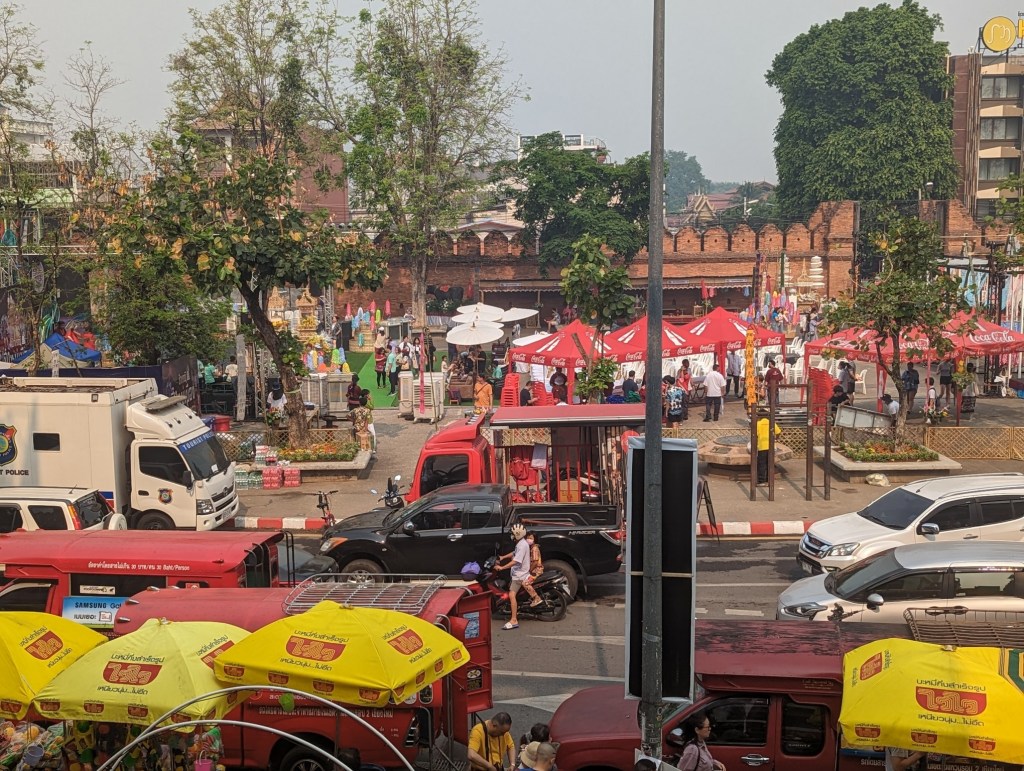
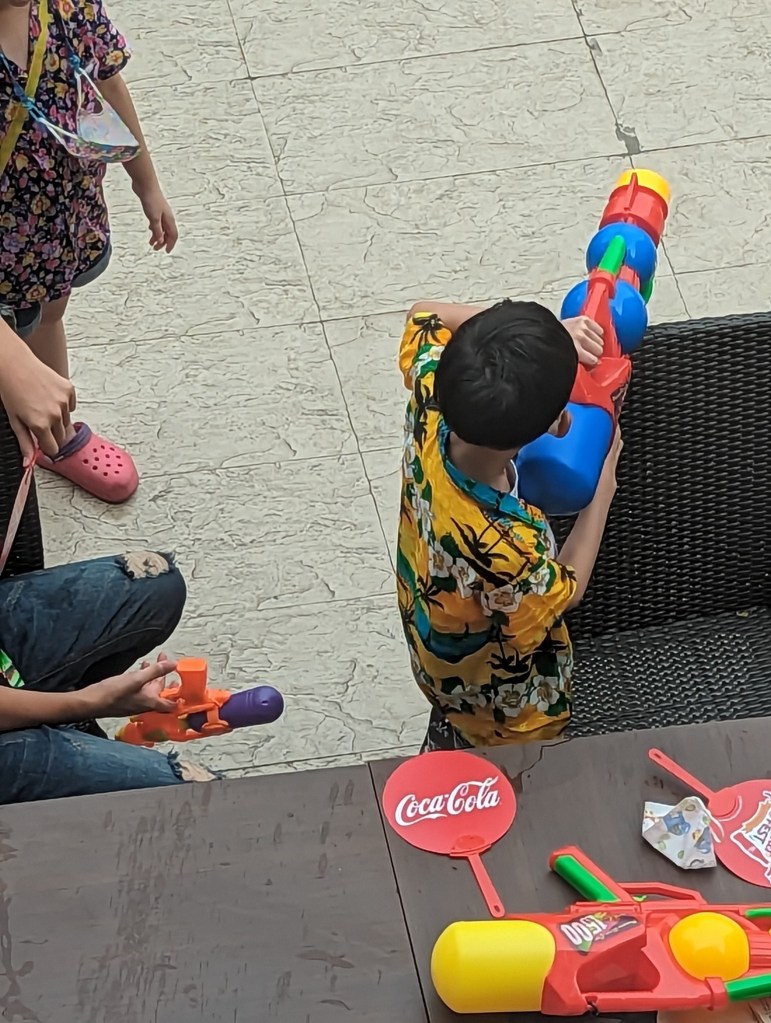
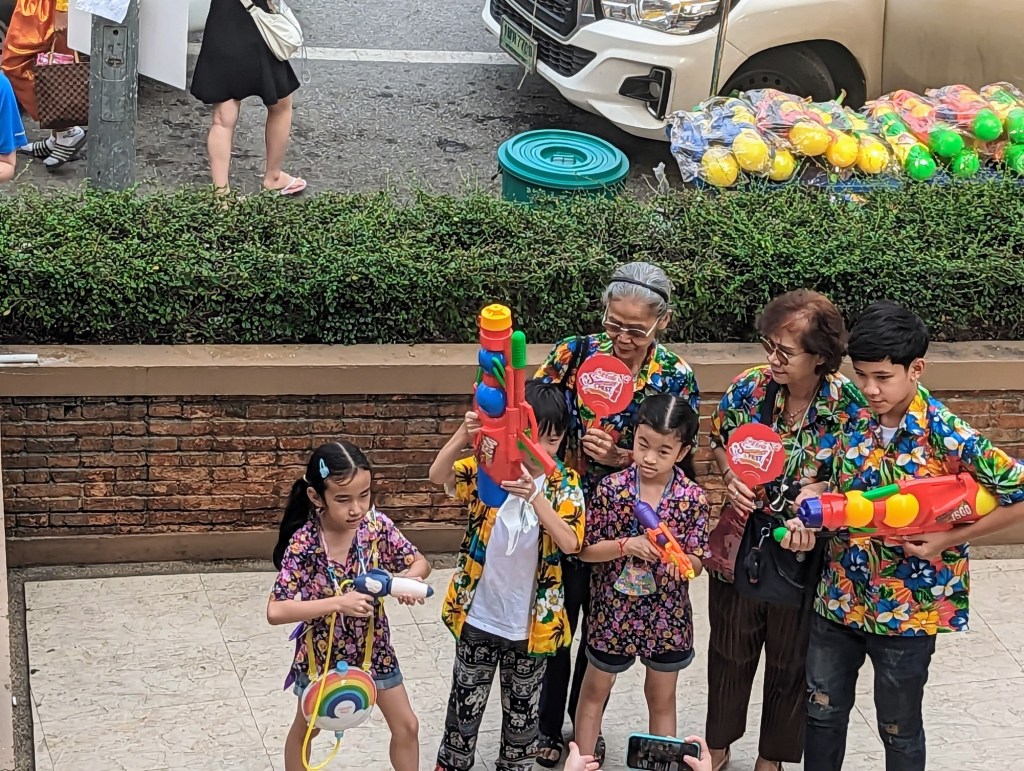
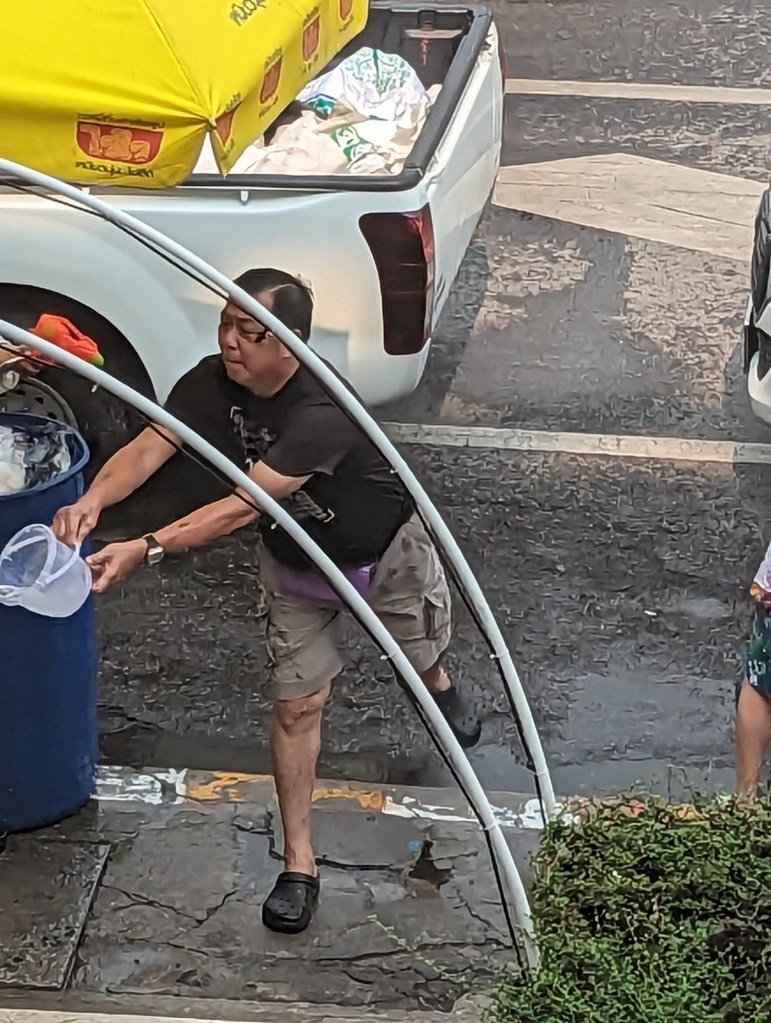
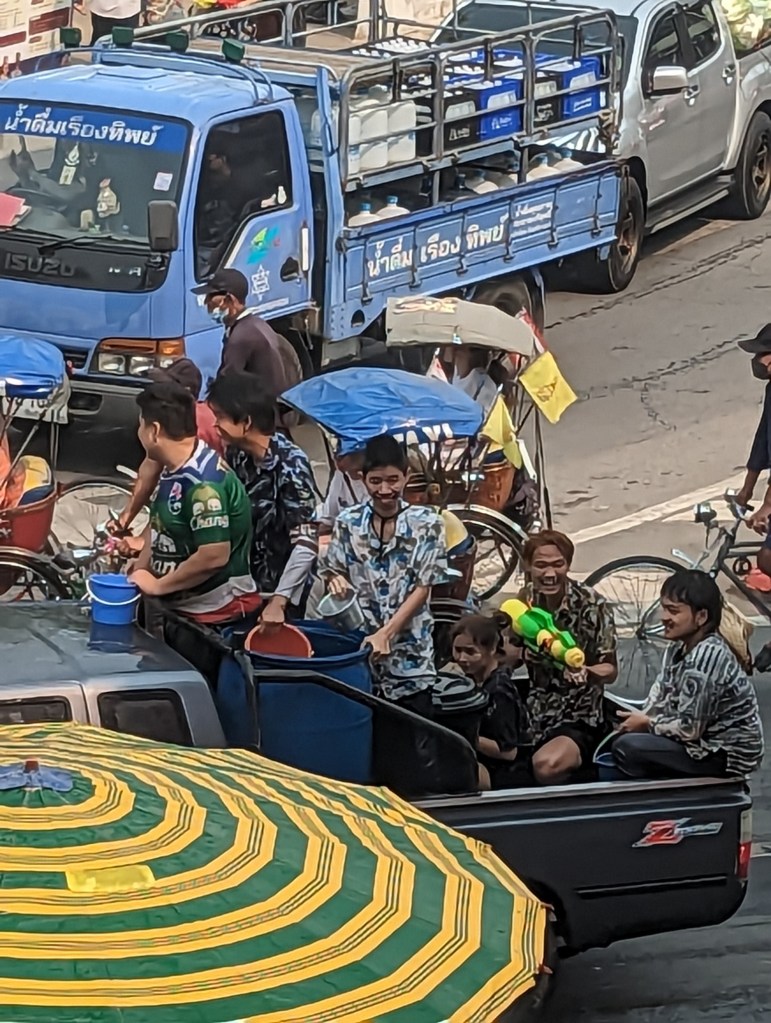
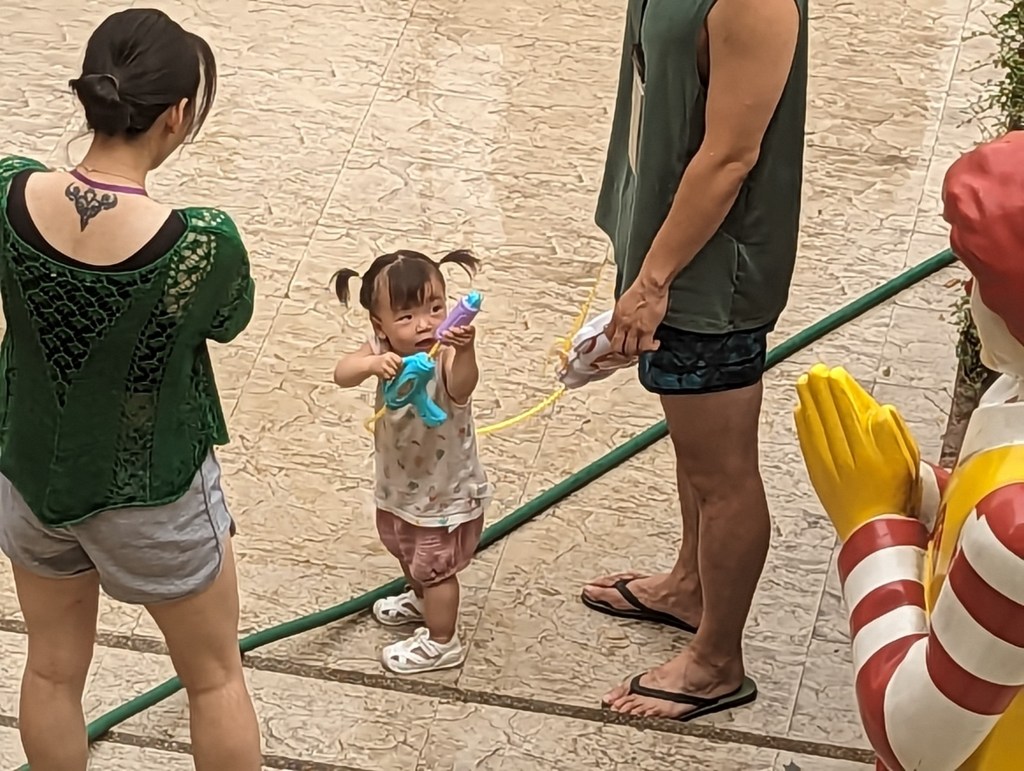
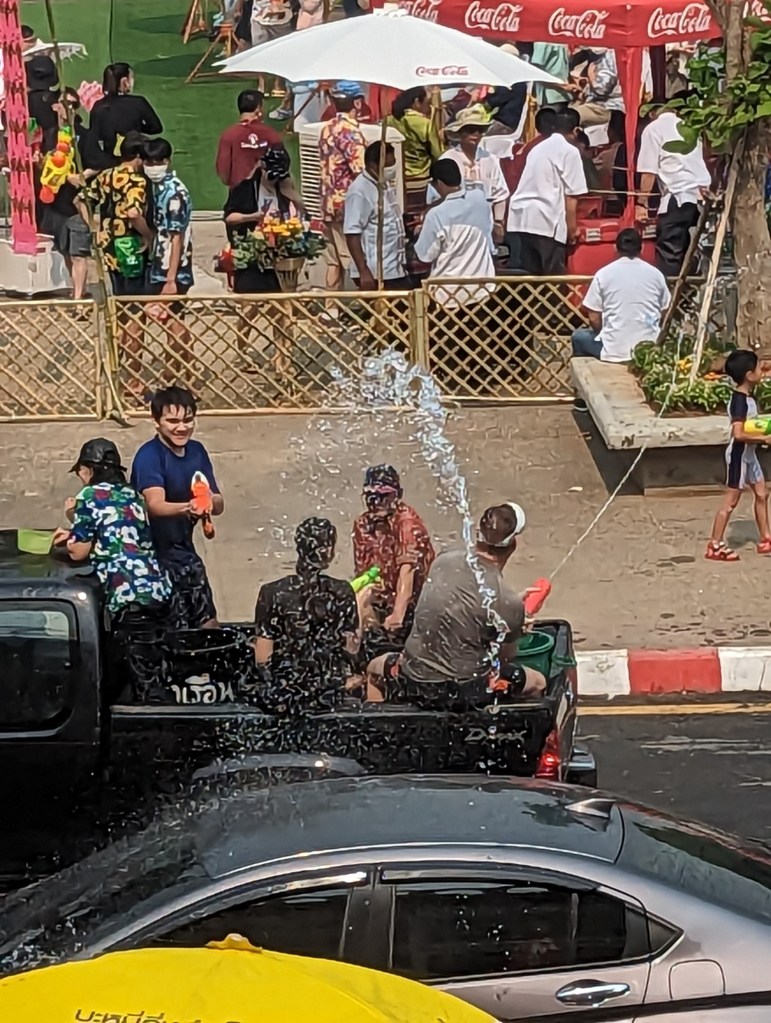
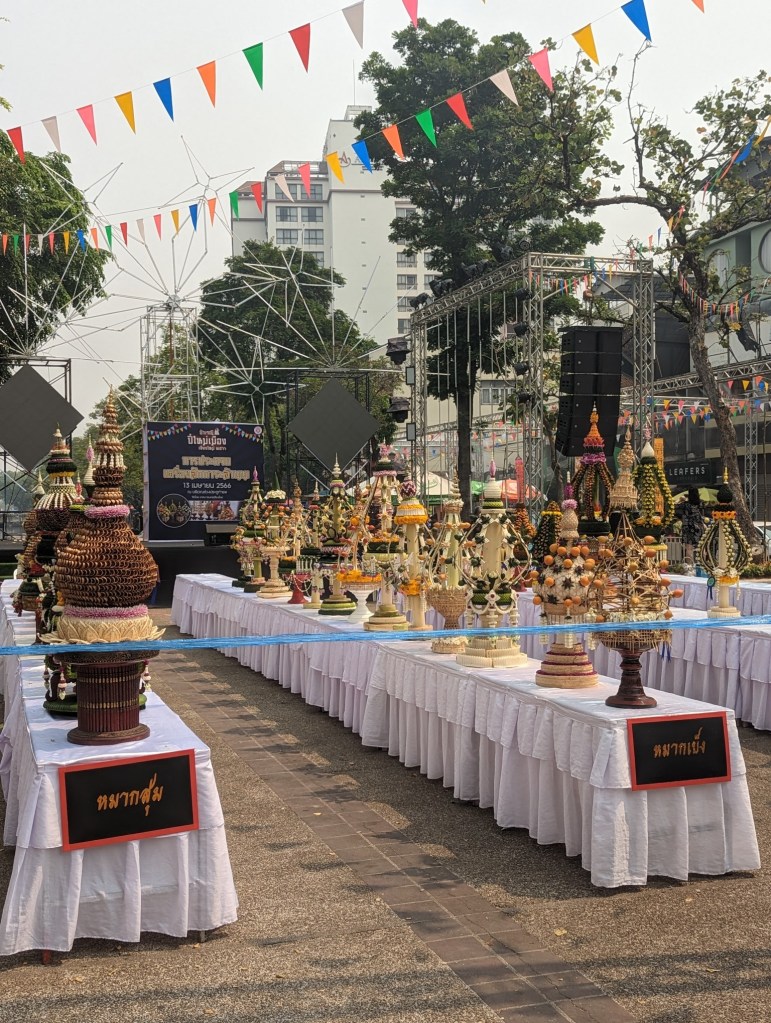
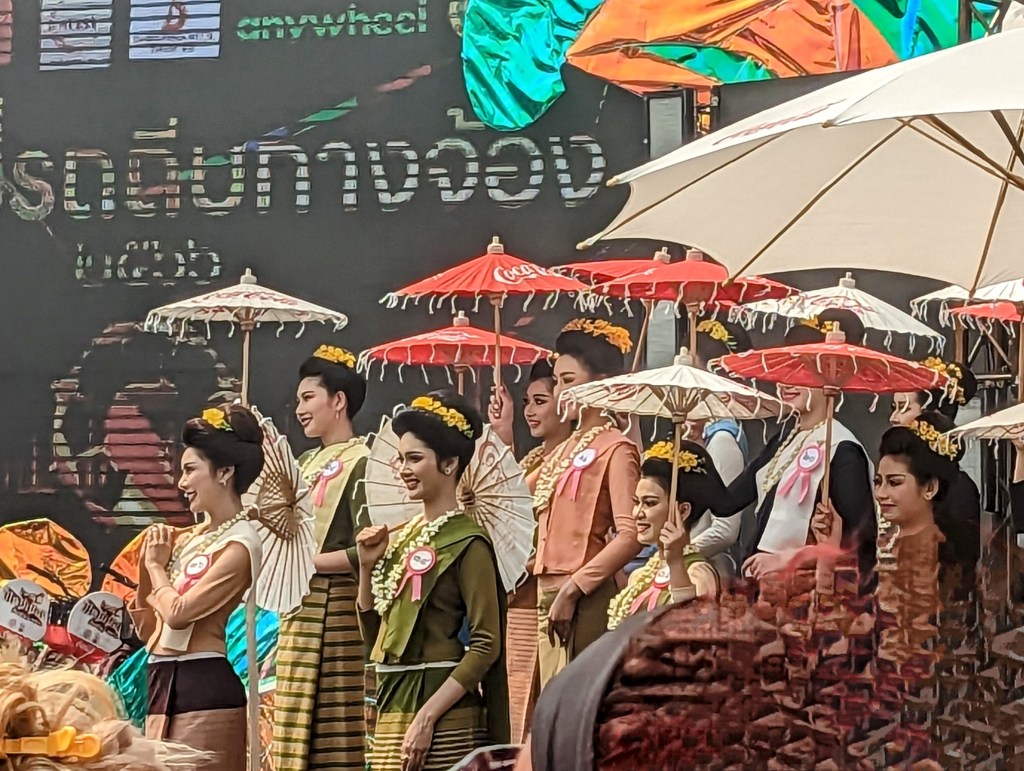
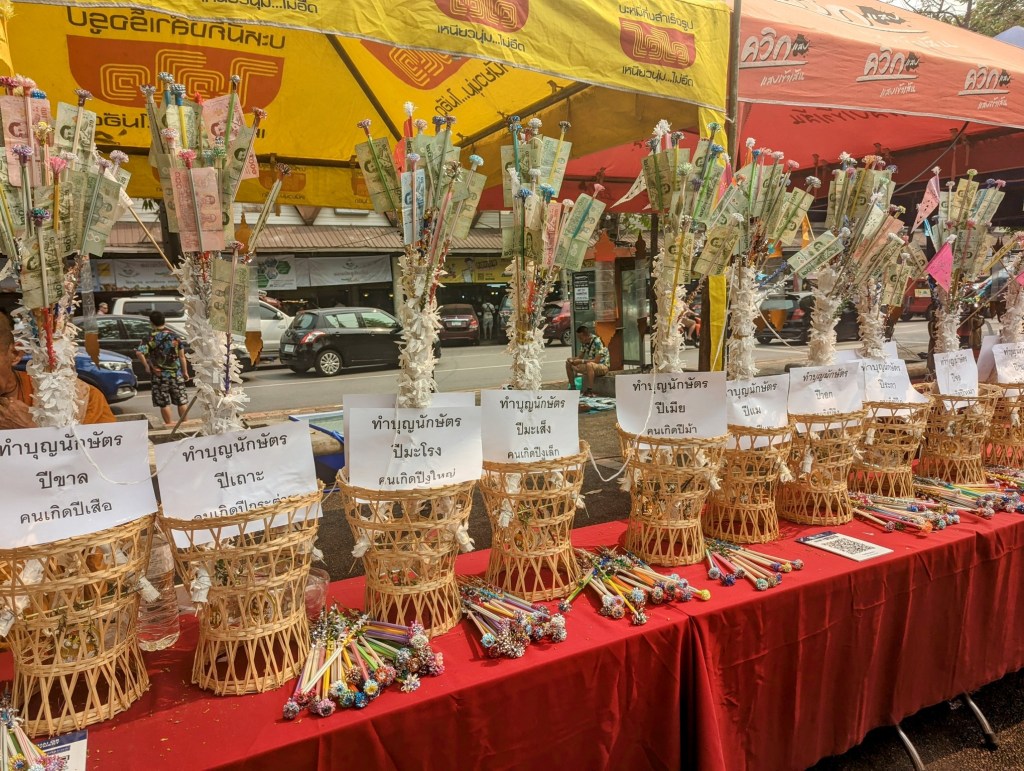
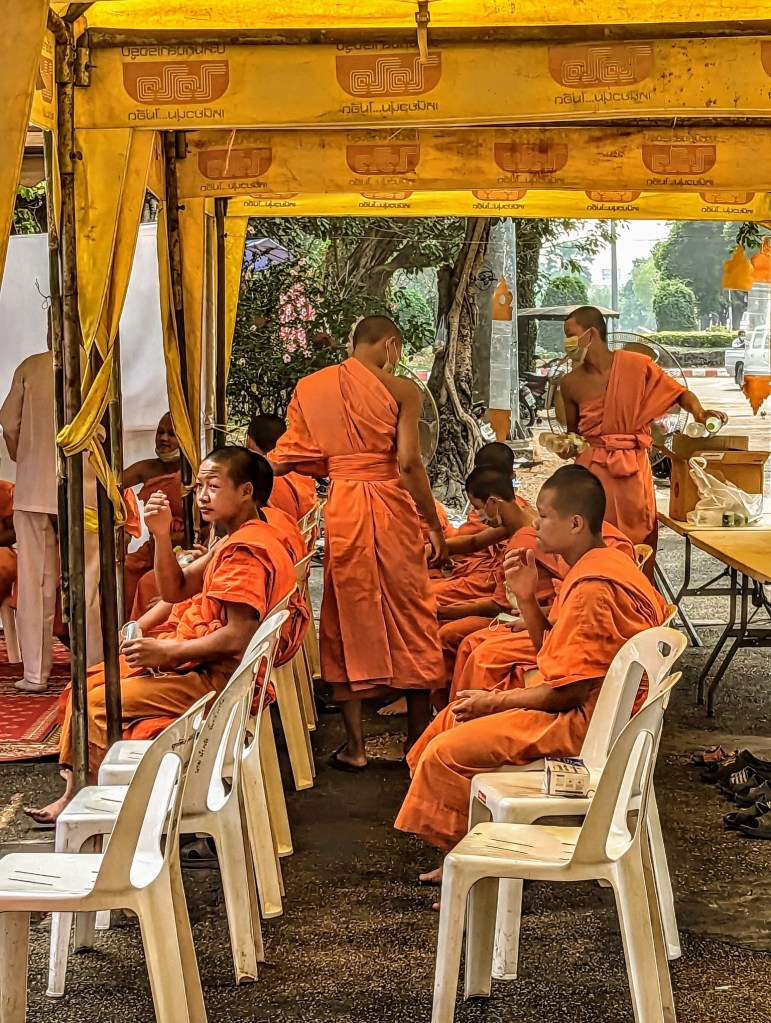
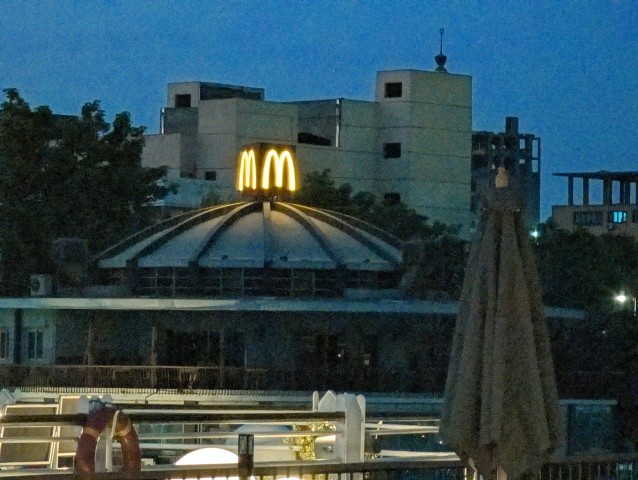
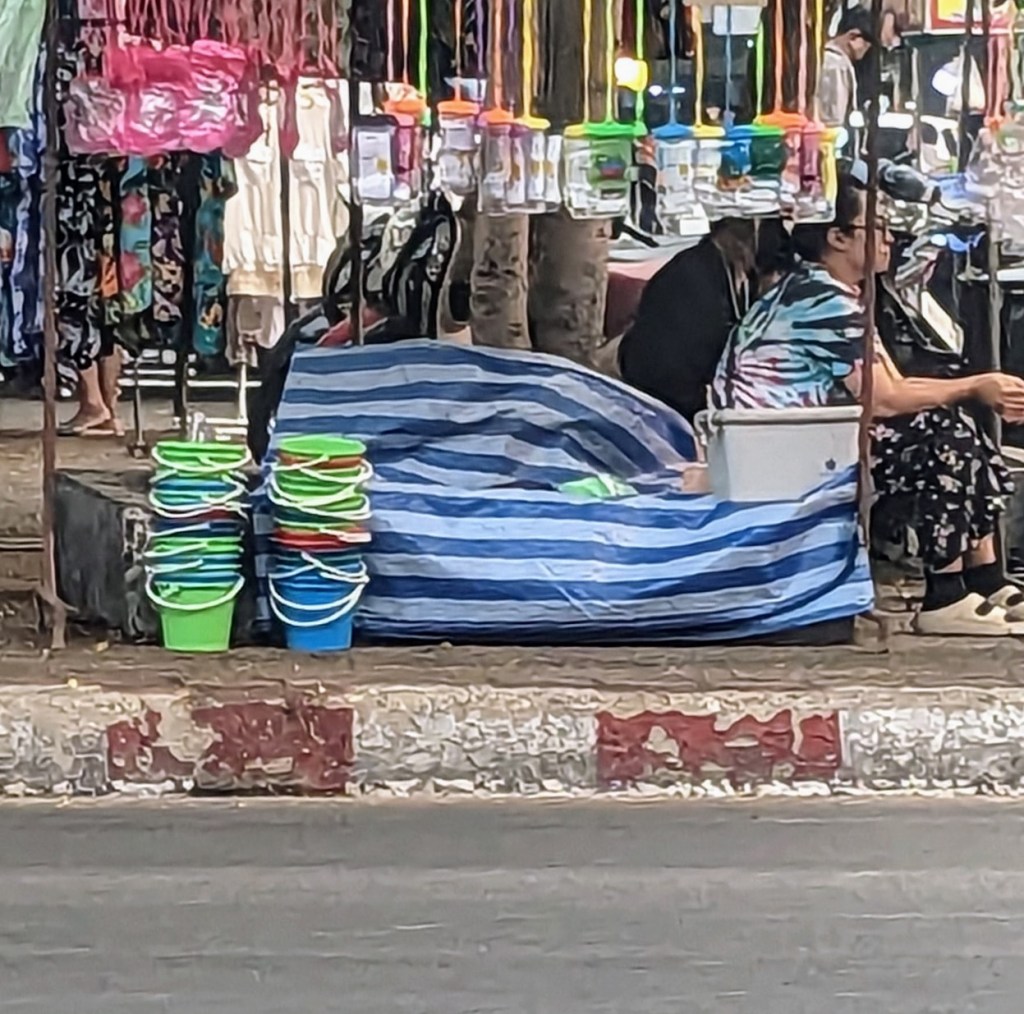
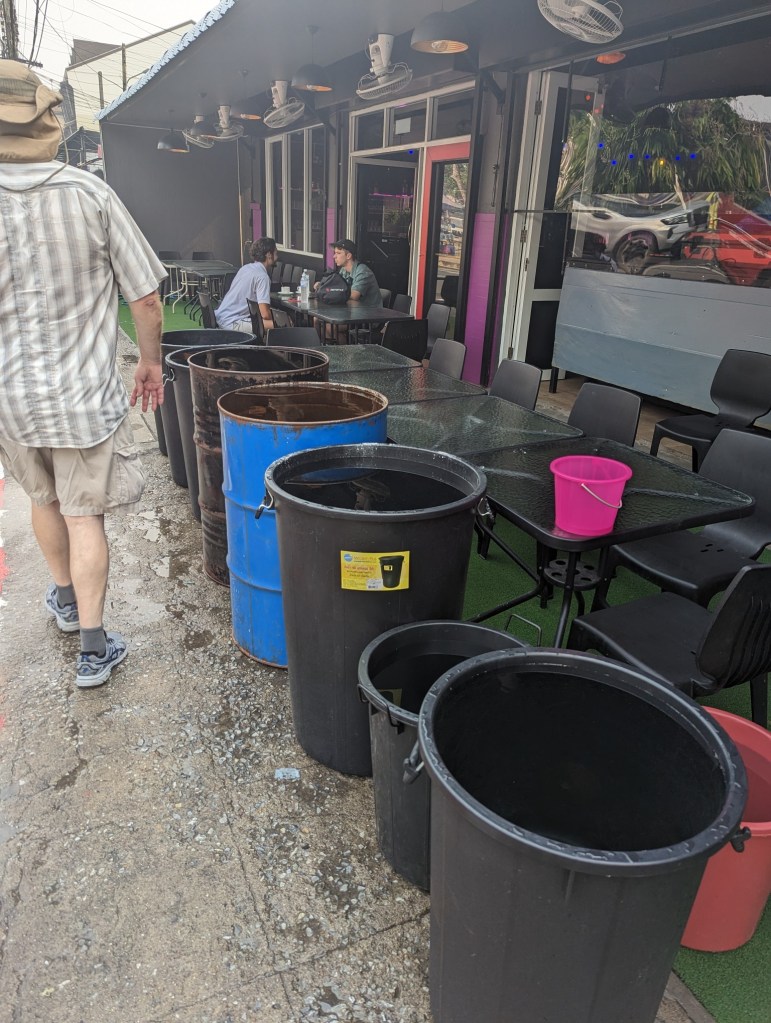
In the middle of this record-setting hot spell, Songkran happened. Songkran is the Thai New Year, which is celebrated over 3 days (or more!). If you have seen pictures of the world’s largest water fight, you have seen Songkran! It is a much deeper experience for Thai people than just super-soakers, though. The roots of Songkran are in the Buddhist faith. The faithful here go to their local Wat (temple), pour water on elders’ hands, spend time with family, and of course, go crazy with water! A week before Songkran, we started to see signs of the upcoming festivities. We had seen pictures of the craziness and really didn’t know what to expect. Friends had told us that the locals used water from the moat that surrounds the old city to refill their water guns. Gross, gross, gross. The moat water is not clean, and we weren’t too sure that we wanted to be a part of that. But we did want to experience a little bit of fun, so the first morning of Songkran, we walked to the Tha Pae Gate area. All along the moat, there were booths set up selling buckets, water guns, masks, cell phone protectors, and all sorts of accoutrements related to the festival. There was supposed to be a “Thai women in traditional dress carrying umbrellas while riding bicycles” competition and so we set up shop on the 2nd floor of the McDonalds across the street. We had an excellent view of the action – garbage cans filled with water lined the streets and if you walked or rode by, someone would throw buckets of water on you. There were pickups filled with young people shooting you with their super-soakers and people with hoses spraying those that walked by. One thing we did not see was anyone using moat water. Lots of local businesses provided water for refills. Despite the signs, we never saw anyone in the moat, either.

Everyone was having so much fun that we decided to join in. Incidentally, due to Covid, this was the first Songkran Festival in three years, and so people were really letting loose! We didn’t have water guns but were happy to let others soak us. Clayton made it a special point to let the little ones spray him. Given the excessive heat, it felt great!

Thank you Chat GPT for producing this lovely Songkran Rap:

Yo yo yo, it’s time to celebrate
The Thai New Year with a splash of fate
Songkran is the festival of water and fun
When you can soak anyone under the sun

It’s a tradition that goes back to ancient times
When people sprinkled water as a sign of good vibes
Now it’s a massive water fight in the streets
With buckets, hoses, and water guns on repeat

But Songkran is more than just getting wet
It’s also about respect and gratitude, don’t forget
You can visit temples, make offerings, and pray
Or wash the hands of elders and monks in a gentle way

Songkran is a time to cleanse and renew
To wash away the bad and welcome the good
So grab your friends, family, and strangers too
And join the party of Songkran, the coolest thing to do!

Thai school children have their summer break during hot season, which makes sense. School starts up again in mid-May, which is when smoky season finally ended. There were some fabulous thunderstorms around then as well. I attempted (unsuccessfully) to upload a couple of videos I took of the rain; I have never seen anything like it, and I have been in tropical storms before. Within 5 minutes, the street in front of our place had turned into a river. Crazy!

Will we be in Chiang Mai during the smoky and hot season again? Not on purpose. Once was enough. We will return in September after spending the summer back in Seattle. It will be rainy season when we go back, but in the northern part of Thailand, that means one or two rainstorms daily, and nice weather in between. We will miss the lovely people of Chiang Mai while we are gone. We had lots of hugs and tears when we let people know that we were leaving, but that gives us that much more to look forward to when we return. Thais are known for being warm and friendly. We certainly experienced that, and it is one of the main reasons why we love the area so much.

When we return in September, we have a few side trips planned that I will be writing about. We are taking a trip to Vietnam in October, a cruise in December, and a trip to India in February. More adventures ahead!
Sawadee kha from Chiang Mai!
We are still loving life here and plan on returning next September. I have taken a couple of tours, which shockingly (not) revolve around food! We also took a train journey to Bangkok, and then continued to Kanchanaburi. Other than that, life continues as normal:

  • lots of walking
  • drinking coffee
  • people-watching
  • scooter riding
  • massages (less than $10 for an hour!)
  • pedicures (about $5)
  • delicious food

 It is smoky season here, and all over SE Asia. Farmers burn their crops making very poor air quality. We are staying indoors a bit more as well as running an air purifier to keep the crud out of our lungs. N-95 masks are used outdoors, not for COVID protection, but as a health precaution due to pollution.

I am valiantly trying to learn a little Thai. It’s not easy – Thai is a tonal language, and the same word can be pronounced five different ways, with five different meanings. The letters are a challenge, and the words are not separated by spaces. They say it’s important to keep your brain active and challenged as you age; learning Thai qualifies! I do know a couple of important phrases: mai pet (not spicy) and pet nik noy (a little spicy). We are acclimating to the spiciness of much of the food and now actually add spice such as prik nam pla (fish sauce with chilies) or just ground chilies if the food isn’t spicy enough for our palates.

Since getting our Thai driver’s licenses, we have only been pulled over once. The police officer that pulled Clayton over was delighted to find that he had an actual Thai motorcycle license. He even high-fived Clayton before allowing him to drive on! As for me, I think the police officer either didn’t believe that my license was legitimate (an old, white foreign woman, properly licensed and riding a motorcycle???) or he was extra-disappointed that he wouldn’t be able to charge me a fine. Either way, he questioned me extensively and examined both my Thai and US driver’s licenses before scowling at me and sending me on my way.

We are pretty cautious about eating street food, given the lack of refrigeration that exists for meat. Nonetheless, I wanted to try some different foods so thought it was a good idea to take a street food tour. That way, the places I tried should be safe. There are several companies that offer tours; I settled on Chiang Mai Foodie Tours. They offer both a morning and an evening tour. I opted for morning, given that there is a bit of walking on the tour and mornings are much cooler than evenings. Also, I don’t like to eat much in the evening. It was a fun activity, and you can read about it here.

If you follow my blog, you know that I have taken three different cooking classes on previous visits to Chiang Mai. This year, I opted for Smile Organic Farm Cooking School. The class took place on the farm as opposed to most classes which are located near the old city and include a visit to the local market to teach about the vegetables used in Thai cooking. Since I visit the local market several times per week, I thought it would be more interesting to take the farm class. My friend, Mary Jo, as well as a couple of her friends took the class together. My post about the class can be found here.

Clayton and I love taking train trips, from traveling from south Vietnam to north Vietnam by train (36 hours of beautiful scenery), traveling around Europe on a Eurail Pass for a couple of months, or taking the Trans-Siberian Railroad from Beijing to St. Petersburg. We wanted to visit Kanchanaburi, which is located several hours from Bangkok. There are many ways to get to Bangkok – fly, night train, day train, bus, and private car. We wanted to experience the train. We opted for the day train so that we could enjoy the scenery. The journey is supposed to take 10 hours and costs less than $20 per person. In contrast, one can fly to Bangkok for around $31, so not much more expensive (but way less scenic). We spent two days in Bangkok and then took a train to Kanchanaburi: a 2.5-hour ride in a 3rd class, non-air-conditioned train. We loved the Bangkok to Kanchanaburi train, the Chiang Mai to Bangkok, not so much. If you want to read about our experiences as well as some of the history of the death railway and Hellfire Pass, or if you just want to browse my photos, click here.

Winter in Paradise

It seems hard to believe, but we have been living in Chiang Mai for about 3 months already. Time flies when you are living the good life! We take lots of walks and scooter rides as well as eating fabulous food. What could be better?

Since we are here for more than 90 days, we were required to get our Thai driver’s licenses. The process was simpler than it might have been because we both have motorcycle endorsements and International Driver’s Permits so essentially, we had to fill out tons of paperwork (thanks, Thai Assist Visa!), get a medical clearance (got weighed, height measured, and blood pressure taken), and then spent a fair amount of time having our documents checked, rechecked repeatedly (at least by 3 different people) at the Department of Land Transport, were tested for color blindness (but no vision check), paid a nominal fee, and had our pictures taken for our licenses. We are now legal to drive (both car and motorcycle) in Thailand for two years. After two years have passed, we get to do it all over again, but then will receive a “permanent” license for five years. The fact that there is no eye test whatsoever is kind of frightening…

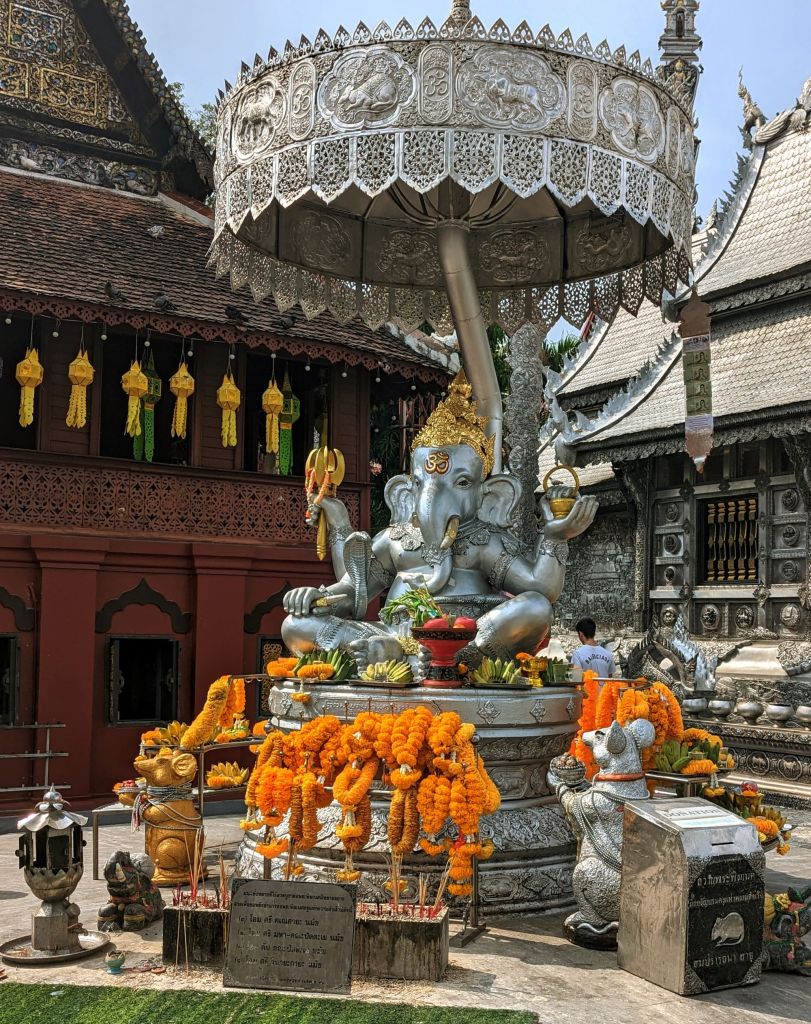
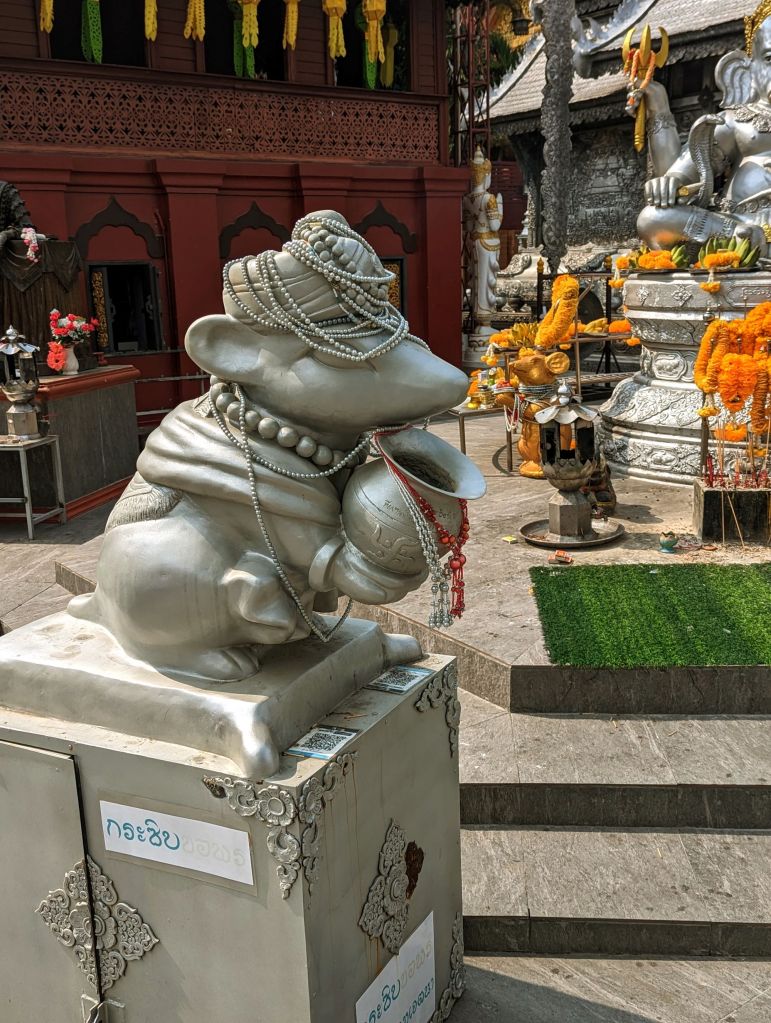
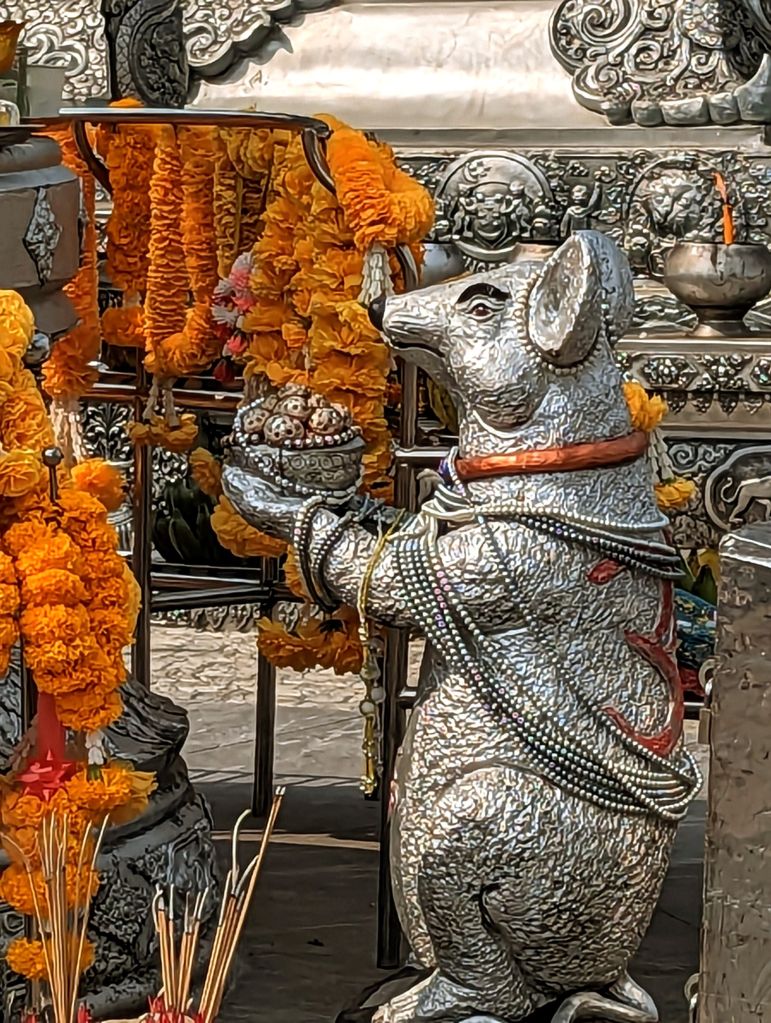
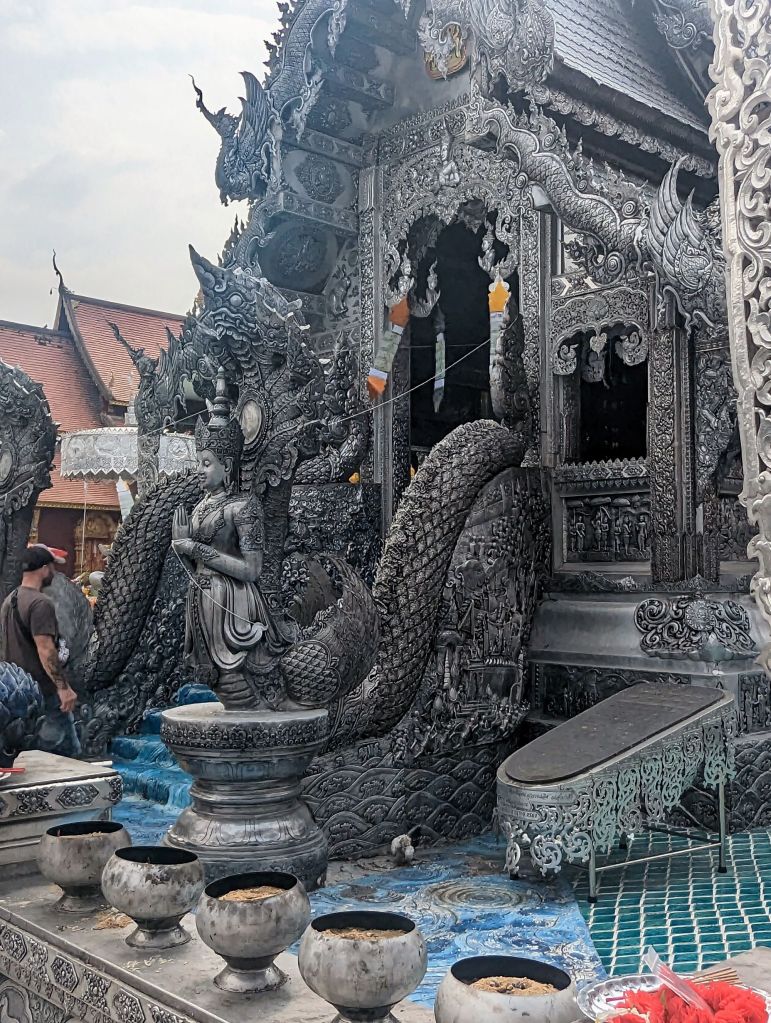
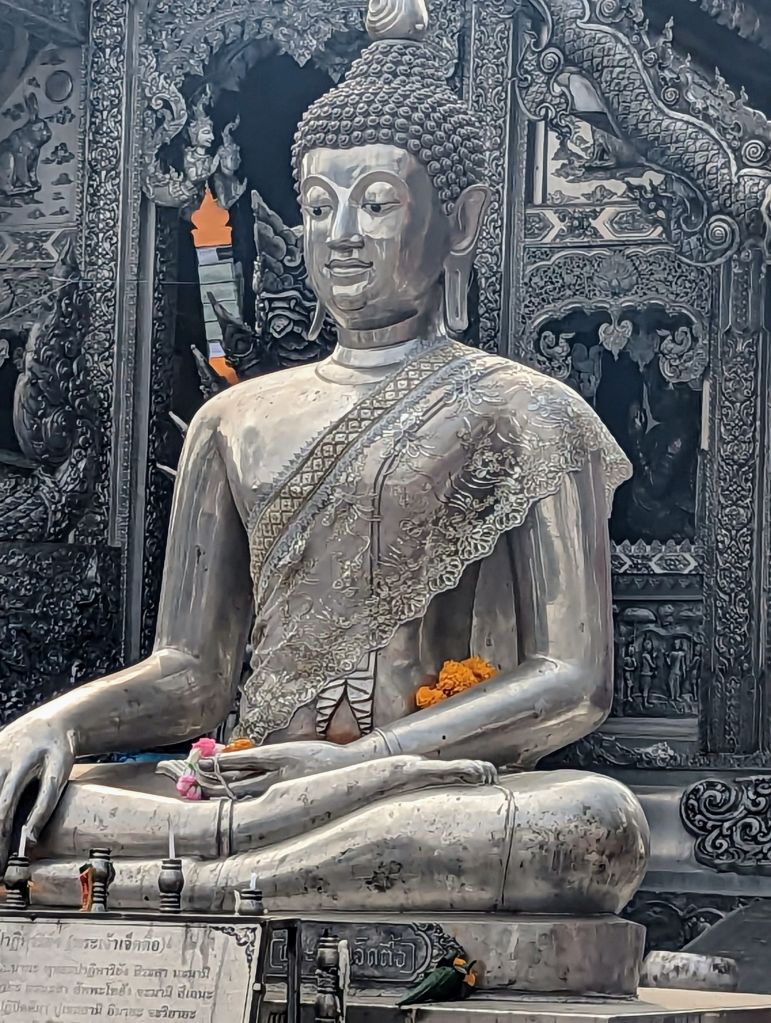
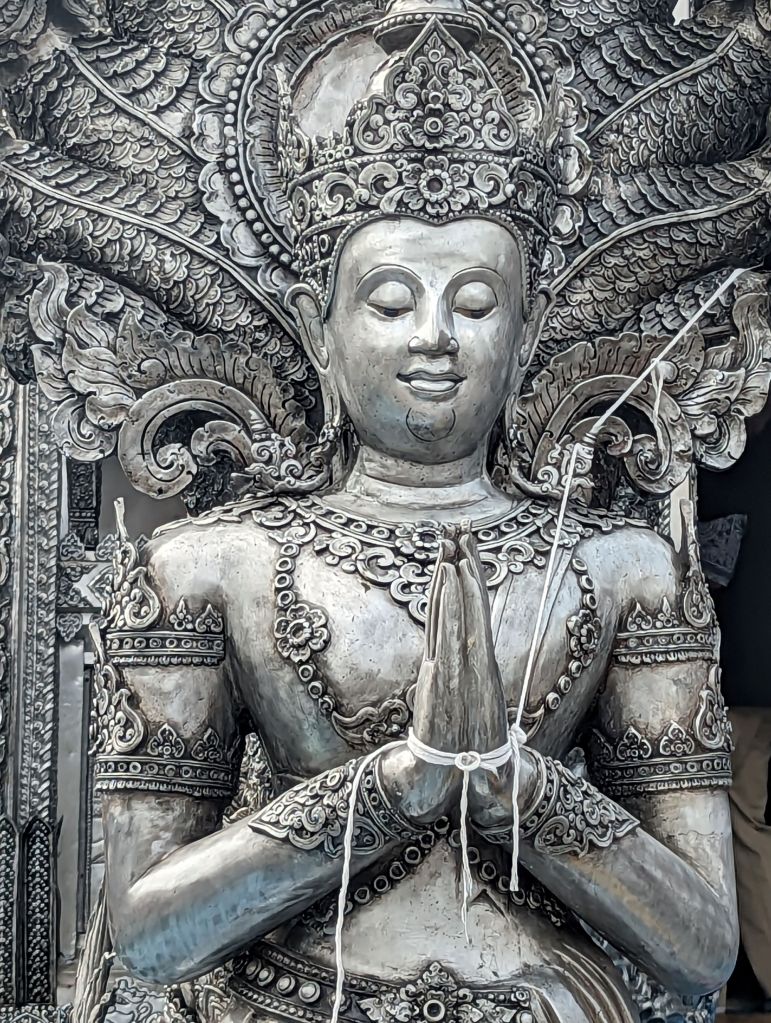
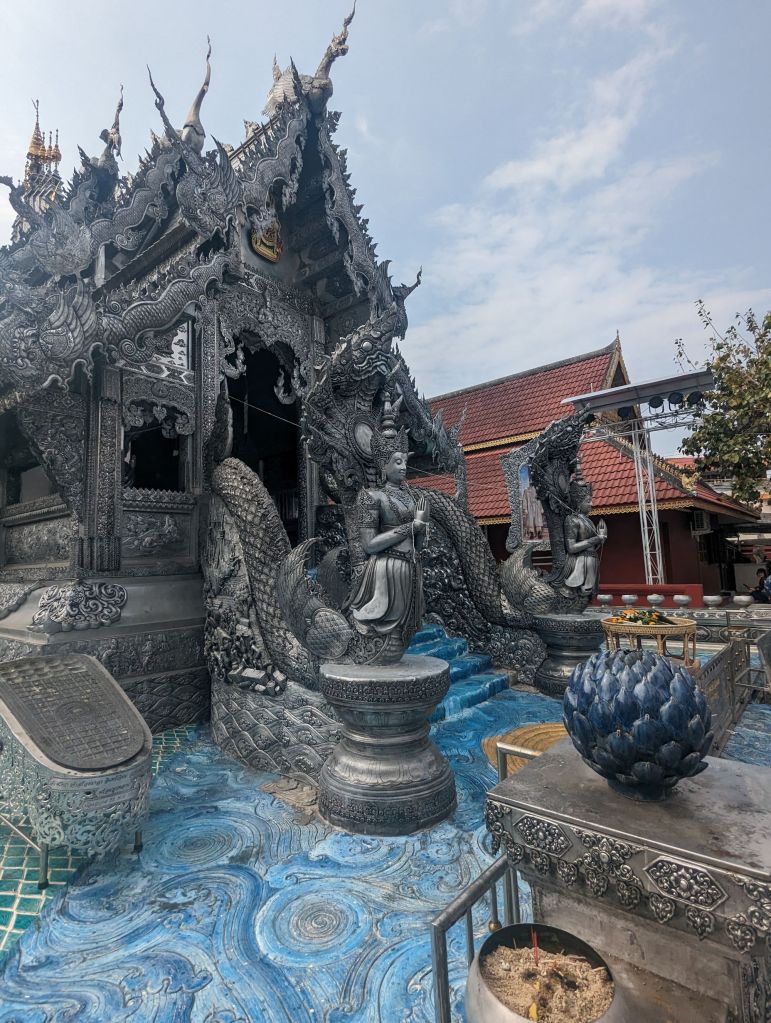
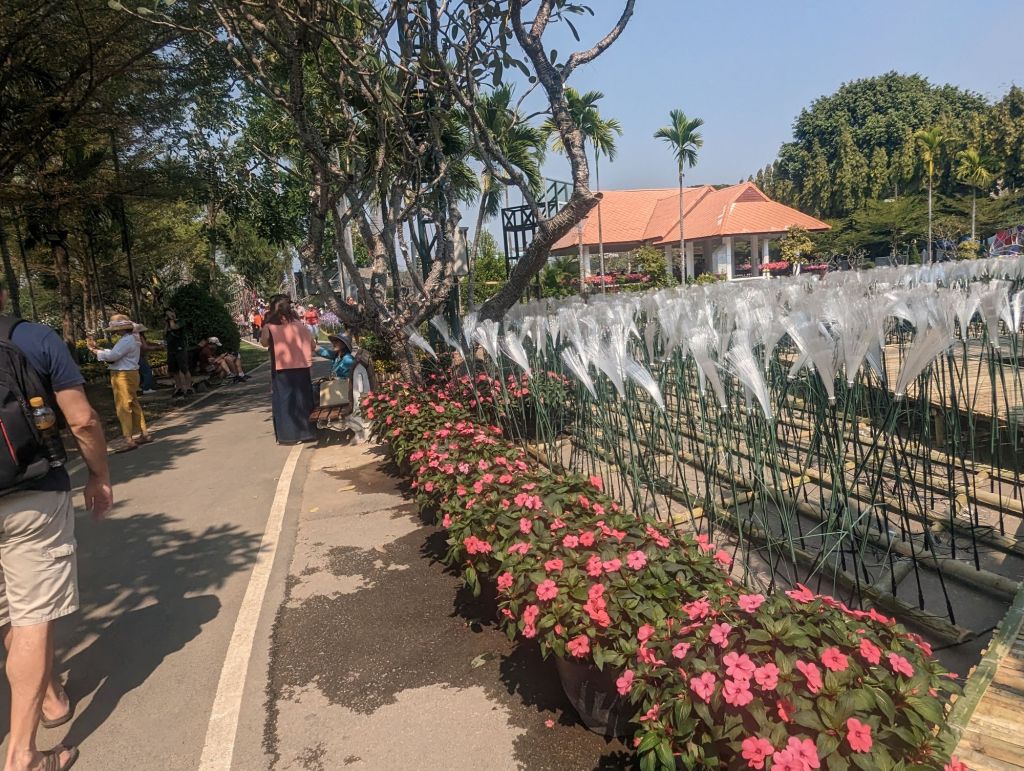
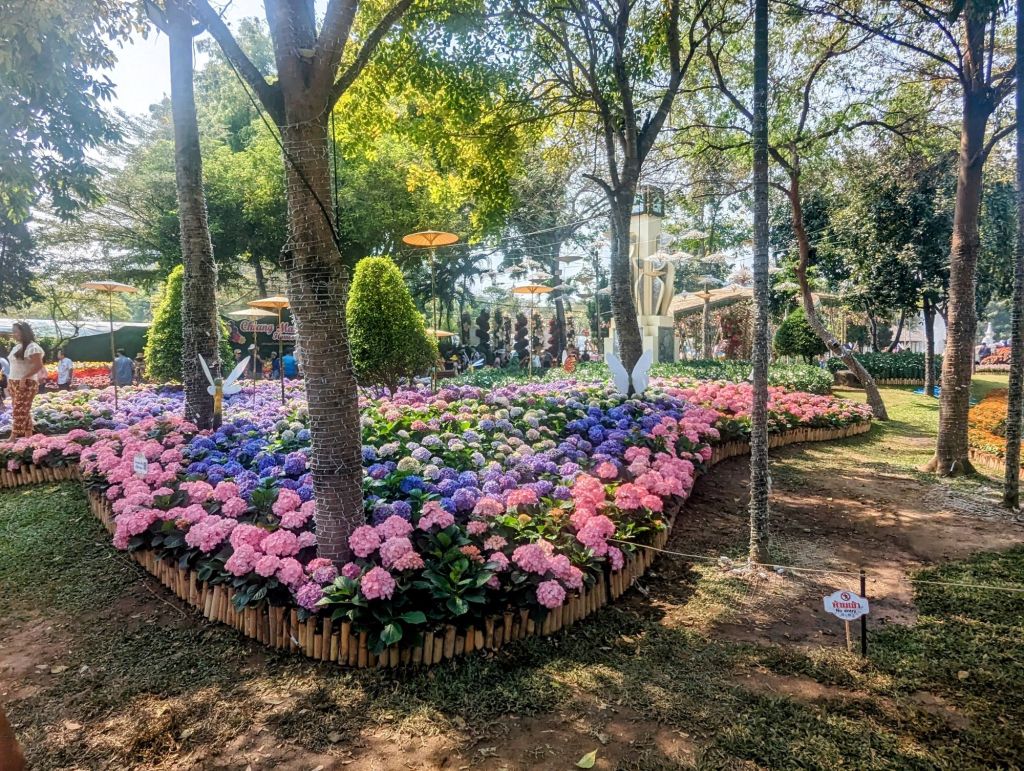
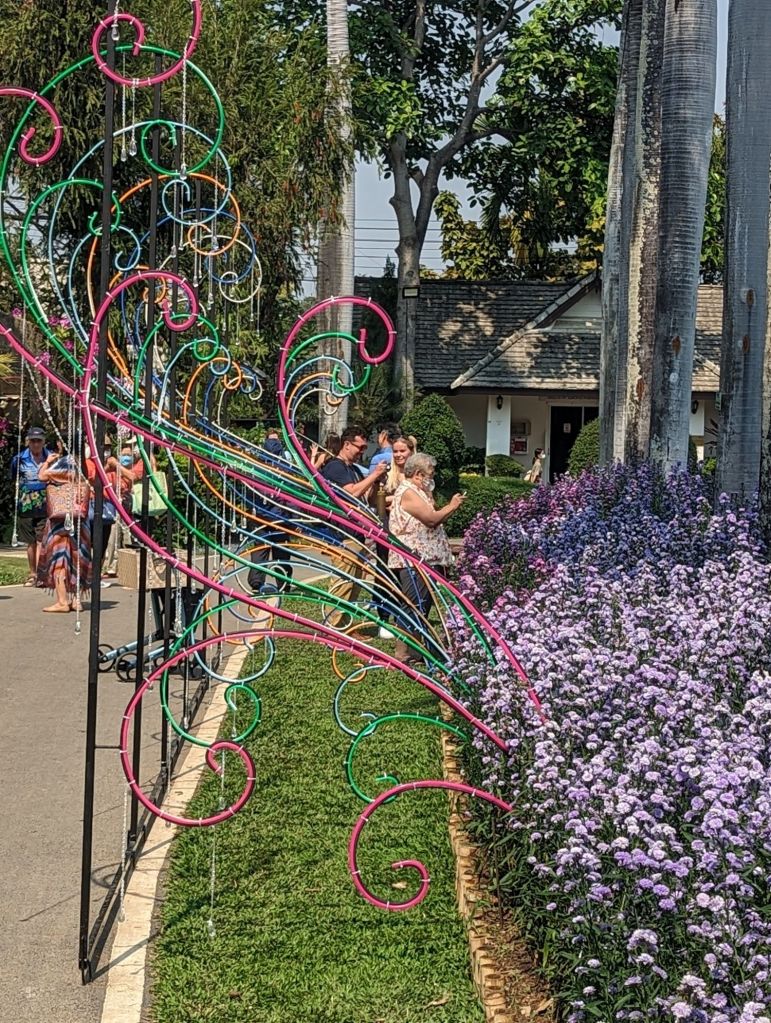
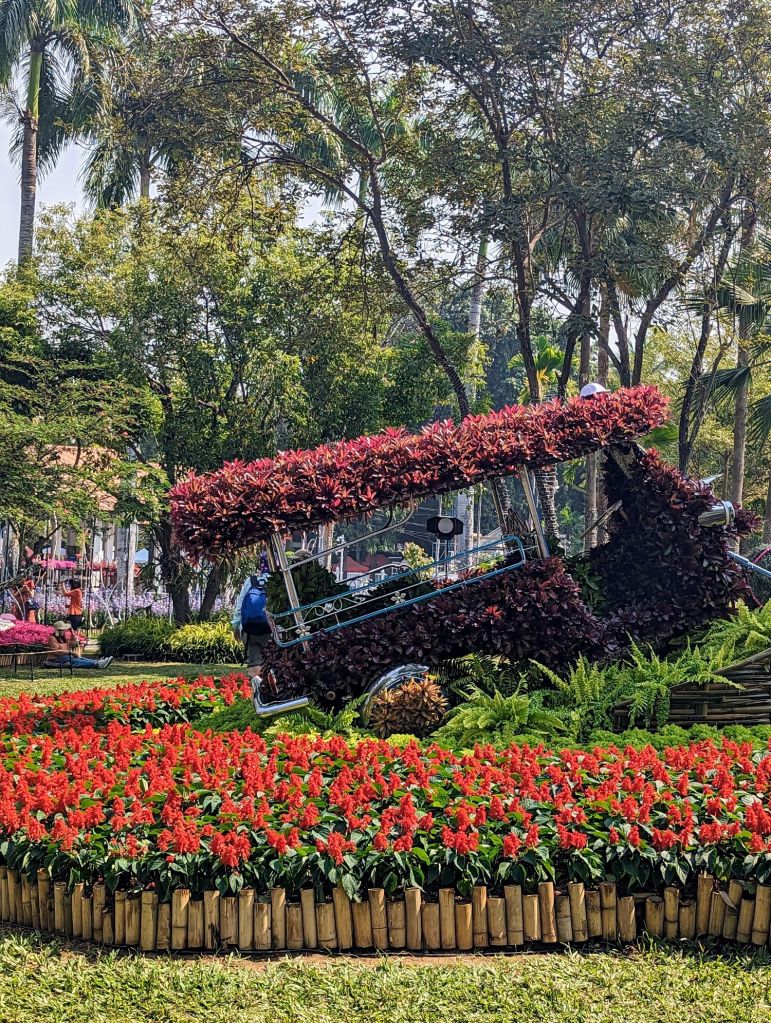
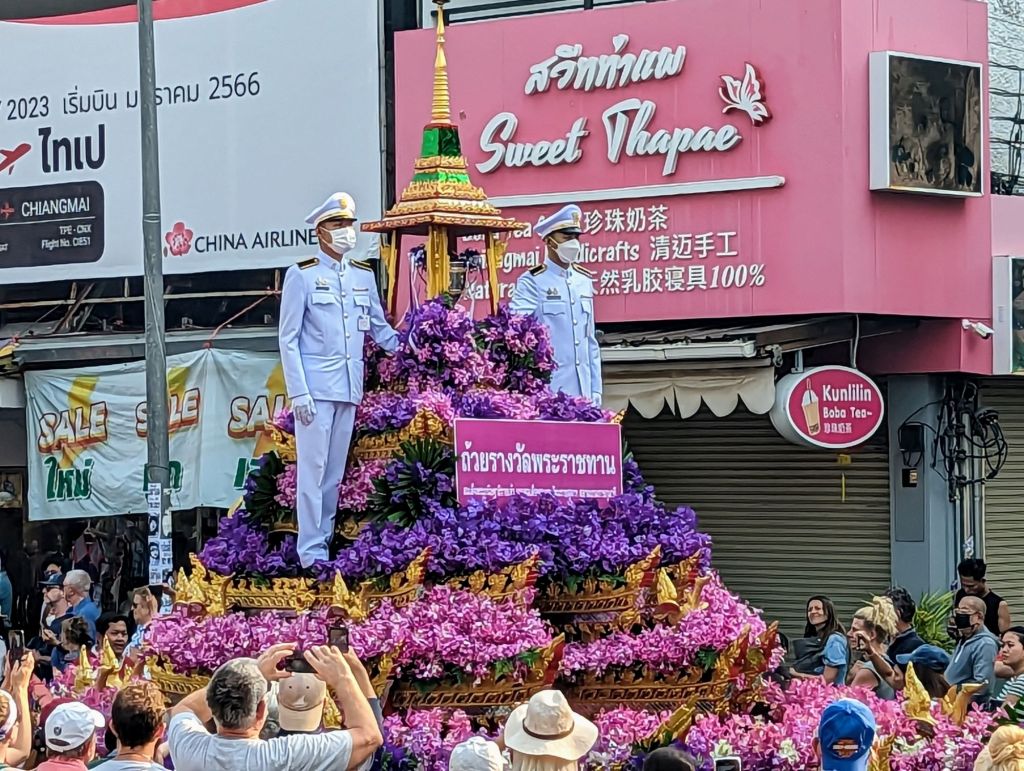
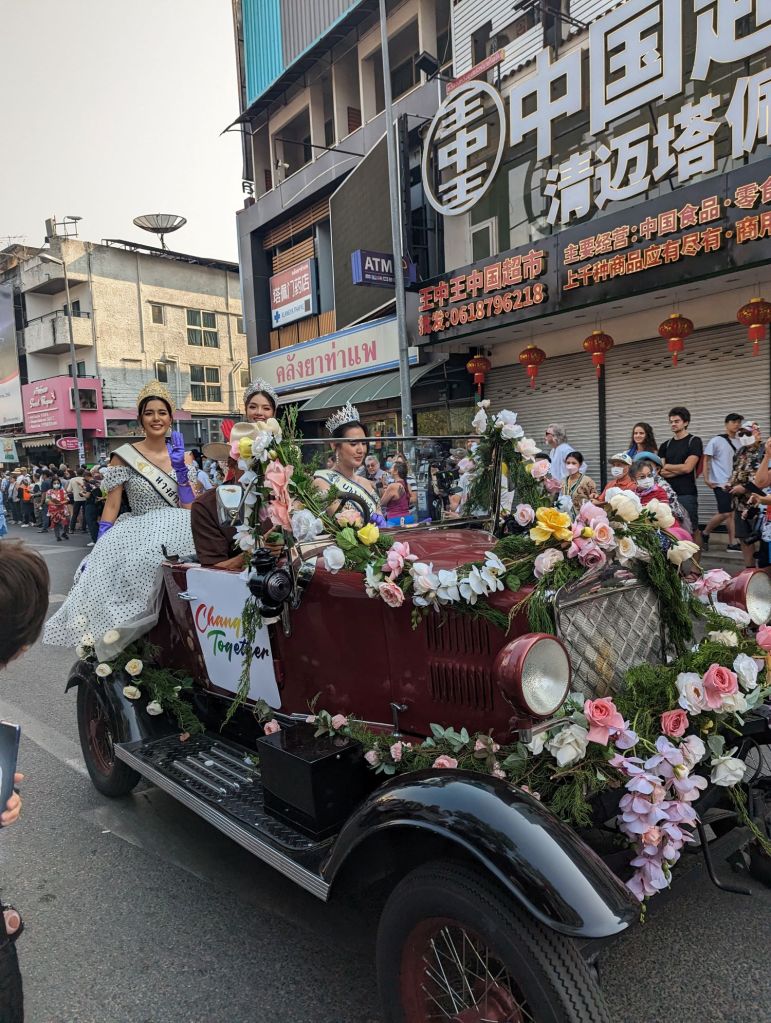
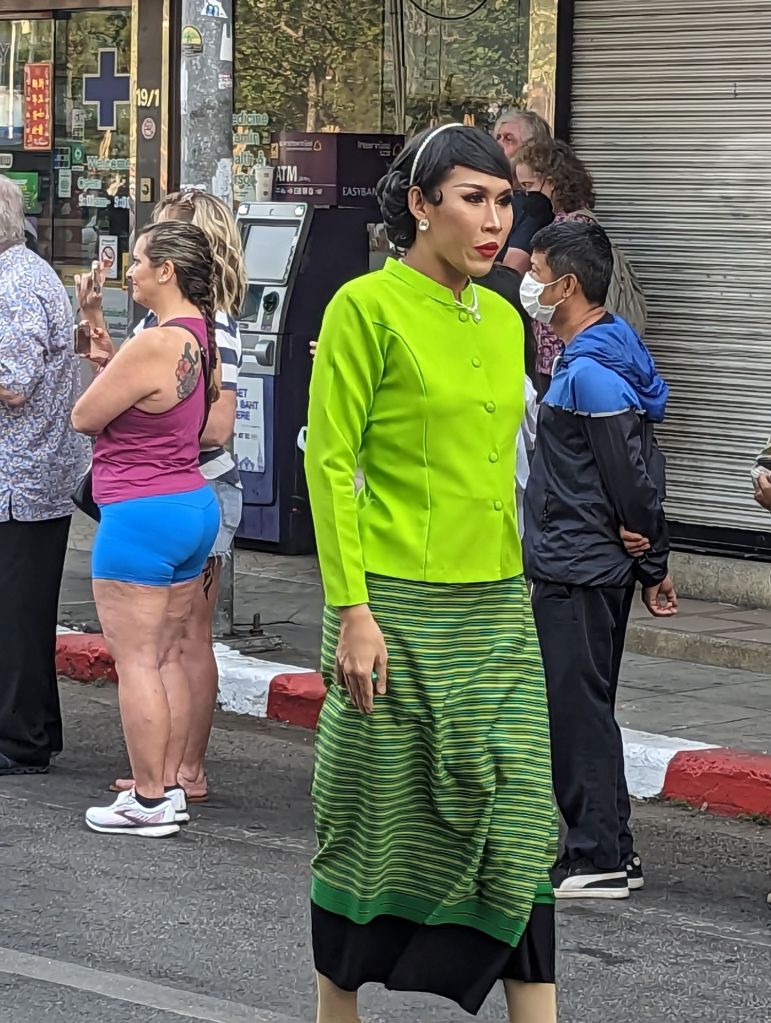
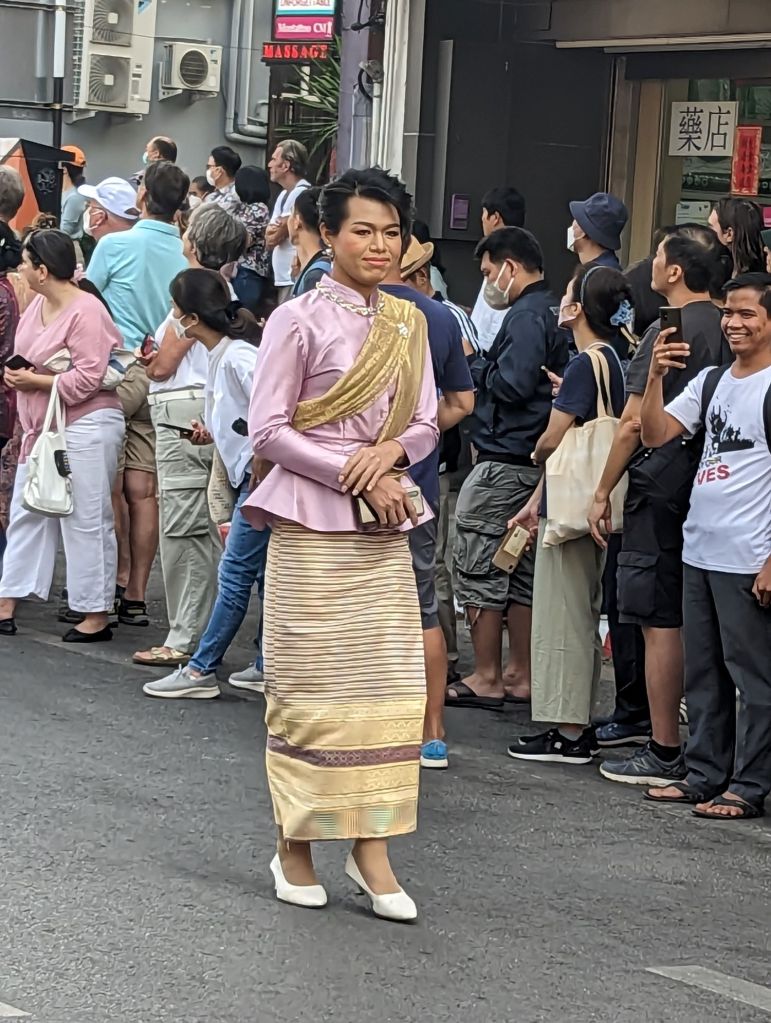
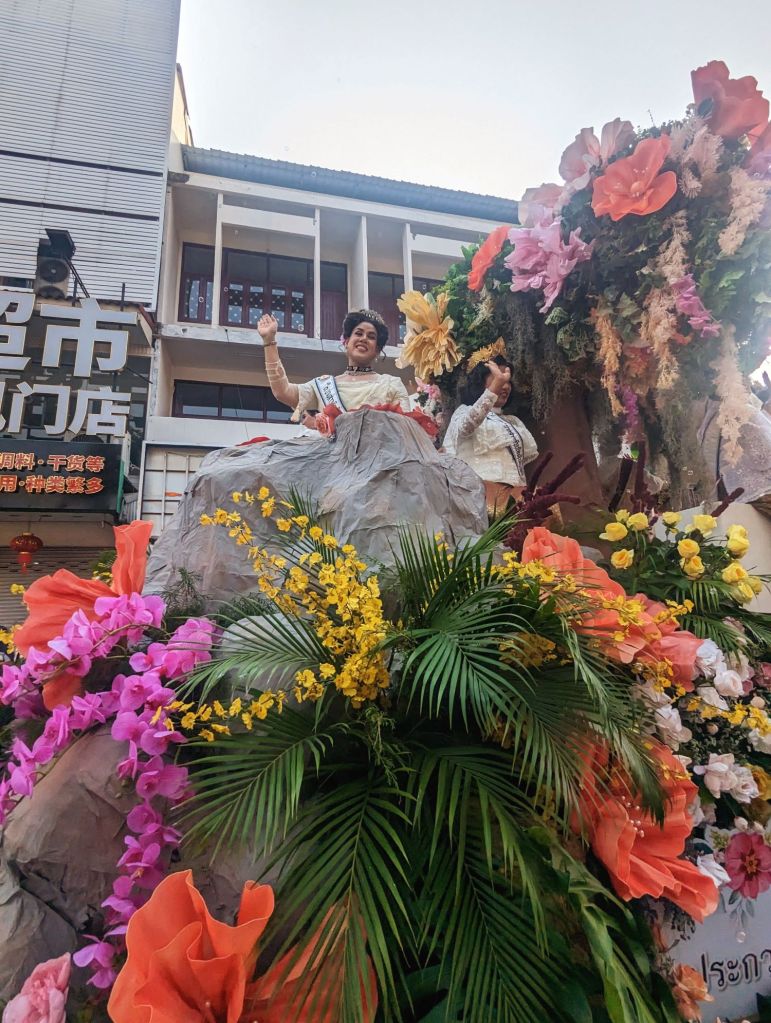
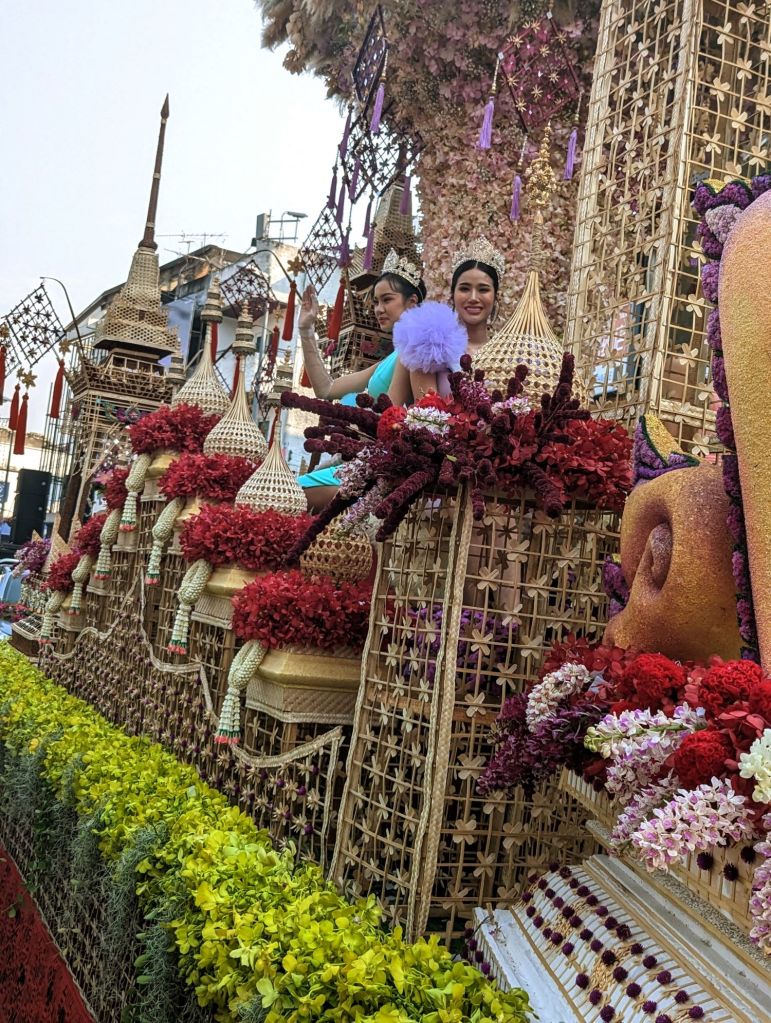
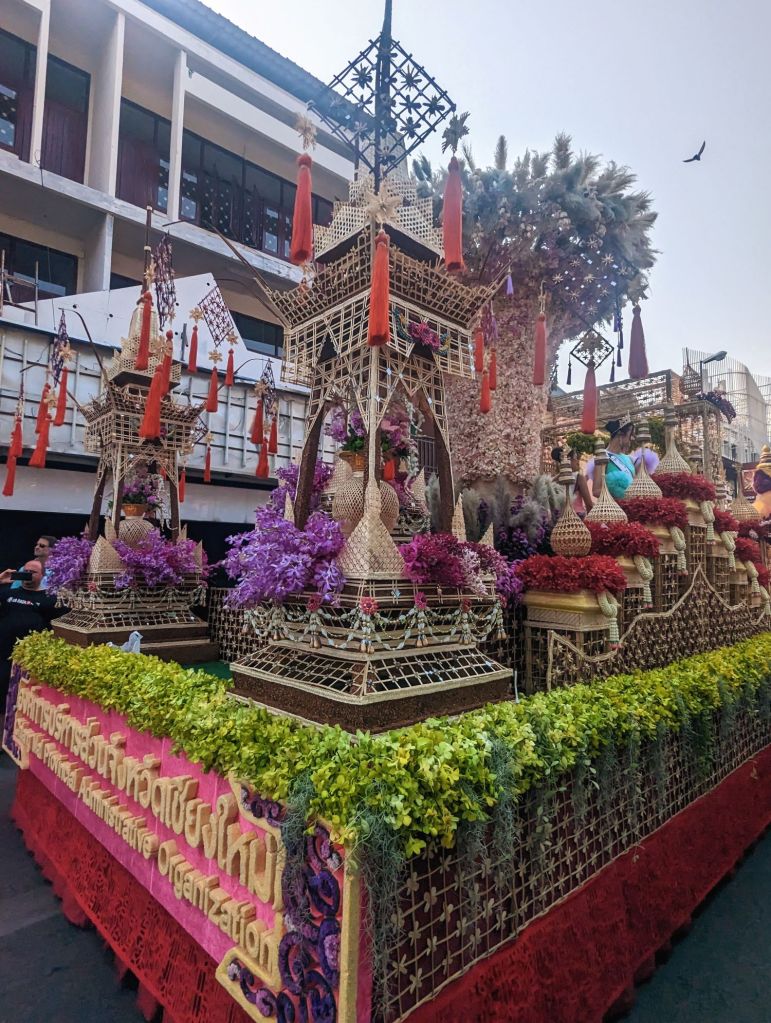
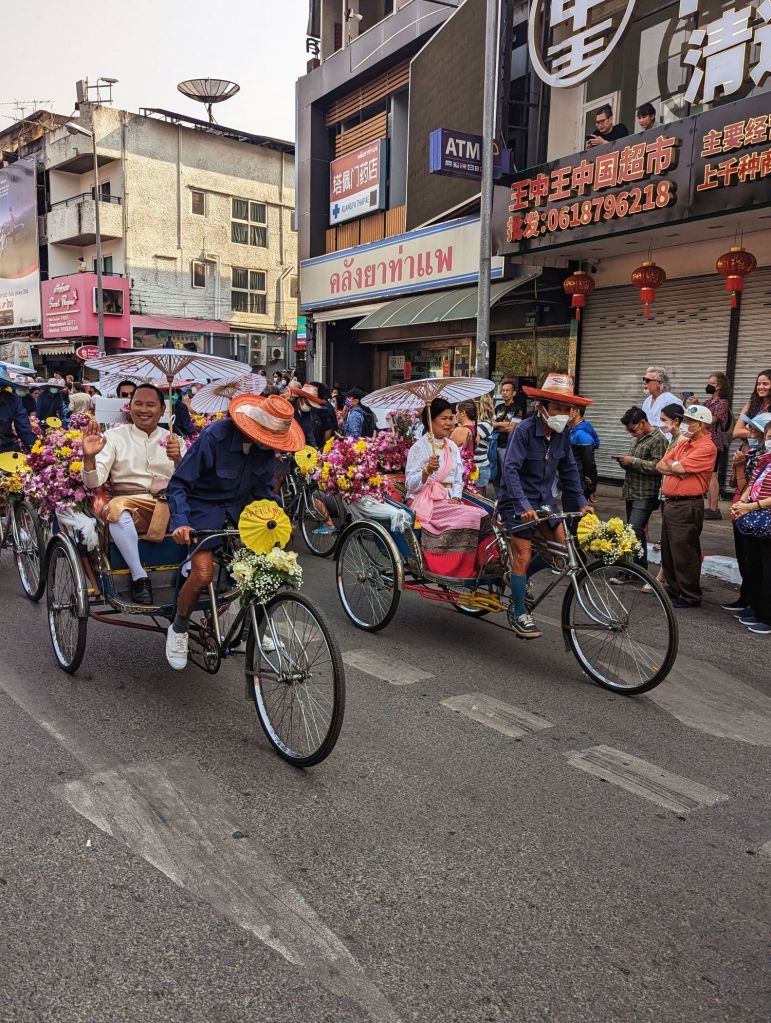
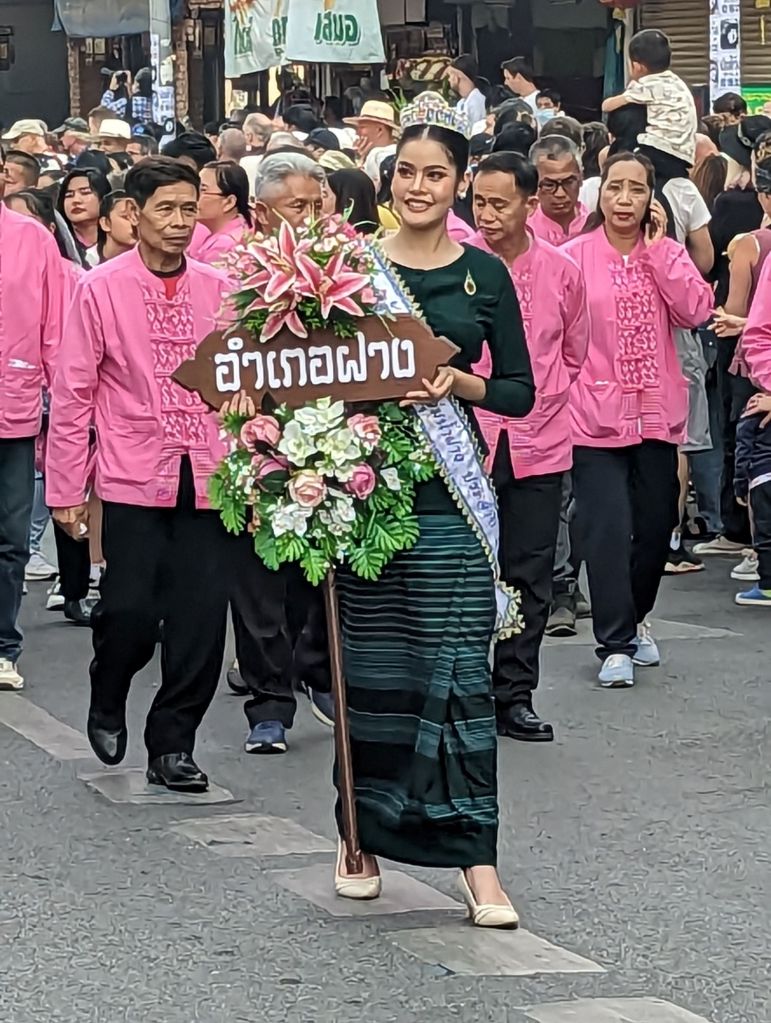
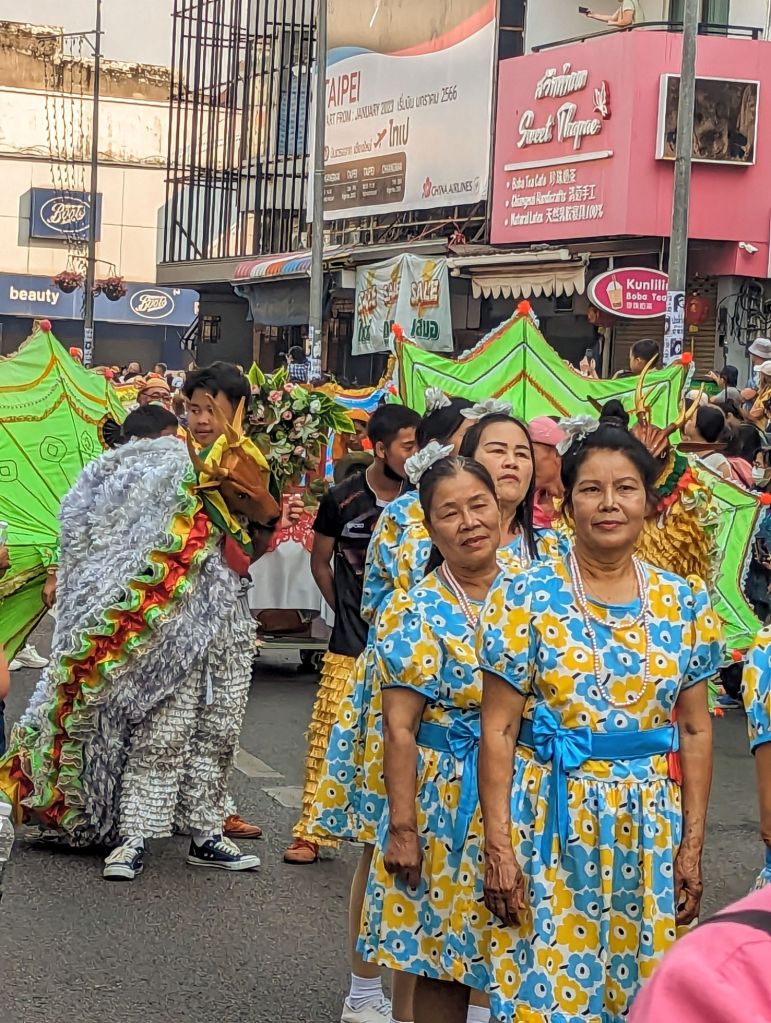
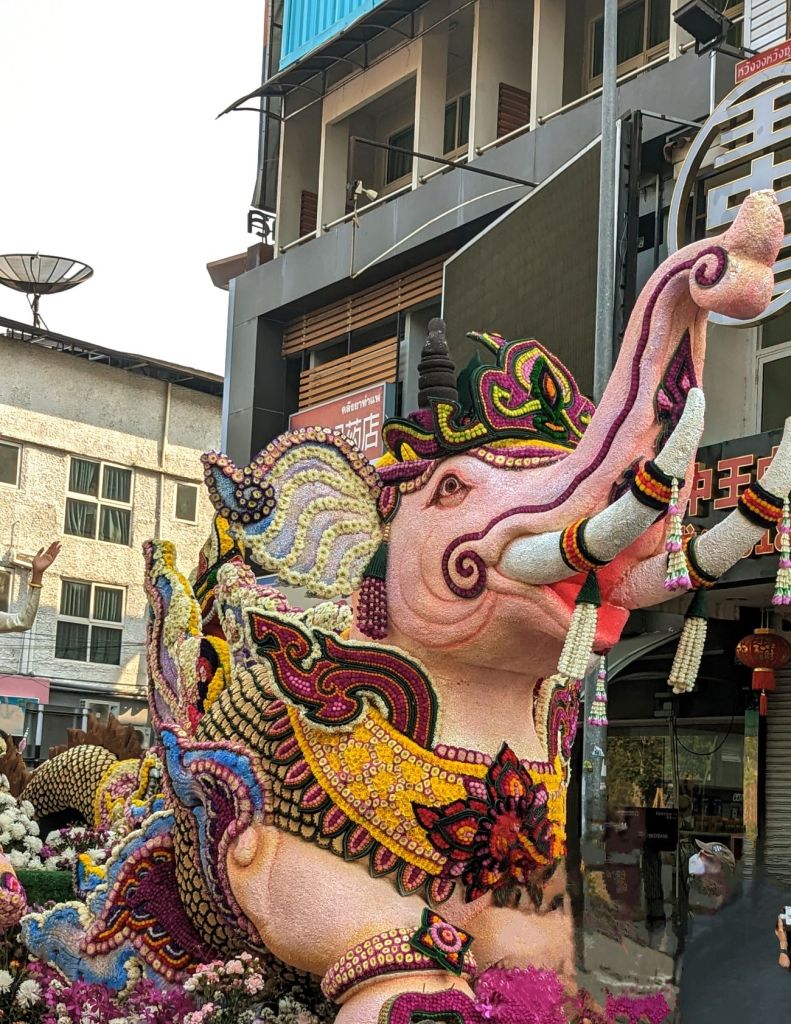
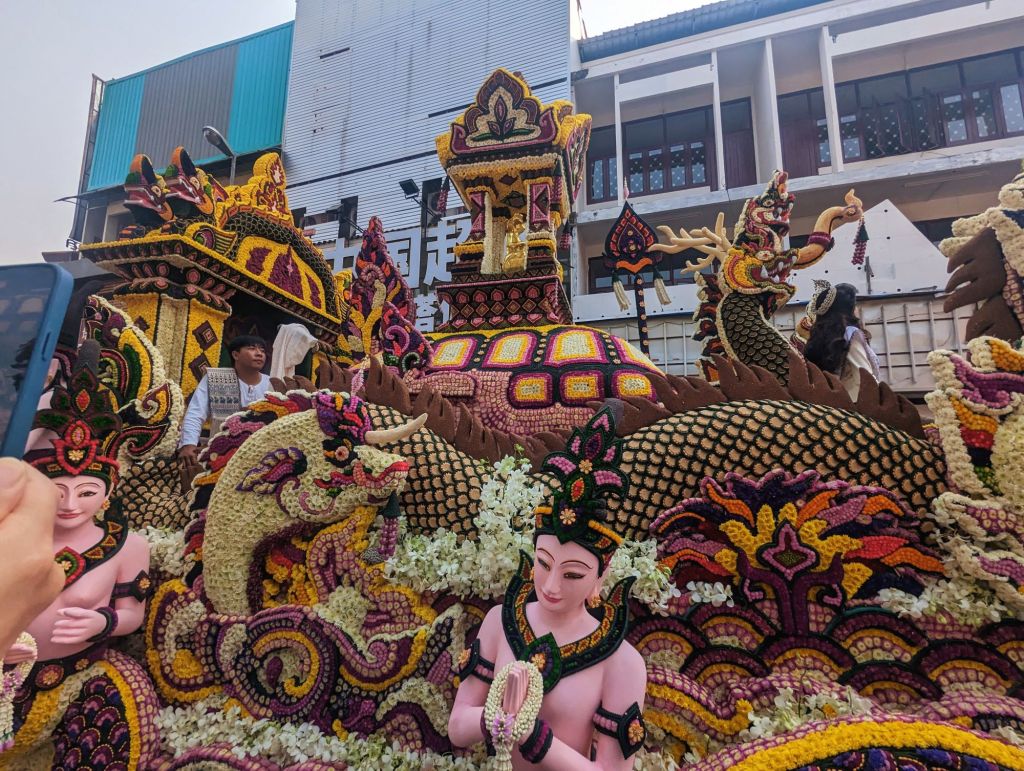
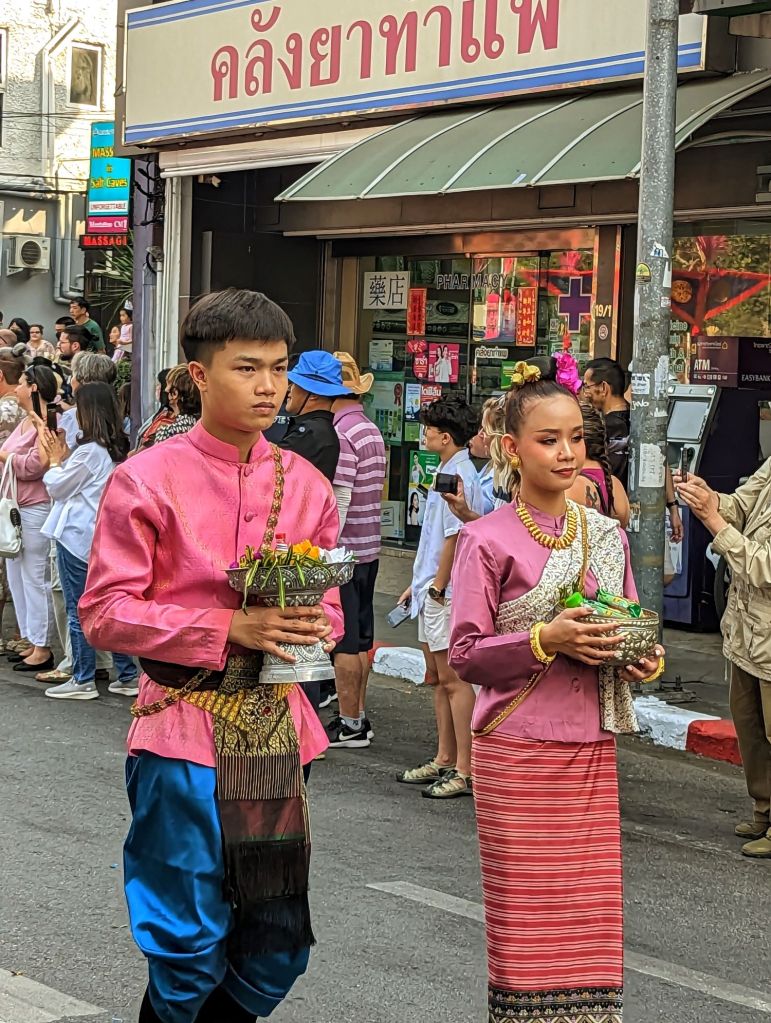
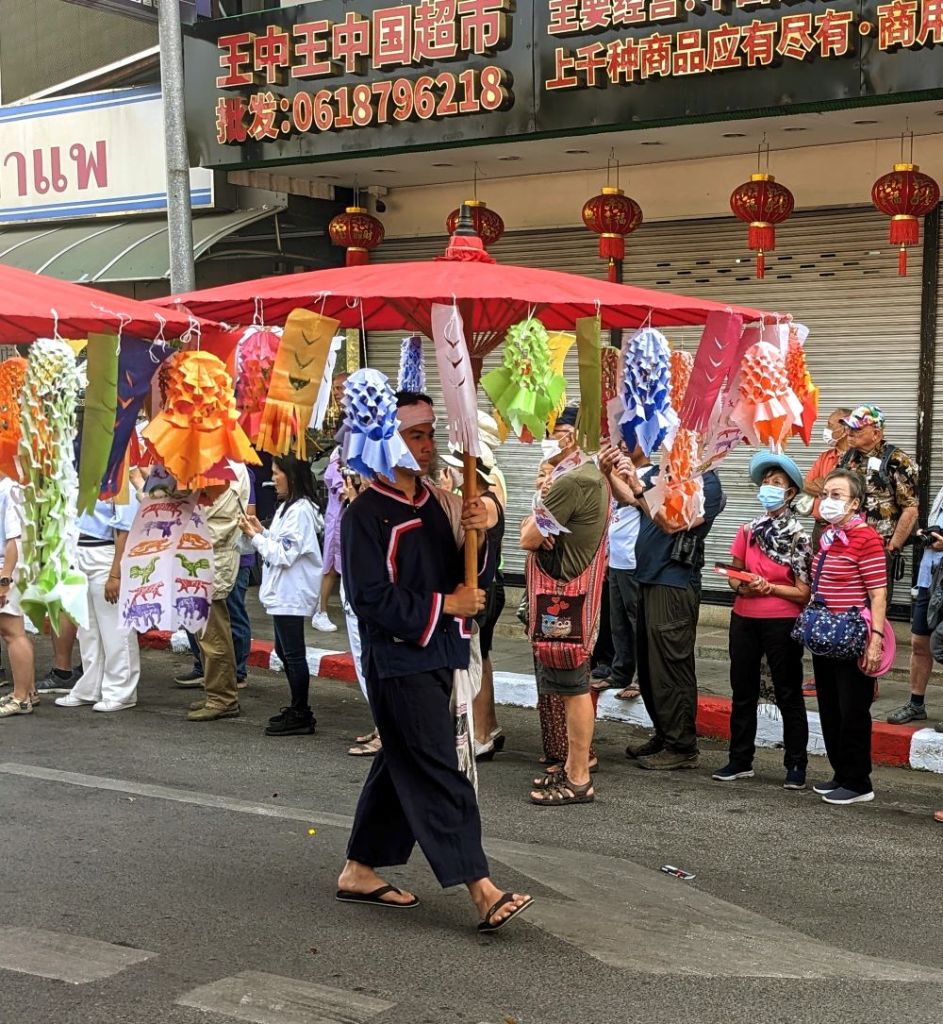
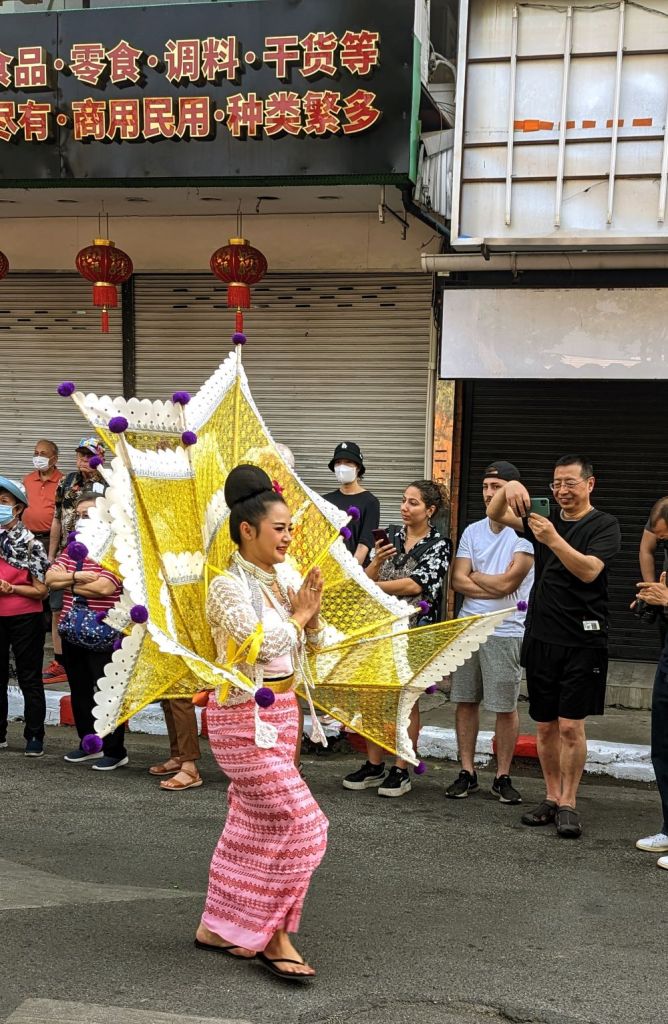
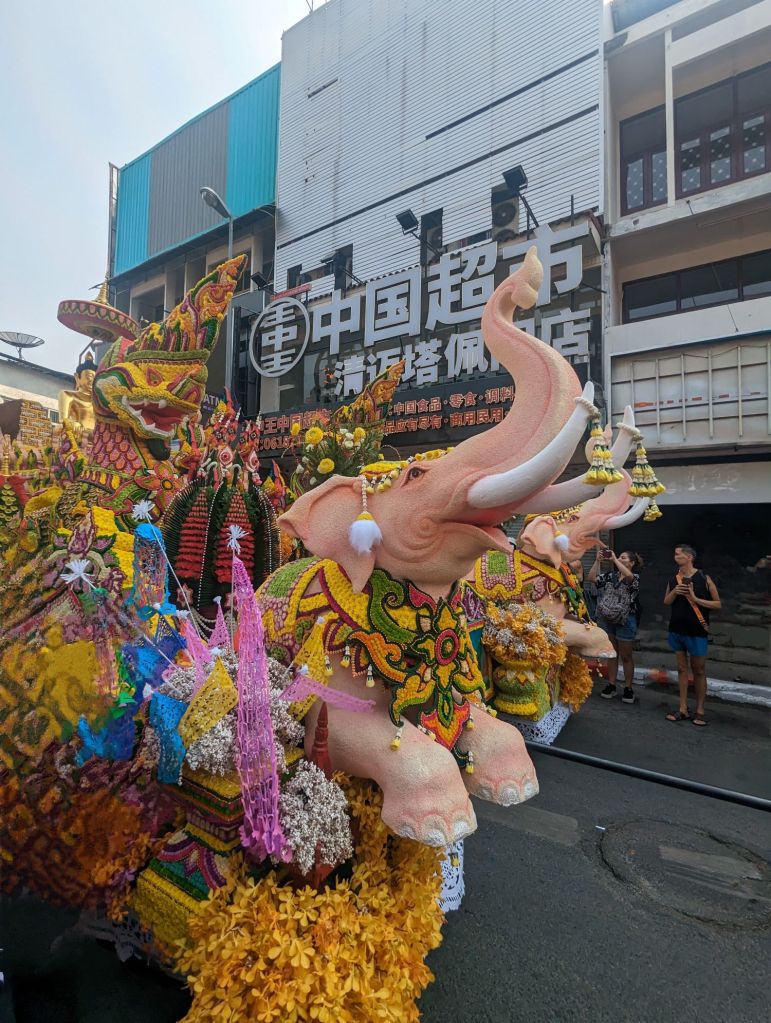
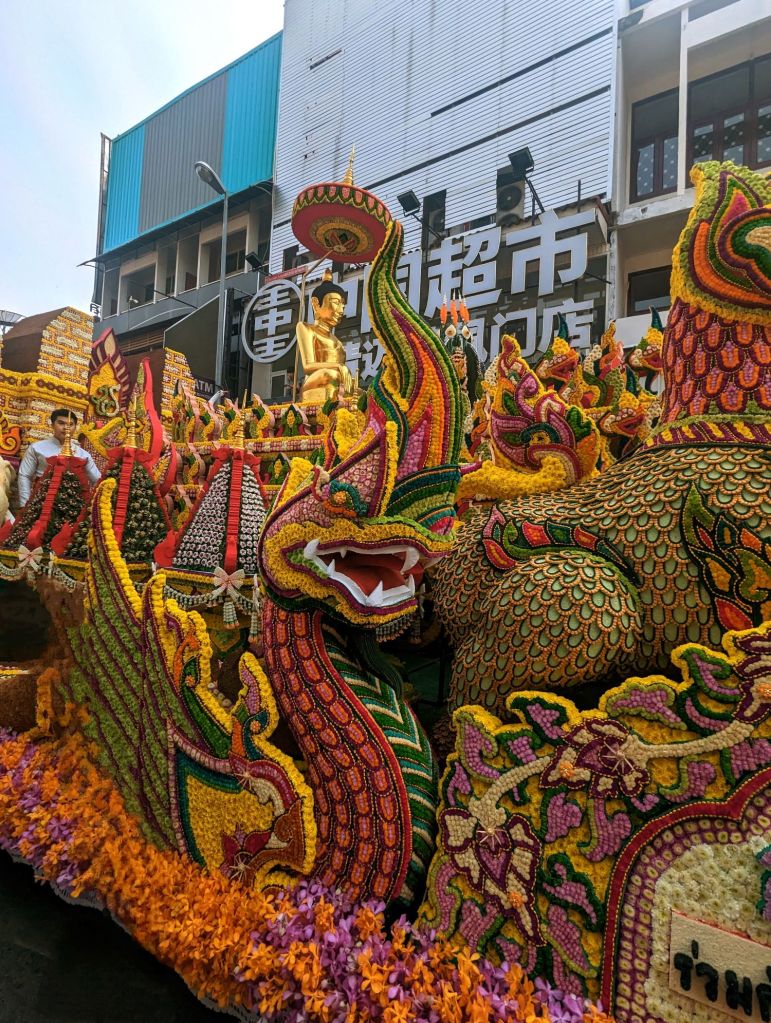
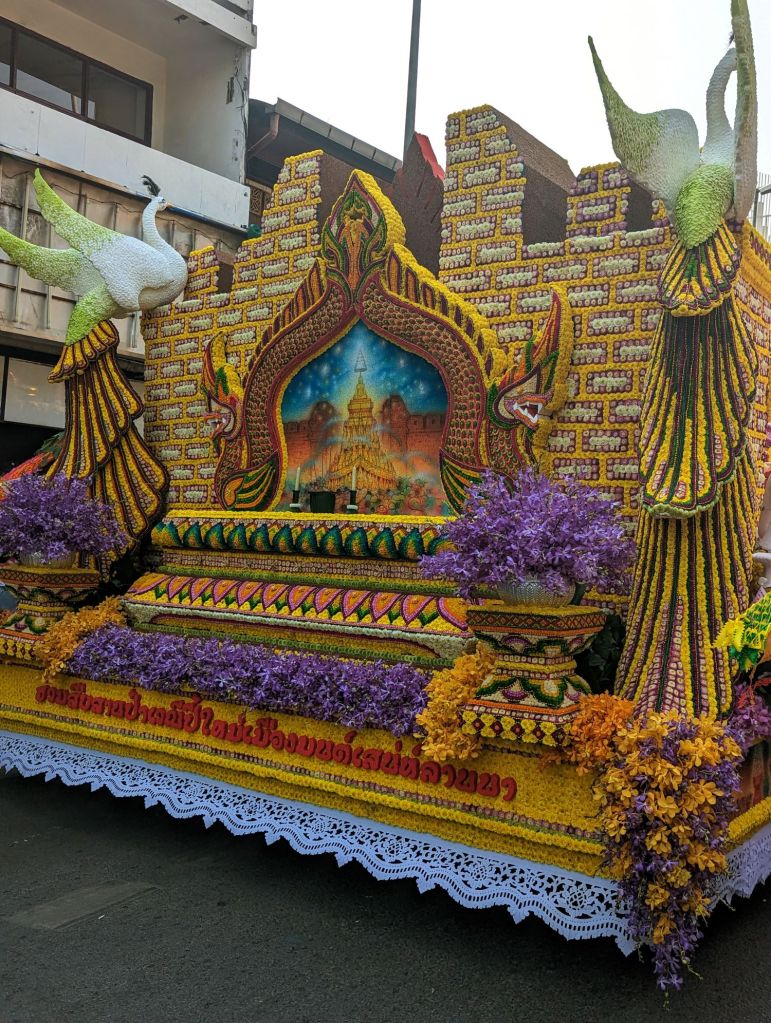
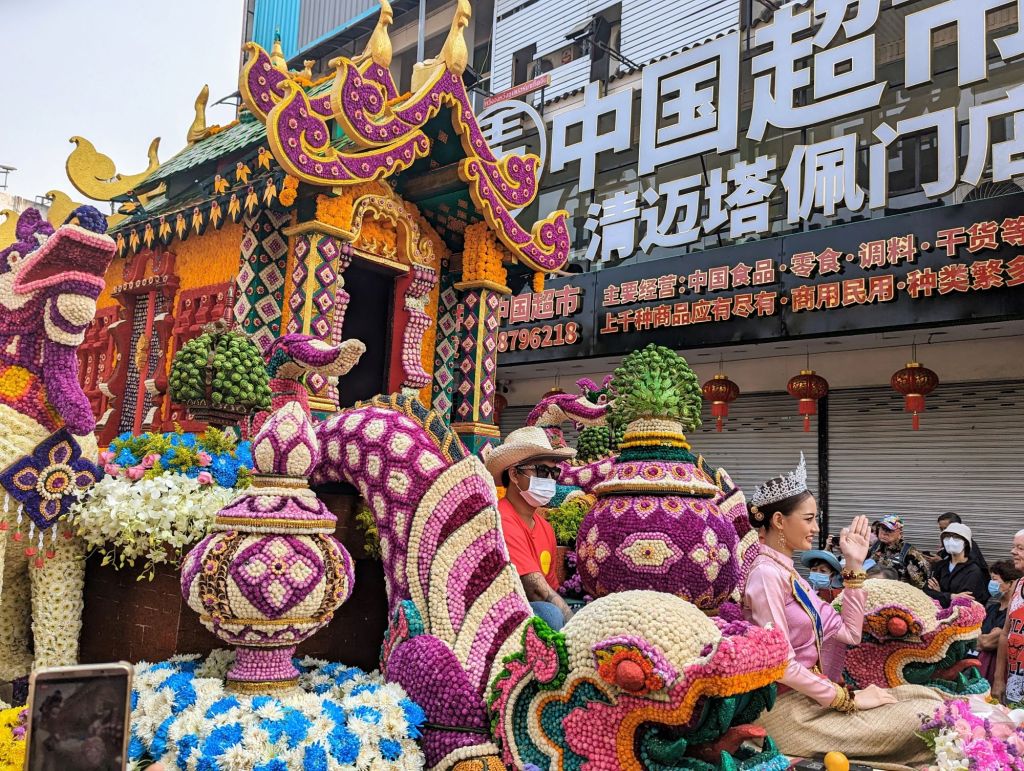
This post is primarily photos of things that caught my eye during our many walks around town; things that are dramatically different than what we normally see at home in Seattle. I revisited the Silver Temple, attended the Chiang Mai Flower Festival and parade, and took pictures of things I found interesting.

We will be taking the train from Chiang Mai to Bangkok in early March, and from there will be taking the train to Kanchanaburi to view the Death Railway and Hellfire Pass. Look for a new post then!

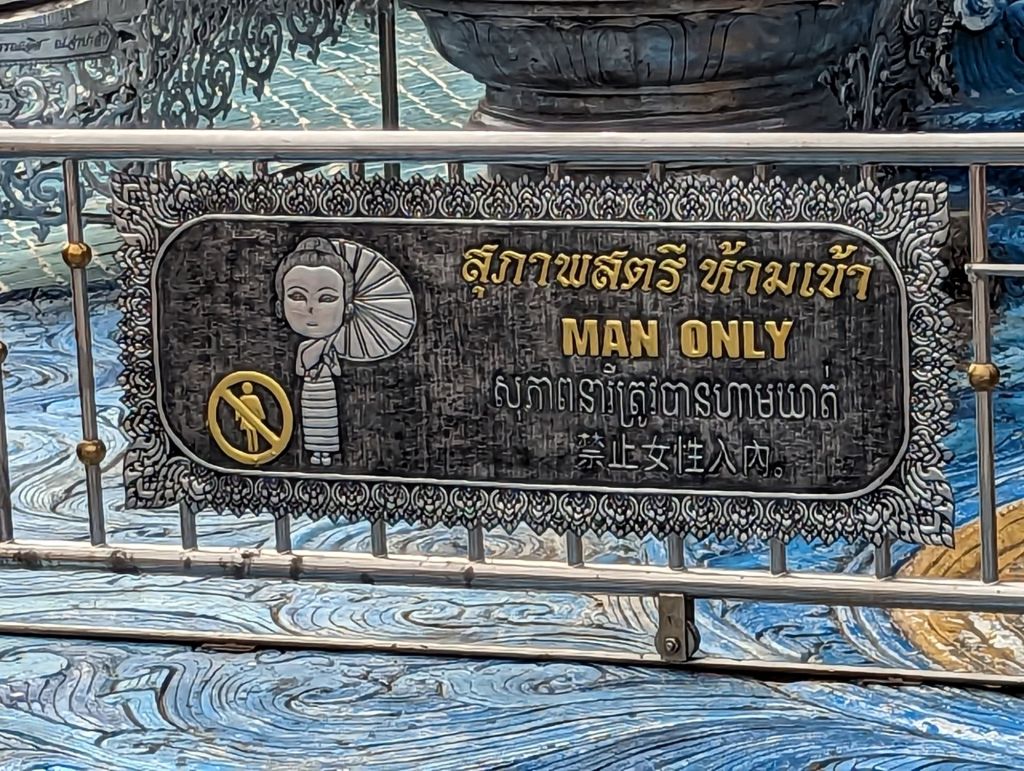
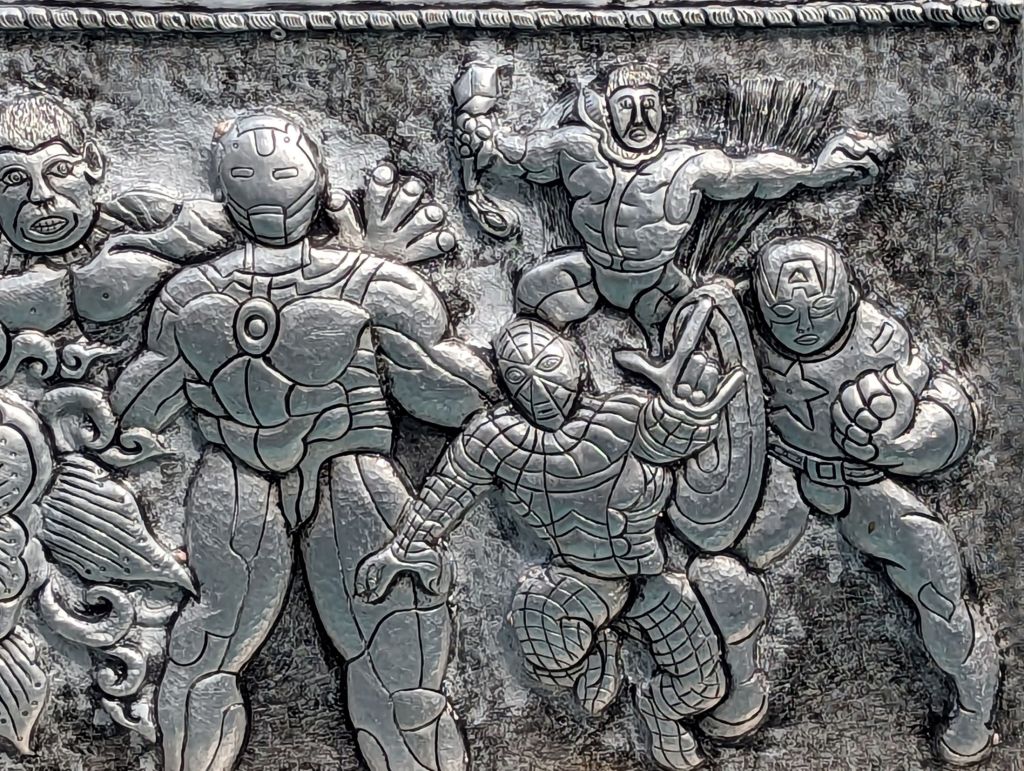
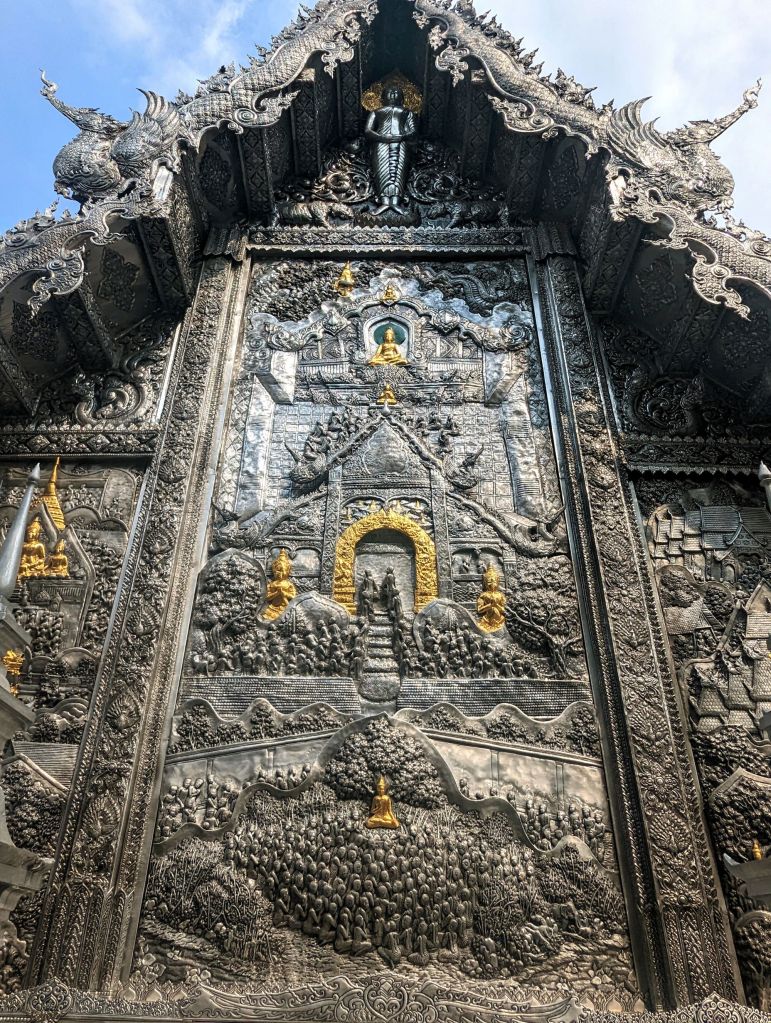
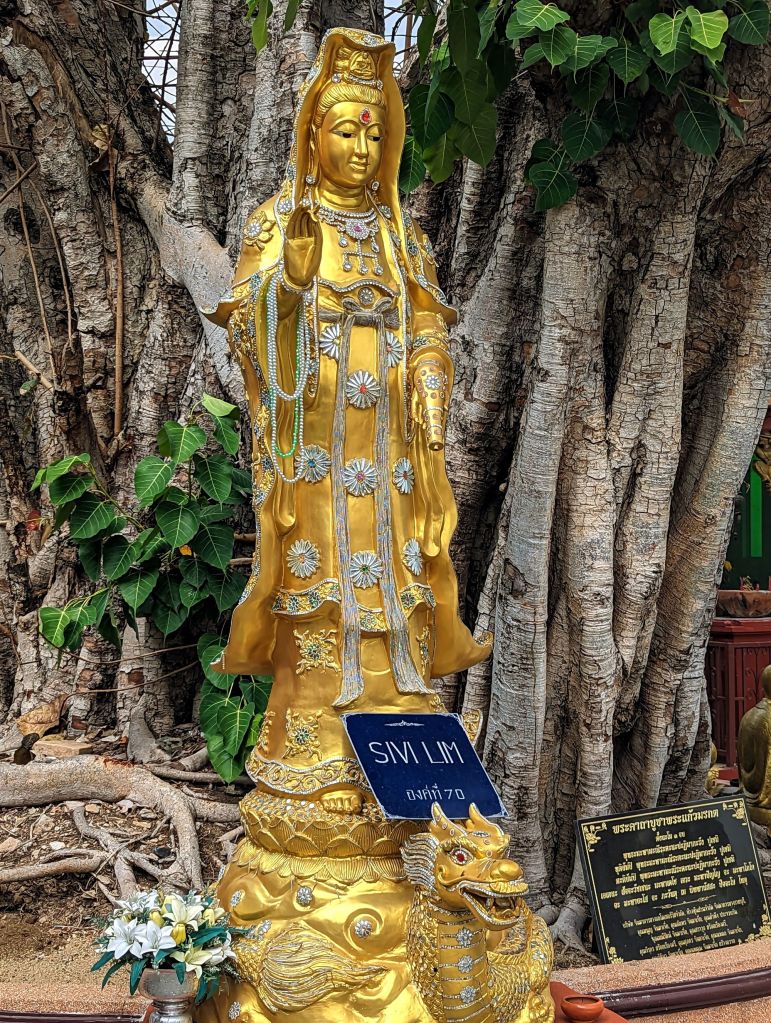
The Silver Temple

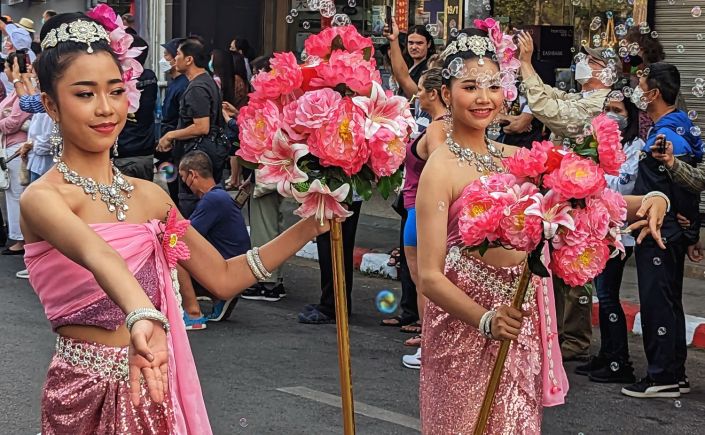
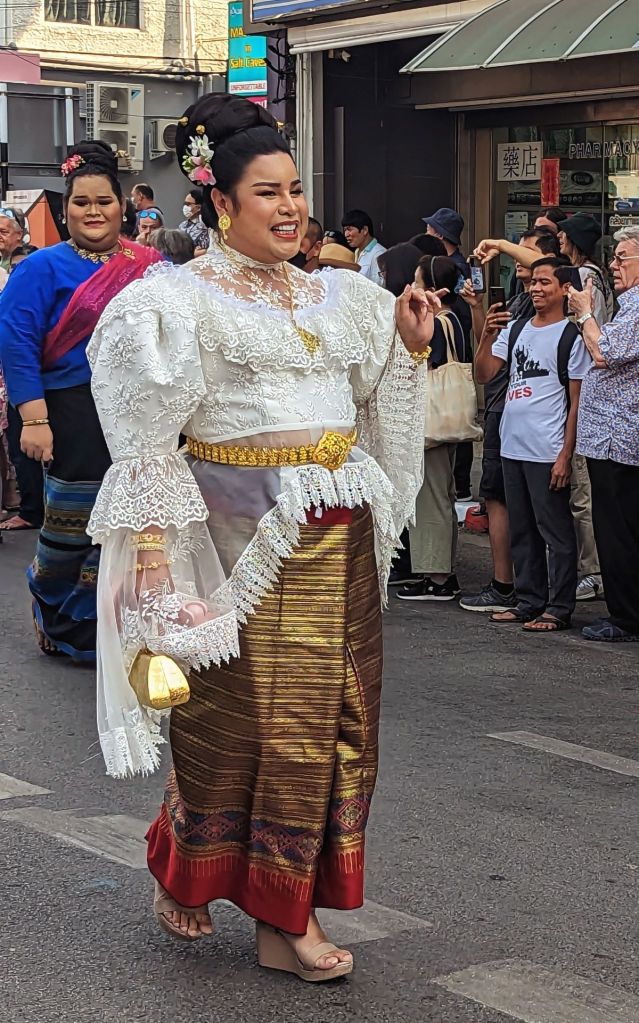
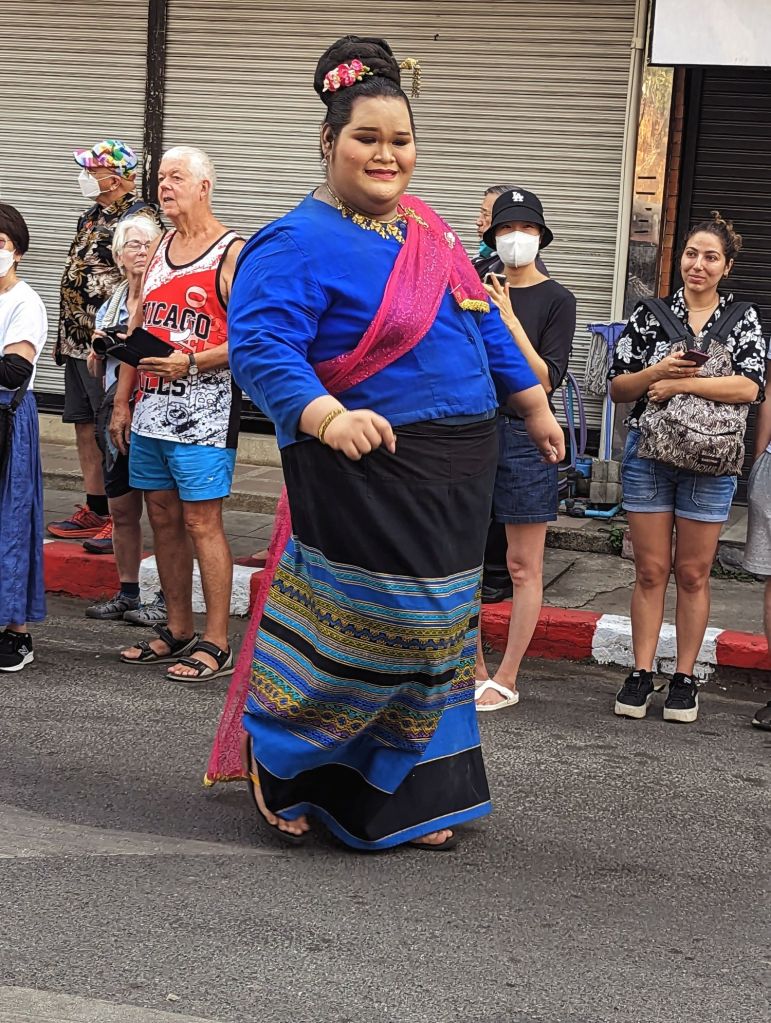
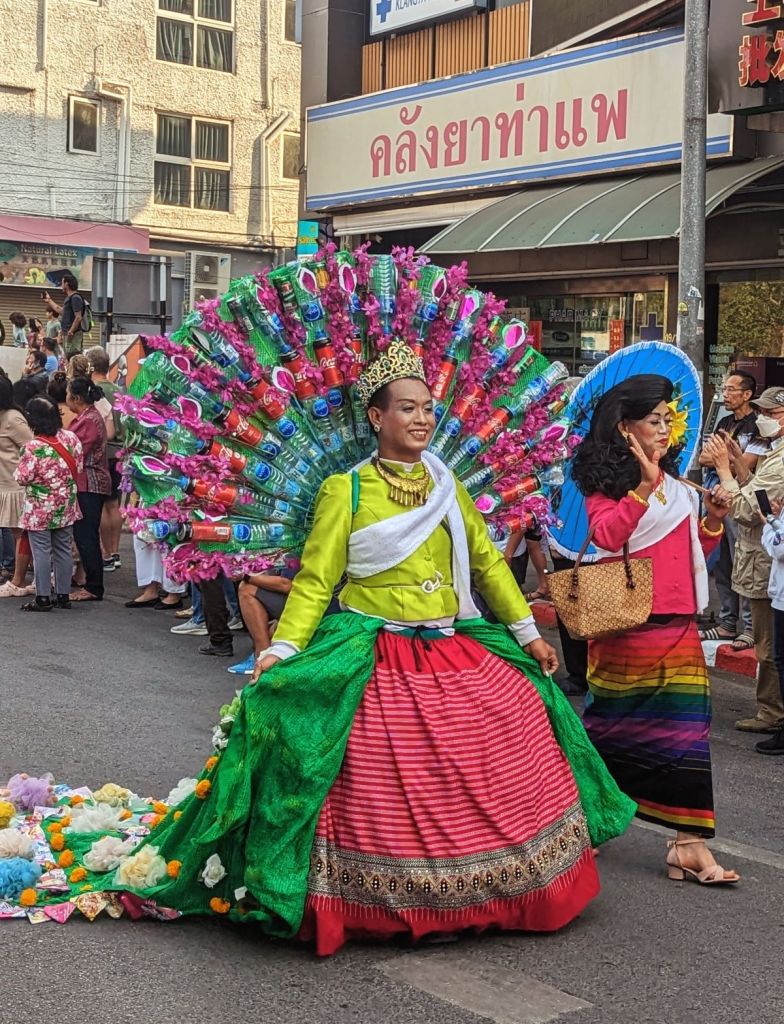
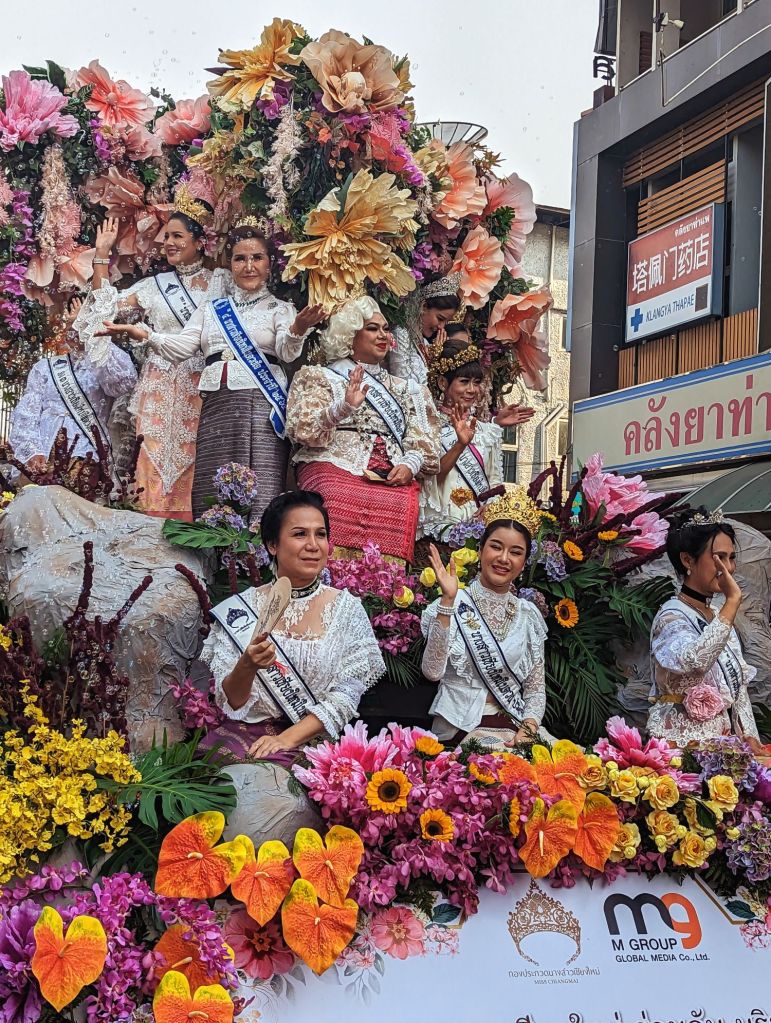
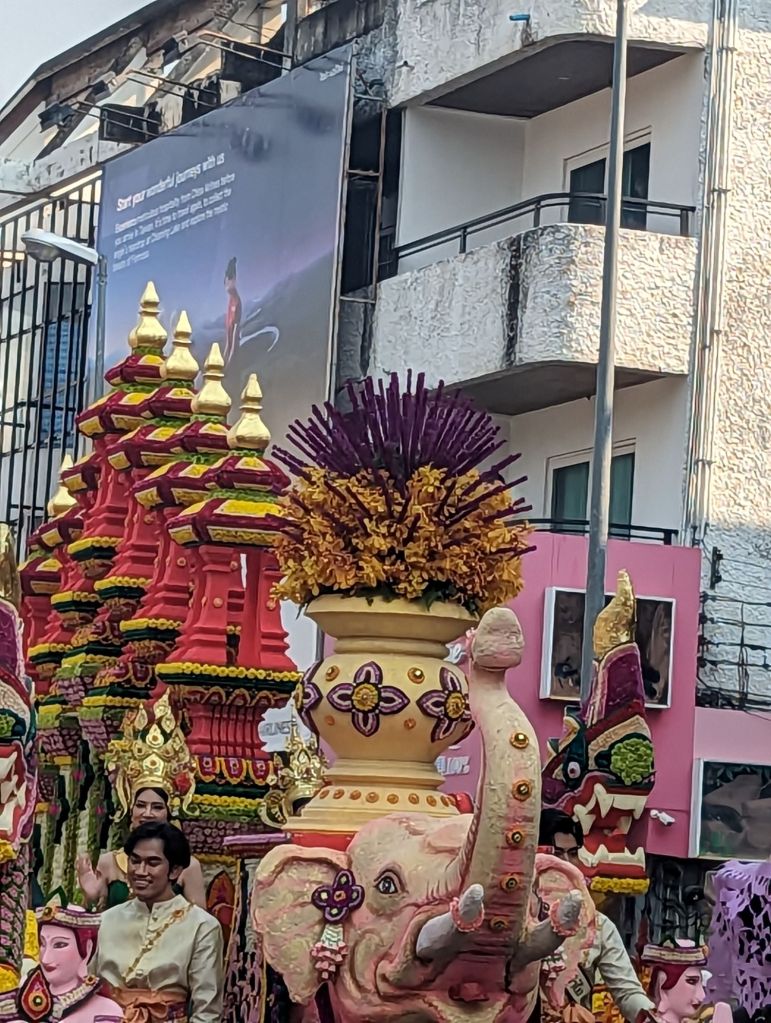
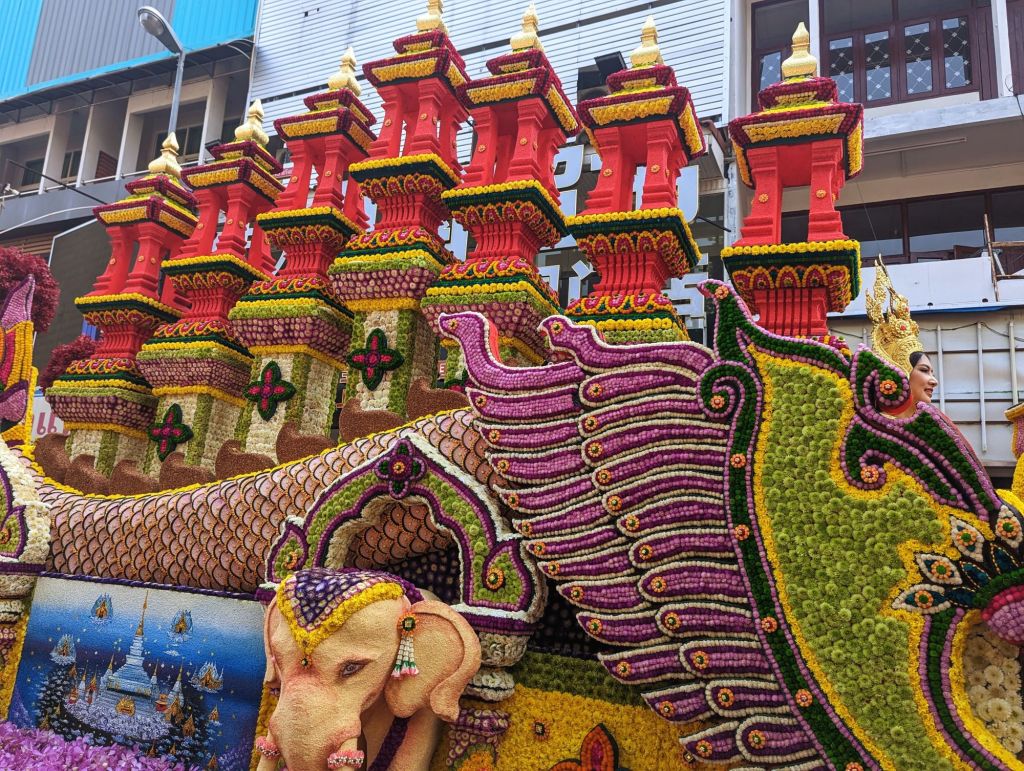
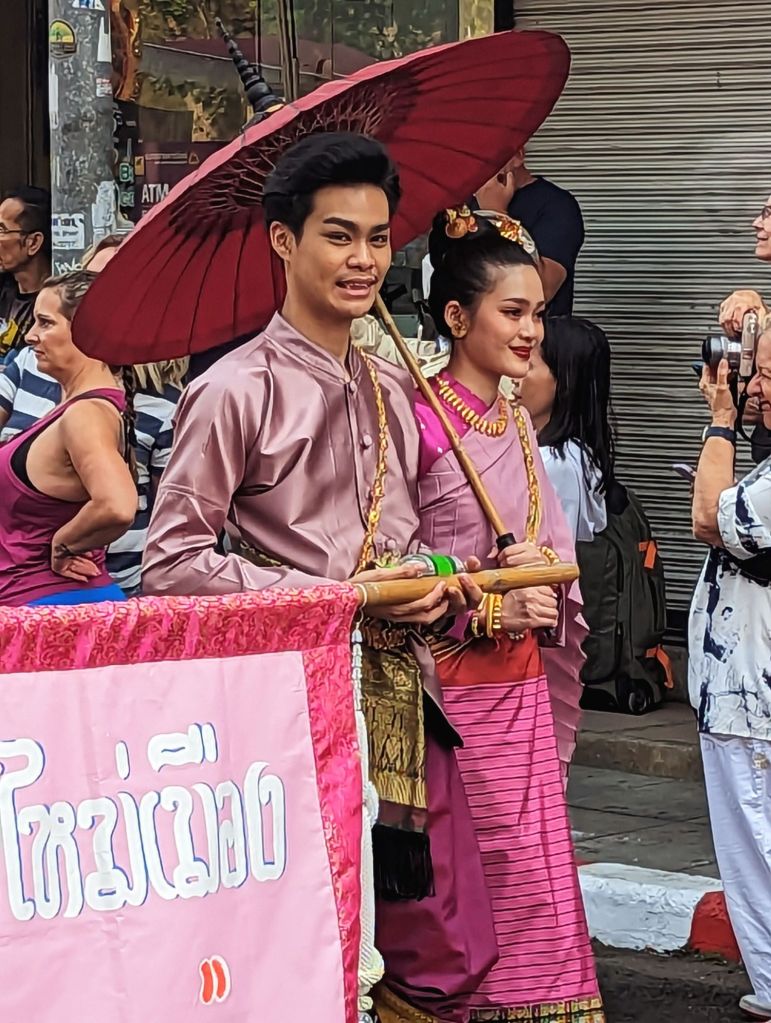
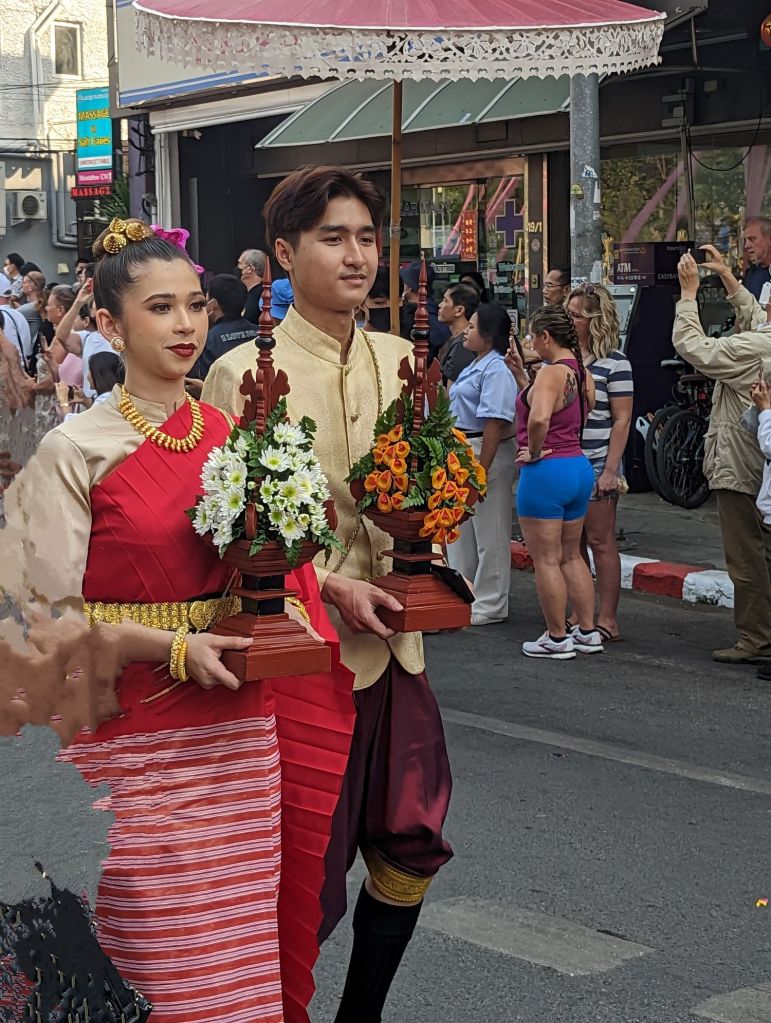
Chiang Mai Flower Festival

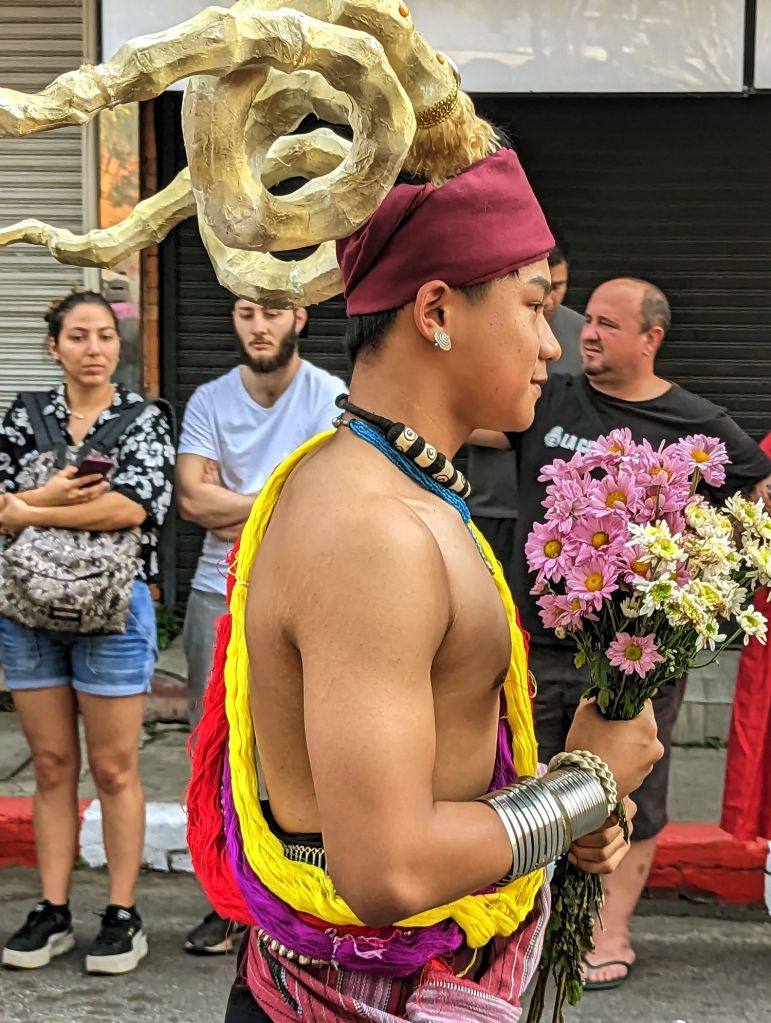
Flower Festival Parade

This and That Around Town

A Visit to Chiang Rai

As a change of pace, we decided to spend a couple of days in Chiang Rai. We visited there four or five years ago and wanted to return, even though we had already seen the major attractions in the area. The bus ride to Chiang Rai from Chiang Mai is between 3 and 4 hours, depending on traffic. Though there is an airport in Chiang Rai, it seemed silly to fly for such a short distance. There are different levels of comfort available for the bus; we chose VIP, which is the nicest. The bus has three seats across rather than four, so there is quite a bit of room. A small snack and a bottle of water are provided and there is a bathroom in the back, though you would only want to use it in an emergency…Though we were on the first trip of the day, the toilet was backed up and had not been cleaned out for quite a while.

The route goes through a mountain pass or two. The first part of the trip is quite windy, then the road straightens out for a bit before turning windy again. If you have motion sickness, I recommend taking meclizine or something comparable beforehand! We arrived in Chiang Rai around noon and walked to our hotel. First on the agenda was a massage and walking around town. Afterwards, we were both so tired we took a long afternoon nap. Retired life is great! We had dinner at the hotel. Though they had a very complete menu that included western food, only Thai food was actually available. And it was quite spicy!

Our tour van picked us up around 8:30 the following morning. We had a full day’s agenda ahead: White Temple, Blue Temple, Black House, Long-Neck Karen Tribe, Tea Plantation, Mae Sai (border town with Myanmar), and the Golden Triangle (including a stop at the Opium Museum). A very full day indeed! Our tour guide was Guy; the driver was Boy. And yes, Guy was a girl! Thai’s use nicknames rather than their given names. We shared the van with a couple from northern California and a family that was spending ten months traveling the world. We lucked out in that everyone was friendly; it made for a very pleasant day.
The White Temple (Wat Rong Khun) is located south of Chiang Rai. It is a spectacular temple that has been completely redone by a Thai artist, Chalermchai Kositpipat, though it is not yet complete. Since it is privately owned, the entry fees collected go towards completion of the temple. There is a donation limit of 10,000 Thai Baht (around $300 US). I did notice one building that had been constructed, but not “bedazzled” just yet! To enter the Wat (temple), you must pass through the artist’s vision of hell before getting to heaven. As is true of any Buddhist temple, shoes must be removed before entering.

Photos inside the temple are not allowed. The back wall is painted to resemble a demon. If you look closely, you can see that the eyes contain images of two men. The right eye is Osama bin Laden; the right is George Bush. Interesting symbolism! The left-hand wall has paintings that represent the circle of life. On the right, three people are portrayed: the first is painted dark, the next is half dark/half-light, and the final is light to represent the progress towards enlightenment. All point towards the Buddha.

There is a beautiful golden building on the grounds. Every other building is glistening white except for this one. What else could be golden but the throne room, aka happy room, aka toilets? I was not able to get a picture because my phone decided to act up.

Next on the agenda was the blue temple, Wat Rong Seur Ten. This is also a reconstructed temple that was designed by a student of Kositpipat (who designed the White Temple) between 2005 and 2015, though there are still some parts that are being built. The tigers on the side of the building are representative of the fact that tigers used to roam in this area.

The last stop near Chiang Rai was the Baandam Museum (baan means house, dam means black). This place was quite unique compared to the temples we had just visited. The artist, Thawan Duchanee, started collecting animal skins, bones, and other unique items from around the world. The Black House is not a single building; it consists of 40 buildings spread around a large garden area. It started as a hut to contain his collection of “stuff”, then grew to a house, and eventually spread into a complex.   He was already an acclaimed painter and replicas of his paintings dot the walls of the main building. Each painting has a QR code that can be scanned to get further information about it. What really draws a person’s attention, however, is the sculptures and other objects d’arte. Let’s just say that he has a strong fascination for the phallic! It is quite the counterpoint to the White Temple.

We were now heading north towards the border with Myanmar. Our next stop was at a long-necked Karen village. The Karen tribe originates in Myanmar but has relocated to Thailand. They are not allowed to work and so exist by selling admission to their “village” which is actually a series of stands filled with objects that they well. You may wonder why they wear the coils on their necks. Legend has it that a tribal leader started the practice to protect the women from being attacked by tigers. Girls start accumulating rings at age 5. New rings get added every couple of years. The rings are quite heavy but there is a maximum weight of 5.5 kilograms (12 pounds) allowed, so at a certain age, no new rings get added. They switched metals about 20 years ago and started using a lighter one. The rings can be removed but if they are, the woman must leave the tribe. It does not kill the woman to remove her rings, but she does have very weak neck muscles. The wearing of rings is not allowed in schools, so the girls in the tribe are not educated. They must marry within their tribe. The elongated look is partially due to the women’s shoulders being pushed down by the weight of the rings.

Akha woman

Each booth sold essentially the same things. Several women were weaving. The first booth or two were Akha women rather than Karen.

I had mixed feelings after the visit. It’s very unfortunate that the only way these tribes can subsist is by selling tickets for tourists to gawk at them. But, if they did not have that option, they would starve.

Our last stop before lunch was at a tea plantation. Given the number of tour vans and tourists milling about, it seemed to be a common stop on the tour circuit! We were given three teas to taste; none were to our liking, so we did not purchase any. It seems that most tours seem to include one dedicated shopping stop.

Finally, it was time to eat! We had been on the road/touring for 6 hours and we were pretty hungry! The restaurant seemed to cater to tour groups. They provided a small buffet of Thai food (rice, a couple of stir-fried dishes and a couple of soups) as well as some french fries. It helped stave off starvation and gave us energy for the rest of the tour.

The last time we visited Chiang Rai, we were able to cross the border into Myanmar. It is one of our fondest travel memories and so I was curious to see what things were like now with the border closed. There used to be a 5 km zone where the people that lived in Tachilek, on the Myanmar side, could cross into Mae Sai, on the Thailand side, to purchase items without having a visa. Mae Sai was a bustling town filled with people buying all types of items and bringing them back to Burma (Myanmar). Now, it seemed to only have tourists. Though the markets were still open, there were very few customers. It looked like a ghost town compared to what it was in the past.

Our final stop of the day was the Golden Triangle, the place where Thailand, Myanmar, and Laos meet. Its claim to fame is the opium trade, and there is a museum to visit to learn all about it. We had visited the same museum on our previous trip, so opted to sit outside and wait for the rest of the group.

The ride back to Chiang Rai was about 1.5 hours. I spent it chatting with the mom of the family that was taking a sabbatical year to tour the world. What a fabulous experience for those kids! She was home-schooling them to keep them up on their studies, but the experiences they are having will educate them in ways no classroom can. The time flew by, and we were back at our hotel, exhausted from our day.

We took the bus back to Chiang Mai the following morning. Tentatively, we plan on taking the train to Bangkok in March. I will update my blog then.